How Do You Choose Custom Packaging for Wholesale Watches and Jewelry? A B2B Buyer's Guide to Boxes, Inserts and Branding
10/21/2026
Why Packaging Deserves a Line in Your RFQ, Not a Footnote
When buyers compare watch and jewelry manufacturers, packaging rarely appears on the first version of the request for quotation. The conversation usually starts with movements, case materials, plating, stone setting and minimum order quantities, and packaging enters as a one-line afterthought: "boxes included." In practice, packaging is one of the highest-leverage decisions you will make in a wholesale program, because it is the only part of your order that every single customer will physically handle, whether you sell through retail doors, distributors, marketplaces, or your own online store.
The economics are easy to underestimate. A presentation box typically costs a small fraction of the product it protects, yet it shapes three things that decide whether a buyer reorders: the perceived value of the product at the moment of unboxing, the survival rate of the goods through international freight, and the way your brand looks on a shelf next to competitors who treat packaging as an afterthought. A watch that arrives with a scratched crystal because the inner box had no molded cushion is not a discount problem; it is a returns and reputation problem.
There is also a compliance and logistics dimension that consumer-facing articles rarely mention. Export cartons must be marked and documented correctly, inner boxes affect the cubing of your shipment, and a barcoded, retail-ready package can be the difference between a product that a distributor can receive directly into their warehouse system and one that has to be repacked by hand at extra cost. Buyers who specify packaging early get quotes that reflect reality; buyers who add packaging after the PI is signed get change orders, delays and avoidable costs.
This guide is written from the manufacturer side of the table. It explains how professional B2B buyers specify watch and jewelry packaging for wholesale, OEM and private label programs: which packaging layers actually matter, how to choose between stock, semi-custom and fully custom options, which materials and finishes survive international shipping, how packaging changes your landed cost, and what a clean specification process looks like from inquiry to dispatch. The examples reflect how we handle packaging at Aurevo, a Shenzhen-based manufacturer of watches and jewelry producing for retailers, distributors, importers and brand owners in more than 65 markets since 2012, but the decision framework works with any serious supplier.
The Three Layers of Wholesale Packaging: Unit, Inner Box and Master Carton
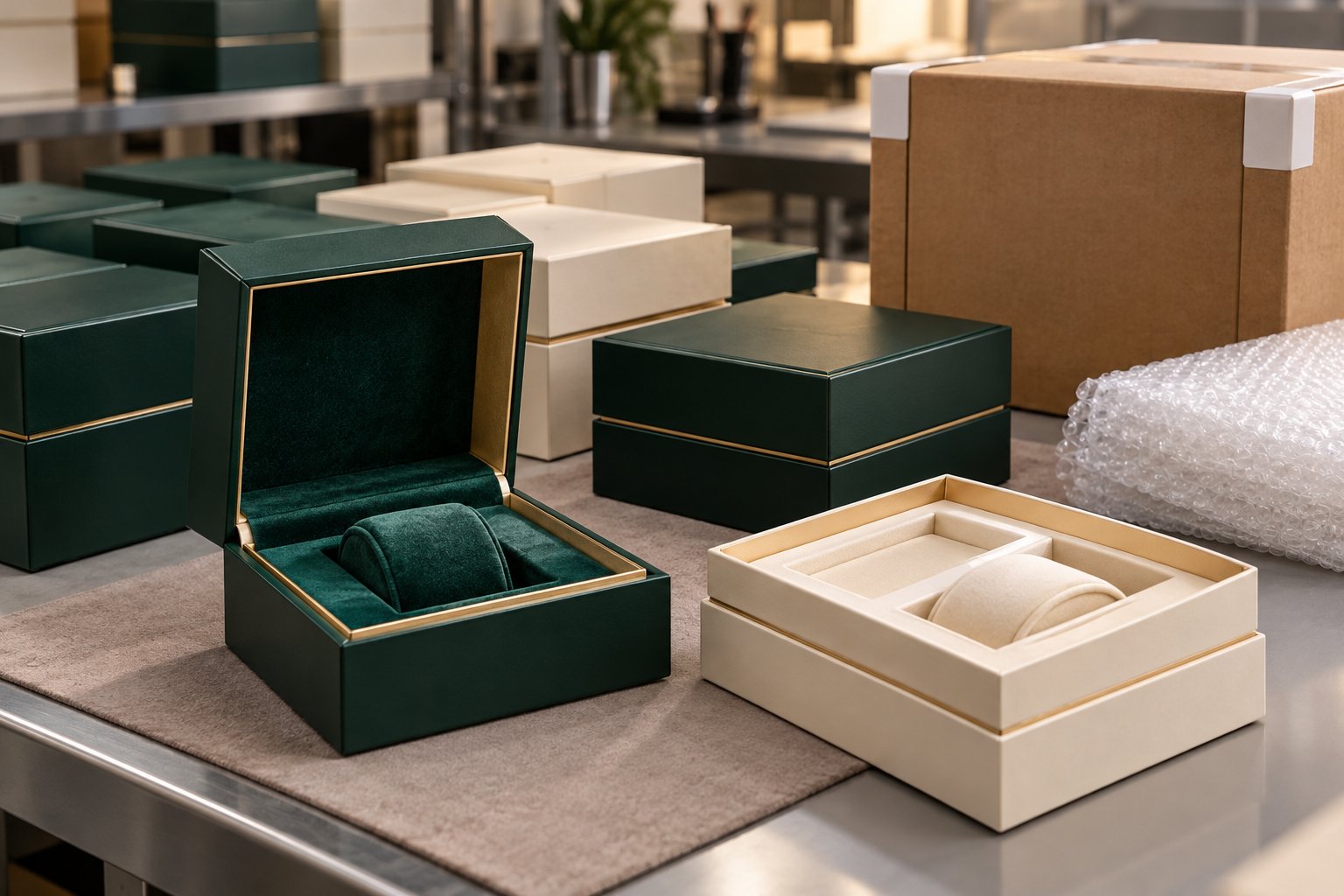
The most common misunderstanding about wholesale packaging is treating it as one item. Professional export packaging is a system of three layers, and each layer answers a different question. The unit packaging answers "how does one product look and survive on a shelf or in a mailer?" The inner box answers "how do units present and protect each other inside a case?" The master carton answers "how does the shipment survive a container, a warehouse and a last-mile truck?"
Our standard export configuration illustrates the baseline that most established manufacturers offer before any customization: each watch or jewelry piece is individually packed in a poly bag or bubble wrap, placed into an inner box, and then packed into a master carton for international shipment. Each layer exists for a reason, and removing one without understanding it is how shipments get damaged.
| Layer | Main job | Typical options |
|---|---|---|
| Unit packaging | Presentation, scratch protection, first touchpoint with the end customer | Poly bag, bubble wrap, stock or custom presentation box, pouch, hang tag |
| Inner box | Counting, display, protection between units | Folding carton with partitions, display tray, branded inner case |
| Master carton | Freight survival, stacking, warehouse handling | Double- or single-wall kraft carton, edge protectors, carton marks |
When you evaluate a quotation, ask which layers are included and which are quoted separately. A price that looks low because it covers only poly bags and a plain inner box is not comparable to a price that includes a branded presentation box, an instruction card and a barcode label. Both can be correct choices, but only if you know what you are comparing.
The three layers also have different owners in the decision. The master carton is primarily an engineering and logistics decision, and your freight forwarder or warehouse will care about its stacking strength and dimensions. The inner box is often a channel decision, driven by how your retail or e-commerce partners receive goods. The unit box is a brand decision, driven by positioning and price point. Keeping these three conversations separate is the fastest way to reach a packaging specification that is both beautiful and cheap to ship.
Stock, Semi-Custom or Fully Custom: Choosing the Right Packaging Tier
Packaging customization is not binary. Between a plain white stock box and a fully bespoke presentation case there are several practical levels, and the right level depends on your channel, your brand maturity and your order economics. We usually walk buyers through three tiers.
Tier 1: Stock packaging
Stock packaging is a ready-made box or pouch in a standard size, color and material, with no branding or with minimal neutral branding. It is the fastest and cheapest option, it usually carries no additional lead time because it can be ordered alongside production, and it is a sensible choice for testing a new design, filling a promotional order, or supplying B2B customers who repackage into their own retail packaging. The trade-off is obvious: the product arrives in packaging that looks like everyone else's, and you lose the chance to make a branded impression at the moment of unboxing.
Tier 2: Semi-custom packaging
Semi-custom packaging starts from an existing box structure and adds your brand elements: your logo printed, debossed or foil-stamped on the lid, your brand colors on the exterior paper, a printed instruction card or warranty card inside, and a barcode label for your retail or marketplace channel. For most growing brands and distributors, this tier delivers the best balance between cost, speed and shelf impact, because the tooling is minimal and the box sizes are already proven for watches and jewelry. When we describe our wholesale programs, this is also the tier where options like logo printing, instruction cards and barcodes are confirmed with our sales team against the buyer's requirements, because the exact combination of elements and quantities affects both price and lead time.
Tier 3: Fully custom packaging
Fully custom packaging is specified from a blank sheet: a unique box structure, custom internal insert geometry, special materials or finishes, magnetic closures, ribbon pulls, window cut-outs, or a matching set across watches, rings, necklaces, bracelets and earrings. It produces the strongest brand statement and is the standard choice for established private label programs and premium collections. It also requires more from you as a buyer: artwork files, physical or digital proofs, more sampling time, and larger quantity commitments to justify tooling. If you are launching a brand for the first time, it is usually smarter to start at tier two, validate your sell-through, and move to tier three with data in hand.
One practical note connects this tiering to order quantities. On the product side, our standard watch programs start from 100 pieces, custom watch designs from 300 pieces, and custom jewelry from 200 pieces, and packaging quantity options are discussed with our sales team in the same conversation, because the economics of custom boxes depend on their own print runs and tooling. A buyer who needs only a small number of fully custom boxes for a 100-piece pilot order may be directed to a semi-custom solution for the first run, then upgrade once volumes justify it. Asking about packaging tiers during the quote stage prevents discovering this after the product PI is already signed.
Choosing Box Materials: Rigid Setup Boxes, Folding Cartons and Kraft Options
Once you know your tier, the material decision becomes concrete. For watches and jewelry, four material families cover most wholesale programs.
- Rigid setup boxes (also called set-up or gift boxes) are made from thick greyboard wrapped in printed or specialty paper, with a separate or hinged lid. They hold their shape, protect well, feel substantial in the hand, and are the default choice for watches and premium jewelry. They cost more per unit and take more shipping volume, so they earn their place on products with enough margin and shelf presence.
- Folding cartons are printed paperboard boxes that ship flat and are erected by hand or machine. They are economical, compact to freight, and work well as inner boxes, secondary packaging for earrings or rings, and mid-market presentation boxes.
- Pouches and soft packaging in microfiber, velvet or faux leather suit jewelry pieces, spare straps and gift-with-purchase programs. They add a branded touch at very low cost and almost no shipping volume.
- Kraft and recycled-look packaging serve brands with an eco-positioned story or industrial aesthetic, and pair naturally with uncoated papers and simple single-color printing.
Material choice is not only aesthetic; it is mechanical. A rigid box with a wall thickness that is too thin will deform under the stacking pressure of a full master carton, and a box that fits a 40 mm watch case perfectly may be too loose for a 44 mm model with a heavier bracelet, letting the piece travel inside the box during freight. This is why serious manufacturers ask for your product dimensions and weight before quoting a custom box, and why a physical sample with your actual product inside is worth more than any render.
Color is the other half of the material decision. If your brand color must match precisely across boxes, hang tags and cards, ask how the supplier controls color: whether they work from a Pantone reference, whether the paper stock affects the final tone, and whether a printed proof is provided before mass production. Between paper brands and printing processes, the same "emerald green" can come out noticeably different, and the cheapest place to discover that is a proof, not a pallet of finished boxes.
Finally, match the material to the price point of the product inside, not to the price point you aspire to. A heavy lacquered rigid box on an entry-level quartz watch creates a cost problem and an expectation problem at the same time; buyers open the box, feel premium packaging, and then judge the watch more harshly against the expectation the box created. Packaging should be calibrated to the product, which is one more reason to discuss it with the same team that is engineering the product itself.
Inserts: Where Perceived Quality Is Actually Made
If buyers remember one technical section from this guide, it should be the insert. The insert is the molded or cut component inside the box that holds the watch or jewelry piece in position. It is invisible in product renders, it is where most of the unboxing experience is actually manufactured, and it is the single most common cause of transit damage when it is done badly.
Insert materials each have a personality. Velvet or flocked inserts on a foam base look classic and rich, and suit dress watches and traditional jewelry. EVA foam inserts, cut precisely to the product, offer modern clean lines and excellent protection, and can be laminated in colors that match your brand. Molded pulp and corrugated inserts are the workhorses of eco-positioned packaging. Vacuum-formed plastic trays are precise, hygienic and economical at volume, but read as functional rather than luxurious, so they tend to live inside inner boxes rather than presentation boxes.
Good insert design answers three questions. First, holding: does the product sit where you want it, at the angle you want, without moving when the box is tilted or shaken? Second, presentation: does the first view of the product look deliberate, with the crown, dial and strap or clasp oriented the way your photography shows them? Third, removal: can a customer take the piece out without a struggle, and can a store employee put it back without damaging the insert? A design that fails any of the three will generate complaints even if the product itself is perfect.
For watches specifically, the cushion that supports the strap and case deserves individual attention. Watch cushions come in different diameters and firmness levels, and the fit matters: a cushion that is too tight makes the watch hard to remove and can stress the strap; too loose and the head can knock against the lid in transit. For jewelry, partitions and slot geometry determine whether chains arrive tangled and whether stone-set pieces can touch each other. These are the details a manufacturer with an in-house packaging workflow checks on a physical sample, on a real production line, with your actual products, before mass production starts.
Branding and Finishing: Logo Options That Survive Wholesale Realities
Branding on packaging is where tier two and tier three buyers spend their attention, and where some expensive misunderstandings happen. The main decoration methods each have a different look, cost structure and durability profile.
- Hot foil stamping presses a metallic or pigmented foil into the paper with heat, producing the sharp, premium metallic logo that most luxury brands use. It has a tooling cost per design and shows best on smooth or lightly textured papers.
- Debossing and embossing press the logo into the material itself, with or without ink or foil. It is subtle, tactile and ages well, and works beautifully on uncoated and leather-look papers.
- Screen printing lays ink directly on the surface and handles simple spot colors economically. It suits logos with few colors and larger areas, and is common on pouches and kraft boxes.
- Offset printing covers full-color graphics, gradients and photographic artwork on wrapping paper and cartons, and is the method behind most heavily branded retail packaging.
- Digital printing removes most setup cost for short runs and is useful for pilot orders and versioned artwork, at a higher cost per unit at volume.
Two realities of wholesale are worth planning for. First, your artwork needs to be production-ready: vector files for logos, Pantone references for colors, and clear instructions for placement. A supplier who asks for these details early is protecting your schedule, not being difficult. Second, branding is not only on the box. Instruction cards, warranty cards, hang tags, barcode labels, tissue paper and even the carton marks are brand and compliance surfaces. In our workflow, custom gift boxes, logo printing, instruction cards and barcodes are confirmed per buyer requirements before production, and carton marks and shipping marks are confirmed before dispatch, so the whole identification chain from unit box to container stays consistent.
A note on barcodes and retail codes, because they trip up first-time importers: if your product is going into retail or marketplace distribution, decide early whether the barcode belongs on the unit box, on a label applied at the factory, or on packaging your distribution partner applies themselves. GTIN and similar retail codes have placement and size conventions, and changing them after boxes are printed means reprinting. Ten minutes of alignment on the artwork spec saves a full reprint cycle later.
How Packaging Changes Your Landed Cost: Cubing, Weight and Carton Math
Packaging decisions do not stop at the unboxing; they follow your goods into the container and onto your landed cost calculation. Freight on international shipments is priced on either actual weight or dimensional volume, and presentation boxes are mostly air. A heavier rigid box may weigh little more than a folding carton, but occupy dramatically more container space, and on sea freight that difference is paid per cubic meter.
This is where the inner box earns its keep as an engineering component. Well-designed inner boxes nest, stack and partition units so that a master carton is filled densely and safely. Poorly matched packaging leaves wasted air inside cartons, and wasted air inside cartons means you are paying to ship nothing. Buyers who send mixed product programs, for example watches and bracelets in the same container, should ask how the carton plan is organized, because a carton plan that mixes products carelessly can add meaningful cost across a year of orders.
Ask your supplier or forwarder for the standard numbers per configuration: units per inner box, inner boxes per master carton, carton dimensions, gross weight and net weight. With those figures you can compute units per cubic meter and freight cost per unit, and compare packaging options on true landed cost instead of unit price alone. A presentation box that adds twenty cents to the product but adds thirty cents of freight and handling is a different decision than it first appeared.
The master carton itself deserves its own questions. What wall strength is used? Are edge protectors needed for tall stacks? How are cartons marked, and does the marking meet the requirements of your market and your forwarder? Carton marks and shipping marks exist so that warehouse staff on two continents can identify, count and route your goods without opening them, and confirming them before dispatch, as our standard process does, is what prevents mixed pallets and misrouted cases. Buyers moving into large retail distribution should also align carton labeling with their partners' receiving requirements early, because some retailers have strict carton marking standards of their own.
One more practical point: protect the protectors. Boxes can arrive at your warehouse crushed not because they were weak, but because they were loaded under heavy goods or stacked too high in a hot, humid container. If your program includes delicate finishes like soft-touch lamination or foil, mention it during the logistics planning conversation; some finishes that look superb in the showroom can scuff under rough freight, and there are material and packing adjustments that mitigate this when they are planned, not discovered.
Retail-Ready, E-Commerce-Ready or Both: Packaging for Your Actual Channel
The same watch can need two completely different packaging strategies depending on where it will be sold, and many modern buyers need both at once.
Retail-ready packaging is designed for a shelf and a salesperson. It favors presentation, tactile quality and display efficiency: boxes that stand upright, consistent facing, and inner boxes that double as counter displays. If your products will sit in glass cases in watch and jewelry stores, spend your budget on the unit box and the insert, because that is where the customer's decision happens.
E-commerce-ready packaging is designed for a courier. It favors survival and low volume: product unit box inside a protective mailer or an additional corrugated layer, minimal void space, and secure closure. Units per carton and dimensional weight matter more than shelf presence, and unboxing experience matters in a different way, because the customer's first physical contact with your brand happens at home, alone, possibly filming it. Many brands solve this with a two-layer approach: an efficient, well-branded unit box that survives the mailer, plus an optional branded sleeve or card that turns the unboxing into a moment.
If you supply both channels, or supply distributors who resell into both, say so explicitly when requesting quotes. It changes how the packaging system should be engineered, and manufacturers can usually propose a configuration that shares the same unit box across channels while varying the outer protection. What you want to avoid is discovering after delivery that your beautiful rigid boxes are not survivable in marketplace fulfillment, or that your courier-grade mailers undersell the product in a retail door.
Sustainability Questions Buyers Should Ask, and How to Ask Them
Sustainability has moved from a marketing paragraph to a real sourcing question, and packaging is usually where it starts, because packaging is the most visible and most disposable part of the product experience. The productive way to approach it with a manufacturer is to ask specific, verifiable questions rather than requesting a general "green" option.
Useful questions include: which packaging materials are available in recycled or recyclable grades; whether FSC-certified or equivalent responsibly sourced papers can be used, and how that is documented; whether inserts can switch from plastic foam to molded pulp or paper-based alternatives for your structure; whether inks and laminations limit recyclability; and how material substitutions affect price, lead time and protection. Material substitution is engineering, not decoration: a molded pulp insert that replaces a foam insert may change the feel of the unboxing slightly, and the supplier should be able to show you a sample, not just a claim.
Be equally honest with yourself about the trade-offs. A heavier recycled box with a large plastic window and mixed materials can be harder to recycle than a simple mono-material kraft box, and a "premium" box that customers immediately discard adds cost and waste without adding brand value. The strongest sustainability stories in wholesale right now are quiet ones: mono-material constructions, right-sized boxes that reduce freight, inserts that double as storage cases, and documentation you can pass on to your own customers. Requirements are confirmed per order with material documentation where applicable, and any certification claim should always be tied to a document, not to a mood.
A Step-by-Step Process to Specify Packaging With Your Manufacturer
Packaging goes smoothly when it is specified with the same discipline as the product. The sequence below reflects how well-run wholesale programs handle it, and it maps directly onto a standard order flow from inquiry to shipment.
Step 1: Define the requirement with your product conversation
Bring packaging into the RFQ while the product is still being quoted. State your channel, your brand position, whether you need stock, semi-custom or fully custom packaging, and any retail or marketplace requirements such as barcodes or carton marking standards. At this stage you do not need final artwork; you need the supplier to understand the scope so the quotation covers it.
Step 2: Collect the technical inputs
Provide product dimensions, weights and variants, your logo in vector format, color references, and any mandatory elements such as instruction cards, warranty cards, barcode numbers or regulatory markings. If you are unsure what is mandatory in your market, ask; an experienced manufacturer will know which markings belong on the product, which belong on packaging, and which belong on the carton.
Step 3: Review the proposal and quotation
The supplier should come back with a packaging proposal that names the box structure, materials, insert type, decoration methods, and the layers included at each level, along with quantities and pricing. This is the moment to compare options on landed cost, not just unit cost, using the carton math from the previous section.
Step 4: Approve samples before mass production
Approve a physical packaging sample with your actual product inside (see also our guide to evaluating a watch or jewelry sample before placing a bulk order). Check the fit of the insert, the orientation of the product, the print quality of your logo, the color match, the closure feel, and how the box survives being packed and stacked. Sampling typically runs 7 to 15 working days, and packaging sampling often runs in parallel with product sampling to protect the overall schedule. This is also the stage to verify any material documentation you asked for, such as recycled content or paper sourcing statements.
Step 5: Lock the specification into the PI
Everything agreed, including packaging layers, quantities, artwork versions, carton marks and inspection standards, should be written into the proforma invoice and order documents. This single habit eliminates the majority of packaging disputes, because "the box we discussed" becomes a line item with a specification, a quantity and a price.
Step 6: Pre-shipment verification
Before dispatch, confirm the packed result: pre-shipment photos and videos of the packed products, carton marks and shipping marks matching what was agreed, and, if your program justifies it, third-party inspection. Reputable manufacturers welcome third-party inspection at the buyer's cost, and packaging is one of the things inspectors check, because it is where substitution mistakes show up if they happen.
Step 7: Close the loop after delivery
When goods arrive, inspect packaging as well as products. If quality claims are necessary, document them with photos and batch numbers within the agreed claim window; verified defects are compensated through replacement, discount or refund of the affected value, and at Aurevo all watches and jewelry carry a 12-month warranty covering manufacturing defects under normal use, with after-sales handled through our sales team. Packaging feedback, including how boxes survived freight in your climate, feeds directly into the next order's specification.
Seven Mistakes B2B Buyers Make With Wholesale Packaging
- Adding packaging after the PI is signed. Late packaging requests become change orders, reschedules and rush fees. Bring packaging into the quote from the start.
- Comparing quotes with different packaging scopes. One price includes a branded presentation box and barcode; another includes a poly bag. Normalize the scope before comparing numbers.
- Approving packaging samples without the product inside. A box that looks perfect empty can misfit the product in ways that only appear with real units, real straps and real stone settings.
- Over-speccing the box and under-speccing the insert. The insert does the protection and most of the experience. Budget and attention should follow that reality.
- Ignoring freight volume. Presentation boxes are mostly air. Cubing and carton math belong in the packaging decision, not after it.
- Forgetting the retail code and marking chain. Barcodes, carton marks and shipping marks are small line items that can stop a warehouse. Confirm them before printing and before dispatch.
- Treating sustainability as a slogan. Ask for specific materials and documentation, and accept the honest trade-offs in price, protection and feel.
Frequently Asked Questions About Wholesale Watch and Jewelry Packaging
What is included in standard export packaging?
Our standard export configuration packs each watch or jewelry piece individually in a poly bag or bubble wrap, places it into an inner box, and packs the goods into a master carton for international shipment. Custom gift boxes, logo printing, instruction cards and barcodes are available and confirmed per buyer requirements, and carton marks and shipping marks are confirmed before dispatch.
Can I order custom boxes for a smaller quantity than my product order?
Packaging quantities are discussed with our sales team together with the product order, because custom boxes have their own printing economics and tooling considerations. For pilot programs, a semi-custom solution, for example a stock box structure with your logo and a printed card, often delivers the branded experience without the minimum quantities of a fully bespoke structure, and you can upgrade to full custom packaging once volumes justify it.
How much lead time does custom packaging add?
Sampling typically runs 7 to 15 working days, and packaging sampling often runs in parallel with product sampling. Mass production lead times run 20 to 40 working days depending on quantity and customization level, and packaging is planned inside that window when it is specified during the quote stage. Fully custom structures with new tooling take longer, which is another reason to raise packaging early rather than late.
Does custom packaging change the product MOQ?
Product MOQs follow the product type: 100 pieces for standard watches, 300 pieces for custom watch designs, and 200 pieces for custom jewelry. Packaging follows its own quantities and is confirmed per order. If you are considering a fully custom box for a smaller pilot run, ask about semi-custom alternatives that keep the branded look within your budget.
Can you print my logo, barcodes and instruction cards?
Yes. Logo printing on boxes, instruction cards, warranty cards and barcode labels are confirmed per buyer requirements. Provide vector artwork and color references, and confirm barcode placement early so it can be built into the packaging artwork rather than added later.
What information should I provide to get an accurate packaging quotation?
Product dimensions and weights, quantities, your packaging tier (stock, semi-custom or fully custom), logo files and color references, any mandatory cards or codes, and your destination market and channel. With these inputs a manufacturer can quote packaging that reflects real print runs and freight reality instead of a placeholder price.
How is packaging protected during international shipping?
Three layers work together: unit-level protection such as poly bags or bubble wrap, inner boxes that partition and stabilize, and master cartons with confirmed carton marks and shipping marks. Pre-shipment photos and videos confirm the packed result before dispatch, and third-party inspection is welcome at the buyer's cost for programs that require it.
Can I use my own packaging supplier or my own design?
Buyer-nominated designs and even buyer-supplied packaging can be discussed; the critical requirements are that the packaging fits the product, survives the freight plan, and arrives at the factory in time for packing. Buyer-nominated freight forwarders are supported in our logistics process, and the same coordination logic applies to packaging supplied from your side.
What happens if products or packaging arrive damaged?
Document the issue with photos and batch numbers within the 30-day claim window after receipt. Verified defects are compensated via replacement in the next order, discount, or refund of the affected value, and all Aurevo watches and jewelry carry a 12-month warranty covering manufacturing defects under normal use, handled through our sales team, as explained in our guide to what warranty to expect when buying wholesale watches and jewelry. Packaging damage patterns also feed into improvements on the next order.
Is sustainable packaging available?
Recyclable and responsibly sourced material options, molded pulp inserts and mono-material constructions are all engineering conversations that can be held per order. Ask for material documentation for any claim that matters to your market, and expect honest trade-offs in cost, protection and feel rather than a generic "eco" label.
Packaging at Aurevo: What We Handle for Wholesale and Private Label Programs
We are a Shenzhen-based manufacturer of watches and jewelry, producing since 2012 for retailers, distributors, importers and brand owners across more than 65 markets, with over 220 employees and a capacity of more than 4.5 million pieces per year across a collection of more than 8,000 styles. Packaging is handled as part of the production program, not as a separate vendor hunt: finished watches and jewelry are packed into protective presentation boxes and prepared for international shipment in-house, with more than 40 quality-control stations across the process covering incoming materials through final inspection.
In practice, that means packaging conversations happen where they belong: alongside movement selection and case materials, inside the quotation, and into the proforma invoice. Whether your program is a ready-to-order collection packed in our standard export packaging, a semi-custom branded run with your logo and instruction cards, or a fully custom presentation system across a watch and jewelry range, the specification is confirmed per order and the packed result is verified before dispatch with photos and videos.
If you are planning a wholesale, OEM or private label program and want packaging specified as professionally as the product itself, send us your requirements, product list and destination market, and our sales team will come back with a packaging proposal and quotation that matches your channel and budget. If you are budgeting a custom program, our buyer's guide to custom logo watch pricing explains where the money goes before packaging is even added. You can start by requesting wholesale pricing or sending an inquiry through our contact page, and browse representative pieces such as the Aurevo Custom Logo Men's Watch and the Aurevo Eterna Silver Ring to see how product and presentation work together.
Key Takeaways for B2B Buyers
- Treat packaging as a three-layer system: unit packaging for presentation, inner boxes for organization, and master cartons for freight survival.
- Choose the customization tier deliberately: stock for pilots, semi-custom for growth, fully custom for established programs.
- Spend attention on the insert; it delivers both the protection and most of the perceived quality.
- Calculate landed cost, not unit cost, using carton dimensions and weights.
- Confirm barcodes, carton marks and shipping marks before printing and before dispatch.
- Put the agreed packaging specification into the PI, and verify it with samples, pre-shipment photos and inspection.
- Ask specific, documented questions about materials rather than accepting general sustainability claims.
Good packaging does not shout. It arrives intact, opens easily, presents the product deliberately, carries your brand quietly, and never appears in a customer complaint. That is not luck; it is a specification, agreed early and checked at every stage, and it is one of the most repeatable advantages a wholesale buyer can build.
How Should You Price Wholesale Watches and Jewelry for Retail Profit? A B2B Buyer's Guide to Markups, Margins and Channel Pricing

How Do You Protect Your Watch and Jewelry Designs When Outsourcing Custom Manufacturing? A B2B Buyer's Guide to NDAs, IP Ownership and Tooling Agreements