
How Long Does It Take to Manufacture Wholesale Watches and Jewelry? A B2B Buyer's Guide to Production Lead Times
10/10/2026
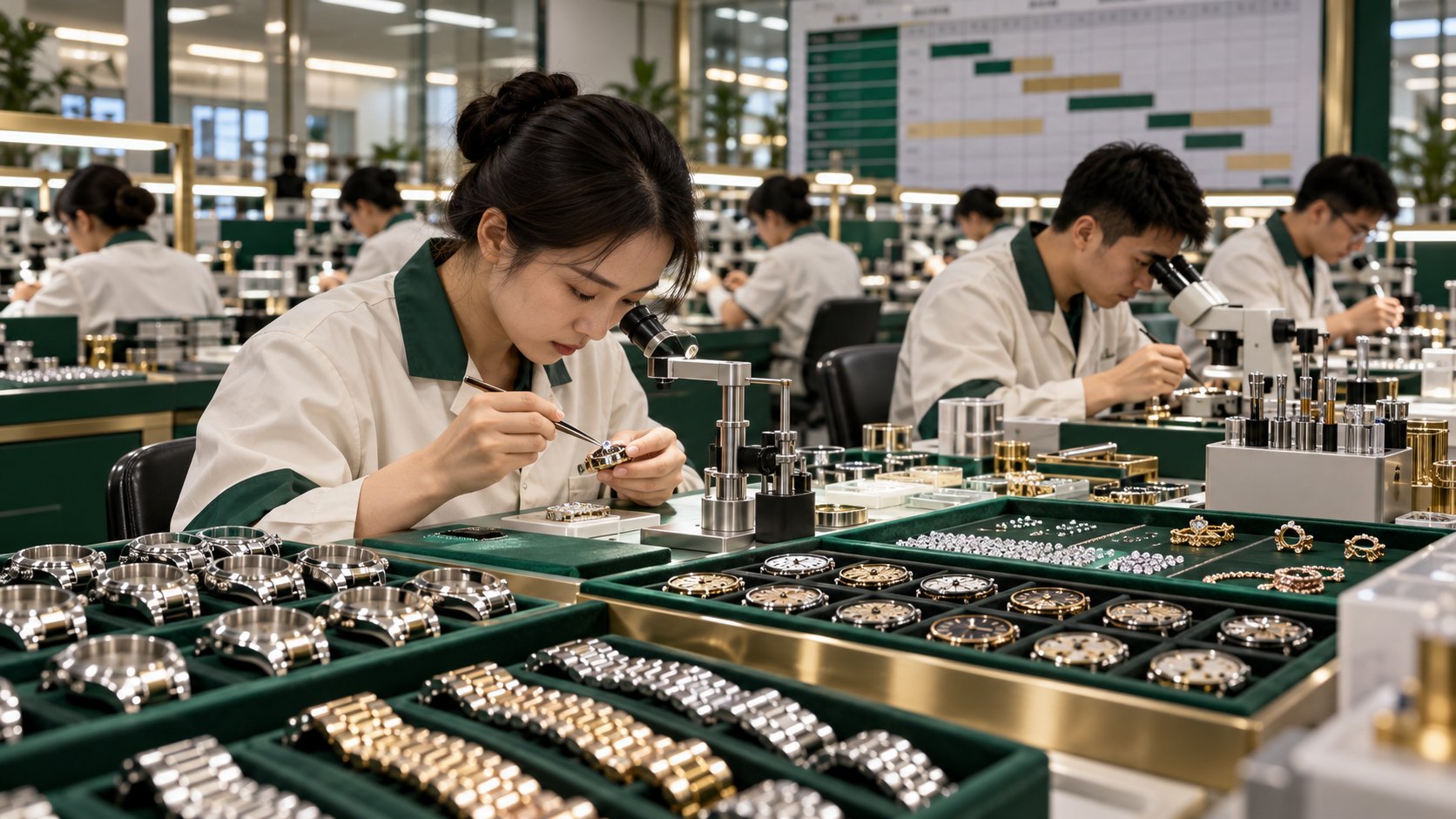
"How long will it take?" is the question that decides whether a wholesale order actually works for your business. You can negotiate price, you can adjust specifications, and you can change a payment term, but no buyer can negotiate time. Your launch calendar, your holiday sales window, your cash conversion cycle, and the promises you make to your own retail customers all depend on a number that many suppliers still answer with a shrug: "it depends."
It does depend — but on identifiable, manageable factors. In more than a decade of manufacturing watches and jewelry for retailers, distributors, importers, and private-label brands, we have found that buyers who understand the production timeline make better decisions at every stage: they approve samples faster, they order at the right moment, they book freight before rates spike, and they rarely find themselves paying air freight premiums to rescue a missed season.
This guide breaks down the full lead time for wholesale watches and jewelry the way a factory floor manager sees it — stage by stage, with real working-day ranges, the reasons behind each number, and a worked order calendar you can adapt to your own market. The figures used throughout come from our own production and logistics workflow: sampling at 7–15 working days, mass production at 20–40 working days depending on quantity and customization level, and sea freight transit of 15–35 days depending on destination.
What Does "Lead Time" Actually Mean in Watch and Jewelry Manufacturing?
The word lead time is used loosely across the industry, and that looseness causes real financial damage. Some suppliers quote only their production time. Others include sampling but not shipping. A few include everything from first inquiry to delivery at your warehouse. If two manufacturers quote "30 days" using different definitions, you are not comparing two schedules — you are comparing two sentences.
In professional sourcing, total lead time is the sum of six distinct stages:
- Inquiry and quotation. You send specifications; the supplier responds with a commercial offer. A serious manufacturer responds within one working day and typically issues a quotation valid for 30 days.
- Sampling. A physical pre-production sample is made so you can approve the design, materials, finish, and logo application before anything is mass-produced.
- Order confirmation and deposit. Both sides sign a proforma invoice (PI), and the buyer pays the production deposit. This is the moment your order enters the production queue.
- Mass production. Materials are procured, components are made or sourced, assembly runs, and in-line quality checks happen during the process.
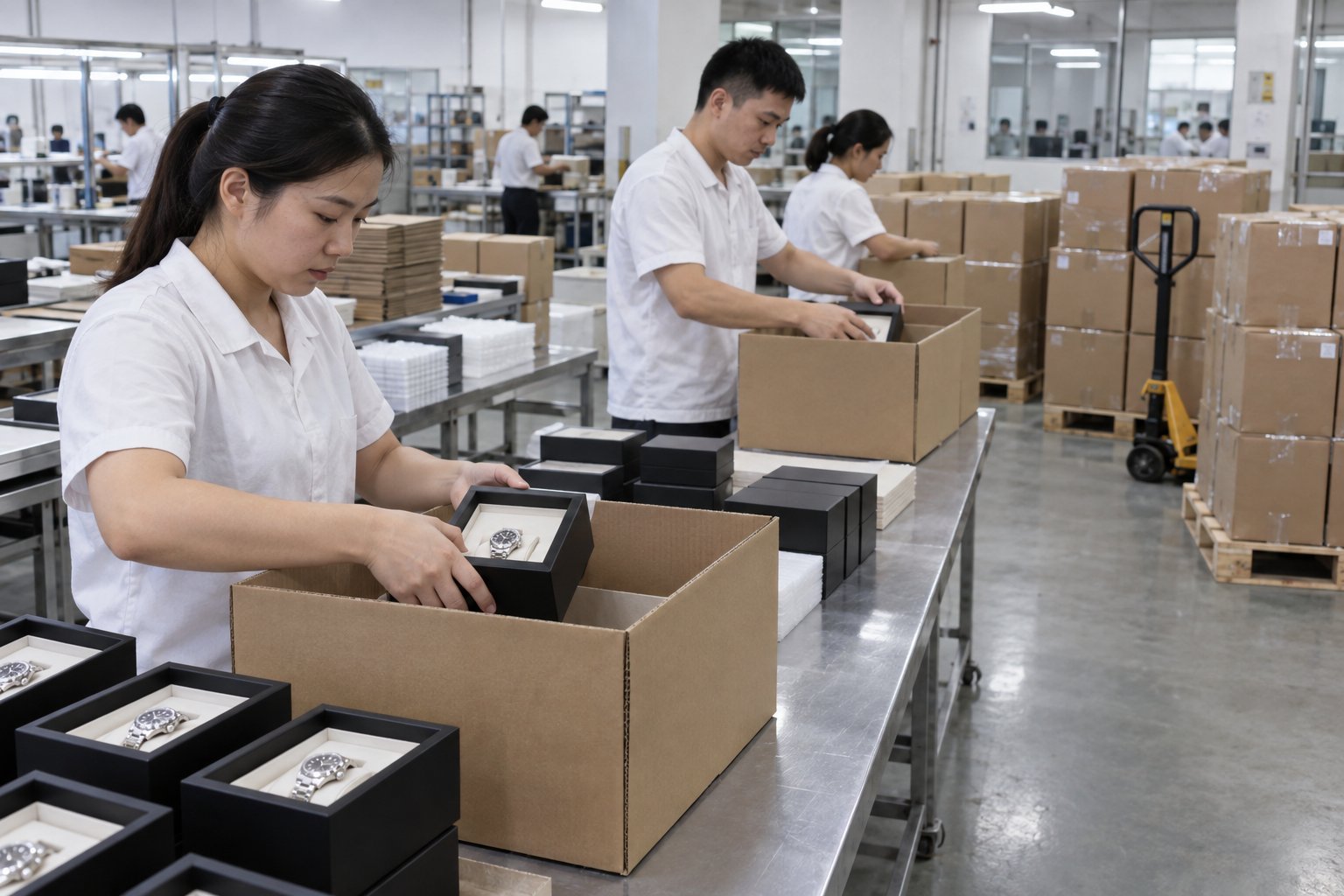
- Final inspection and packing. Finished goods go through final random inspection, pre-shipment photos and videos are taken, and export packing is completed.
- Shipping and customs. Goods move from the factory to your port or door, then clear customs in your market.
Two distinctions matter more than any single number. First, working days are not calendar days. A factory's "20–40 working days" of production equals roughly 28–56 calendar days once weekends are counted. Buyers who confuse the two routinely underestimate their timelines by 40%. Second, approval time belongs to the buyer. The clock between "sample shipped to you" and "sample approved" is not factory time, yet it is the single most common reason orders slip. When this guide gives stage durations, they assume you respond to approvals within a few working days.
How Long Does Each Stage of a Watch or Jewelry Order Take?
Here is the honest stage-by-stage breakdown based on our standard order workflow for watches and jewelry:
| Stage | Typical Duration | What Happens |
|---|---|---|
| Inquiry → quotation | 1–3 working days | Specification review, costing, formal quotation (valid 30 days) |
| Sampling | 7–15 working days | Pre-production sample made, shipped, and reviewed |
| PI + deposit | 2–5 working days | Contract signed, 30% T/T deposit paid, production slot booked |
| Mass production | 20–40 working days | Materials, component preparation, assembly, in-line QC |
| Final inspection + packing | 3–7 working days | Final random inspection, photos/videos, export packing |
| Shipping + customs | 3–35+ calendar days | Express, air, or sea freight; destination customs clearance |
Read the table bottom-up and the pattern is clear: production gets most of the attention, but the stages around it consume a third of the total calendar. Sampling, deposit processing, inspection, and freight together can add four to eight weeks to the 20–40 working days of manufacturing. A buyer who plans only for "production time" will miss their season even when the factory performs perfectly.
One more nuance: the ranges overlap with each other. Components with long procurement lead times — particular movements, custom hands, special leathers — are often ordered during sampling or immediately after deposit so that material arrival coincides with the production start date. Efficient factories compress the calendar this way; disorganized ones run the stages in sequence and lose two to three weeks per order.
Why Do Custom Watches Take Longer Than Standard Wholesale Models?
If you buy a ready-made design from an existing collection, you are buying from tooling that already exists, dials that are already printed, and a production line that already knows the model. If you customize, you are asking the factory to build something that has never existed before — and that difference shows up directly in the schedule.
Our standard watch programs carry a minimum order quantity of 100 pieces. These are ready-to-order designs from a collection of more than 8,000 watch and jewelry styles: proven builds, established component chains, and predictable production runs. A standard-model order can often move from deposit to shipment at the faster end of the 20–40 working day window because nothing new needs to be created.
Custom logo watch programs carry a higher minimum — 300 pieces — and for good reason. Customization touches several sequential processes:
- Dial production. Your logo must be converted into dial artwork, approved, and then printed or applied. Dial printing runs in batches; a custom dial cannot simply be added to an existing run of a different design.
- Component matching. Hands, indices, and case finishes are selected or made to complement your specific dial. A mismatch discovered at assembly means rework.
- Caseback and crown engraving. Laser engraving is quick per piece, but setup, test engraving, and first-article approval add days.
- Packaging. Custom boxes, printed instruction cards, and barcodes are produced in parallel but must be approved alongside the product.
- Sample round-trip. The sample must physically reach you, be reviewed against your expectations, and be approved — or revised.
None of these steps is individually dramatic, but together they push custom watch programs toward the middle and upper end of the production range. The practical implication for buyers: if your launch date is fixed, start the customization conversation earlier, not the production itself. The extra four to six weeks of planning is almost always cheaper than the alternatives — a reduced specification, a rushed approval, or a missed window. For a deeper comparison of manufacturing models, see our guide to OEM vs ODM vs private label.

How Does Jewelry Production Scheduling Differ From Watch Assembly?
Watches and jewelry are often discussed as one category, but their production logistics are structurally different, and buyers should plan them differently.
A watch is fundamentally an assembly product. The factory's job is to bring together a movement, a case, a dial, hands, and a strap or bracelet, then assemble and regulate them. When components are in place, assembly is fast and linear. The schedule risk in watches concentrates at the beginning — component sourcing — and at the end — quality control and water-resistance or timing checks.
Jewelry is a transformation product. Each piece passes through casting, CNC processing, stone setting, polishing, plating, engraving, and final finishing. That chain matters for planning in three ways:
- Batch logic. Casting and plating run in batches. A 200-piece jewelry order does not simply take twice as long as a 100-piece order; it often takes the same time, because the batch is the unit of production. This is one reason our custom jewelry minimum is 200 pieces — below that, the per-piece economics of running a full production chain stop working for both sides.
- Color and finish consistency. Plating color is judged against an approved sample, and stone setting is checked piece by piece. Buyers sourcing gold-tone jewelry should review batch consistency expectations before production starts; our guide to sourcing quality gold-tone jewelry at wholesale explains what to specify.
- Finishing queues. Polishing and plating are shared resources across many concurrent orders. A design requiring unusual finishing — mixed finishes, heavy engraving, unusual stone settings — waits longer in these queues than a design that flows through standard processes.
For buyers building mixed collections, the scheduling consequence is straightforward: place watch and jewelry orders on the same day, but expect them to move through production at different rhythms. Confirming both timelines in the PI — rather than assuming they ship together — avoids a common planning error in which a completed watch program waits for a jewelry batch that is still in plating.
Which Factors Stretch — or Shrink — Your Production Lead Time?
The 20–40 working day production range is wide, and the difference between a 25-day order and a 55-day order is rarely luck. These are the variables that move your position within — and occasionally beyond — the range, in rough order of impact:
1. Customization depth
A logo on an existing dial adds days. A fully bespoke case, a proprietary dial design, or a unique bracelet adds weeks. As a rule of thumb, every element that requires new tooling or a new component supplier adds one to two weeks of preparation before assembly can begin. Tooling fees, where they apply, are payable in advance and are refundable for qualifying volume orders — a structure that also signals the factory's commitment to the program.
2. Order quantity
Quantity affects lead time non-linearly. Going from 300 to 600 pieces of the same watch rarely doubles production time, because setup, sampling, and inspection overheads are amortized. But going from 600 to 3,000 pieces may cross component availability thresholds: if a movement or strap is sourced against supplier stock, large orders wait for replenishment that small orders never see.
3. Component availability
Movements, mineral and sapphire glass, specific strap materials, and specialty stones each have their own supply chains. A standard quartz movement is typically available from stock; a specific automatic caliber in a particular finish may need to be scheduled with the movement supplier. Buyers can meaningfully de-risk this by keeping movement choices within well-established options — our quartz vs automatic comparison covers the trade-offs.
4. Approval speed
Every approval loop — sample approval, artwork approval, pre-production photos, packaging approval — transfers waiting time to the buyer side. In our experience, the difference between a smooth program and a delayed one is rarely factory throughput; it is whether the buyer's team reviews and responds within days or within weeks.
5. Chinese holidays
Two calendar events reshape every China-based production plan. Chinese New Year (late January to mid-February, exact dates move with the lunar calendar) closes factories for two to three weeks, and the weeks before it are the busiest production period of the year as buyers push orders through before the shutdown. Golden Week (early October) closes factories for about a week. Both holidays also congest freight: vessel space tightens before Chinese New Year, and rates rise. The planning rule is simple — do not let a production schedule cross a major holiday without a buffer on both sides.
6. Packaging complexity
A standard export pack — poly bag or bubble wrap, inner box, master carton — adds no meaningful time. Custom gift boxes with logo printing, foam inserts, instruction cards, and barcodes are a parallel production run with their own sampling and approval cycle. Well-run factories start packaging production at the same time as the goods; poorly-run ones discover the packaging gap during final packing.
7. Quality specification clarity
Ambiguity is slow. If the AQL level, defect classification, and inspection standard are agreed in the PI before production starts — as they should be — final inspection is a formality. If they are negotiated after production, the inspection becomes a negotiation, and the calendar pays for it.
How Much Time Should You Reserve for Shipping and Customs?
Manufacturing ends at the factory gate; your launch date lives at your warehouse. The distance between the two is where otherwise well-planned programs fail, so it deserves the same rigor as production planning.
The three freight options
Our standard logistics menu covers the three options that cover essentially all B2B watch and jewelry shipments:
| Method | Typical Transit | Best For |
|---|---|---|
| Express (DHL/FedEx/UPS) | 3–7 days | Samples and urgent small orders |
| Air freight | 5–10 days door-to-door | Mid-size orders, high value density |
| Sea freight (FCL/LCL) | 15–35 days port-to-port | Bulk orders where cost per piece matters |
Within sea freight, the destination dominates the number. Published 2025 freight-forwarder transit tables put China–US West Coast routes at roughly 18–22 days port-to-port and China–US East Coast routes via the Panama Canal at roughly 30–35 days, with comparable North Europe routes in a similar band to the East Coast (industry references such as ChinaTopFreight and Senghor Logistics publish regularly updated tables). Our own planning range of 15–35 transit days reflects the destinations our customers actually ship to. On top of port-to-port time, buyers should reserve for customs clearance and inland delivery — commonly another 3–10 days depending on the market — and note that LCL (less-than-container) shipments typically add several days for consolidation and deconsolidation compared with a full container.
Incoterms change what you are waiting for
We ship EXW, FOB Shenzhen, CIF, and DAP, confirmed per order, and the chosen term determines which delays are yours to manage. Under FOB, your nominated forwarder controls the booking — a good forwarder is a schedule asset; a slow one adds a week silently. Under CIF, the factory arranges main-carriage freight but delivery to your door and customs remain yours. Under DAP, the goods arrive at your named destination with transport arranged by us, which removes coordination burden but means you should agree the delivery timeline explicitly. Buyer-nominated freight forwarders are fully supported — many experienced importers keep their own forwarder relationships precisely because booking discipline is a schedule variable.
Documents and clearance
Every shipment leaves with a commercial invoice, packing list, bill of lading or airway bill, and certificate of origin. Material test reports and additional certificates are arranged on request where applicable. Documentation is not an afterthought in the schedule: a missing or inconsistent document can hold a shipment in customs longer than the voyage itself. Buyers importing into regulated markets should also verify compliance paperwork before production begins; our checklist of certifications and compliance documents to verify covers the essentials.
How Do Payment Terms Anchor Your Place in the Production Schedule?
Production scheduling and payment terms are inseparable, and buyers who understand the connection plan better. Our standard structure is a 30% T/T deposit before production with the 70% balance before shipment. For orders above USD 50,000, L/C at sight is accepted.
The deposit is not merely a payment — it is the event that converts your order from a plan into a schedule entry. Material procurement, component orders, and line scheduling are initiated against the deposit, which is why the PI-and-deposit stage in the table above carries its own 2–5 working day window. A buyer who signs the PI and releases the deposit in two days enters the queue a week earlier than one who routes paperwork through three internal approvers over ten days.
Two details worth noting for financial planning. First, samples and tooling fees are payable in advance, separately from the production deposit; tooling fees are refundable for qualifying volume orders, which materially changes the economics of a serious custom program. Second, because the quotation itself is valid for 30 days, material-price movements are absorbed within that window — but a buyer who returns to a three-month-old quotation should expect a re-quote rather than an honored number, since material costs — particularly gold-tone plating inputs and movements — move.
What Quality Checks Happen Before Dispatch — and How Do They Affect Timing?
Quality control is often framed as a cost center, but from a scheduling perspective it is a protection system: the inspection stages that happen during production are what prevent the discovery of a systemic defect after production, when the remedy is a delayed shipment rather than an adjusted line.
Our process runs more than 40 quality-control stations across the production flow, from incoming material inspection through in-line checks to final random inspection before shipment. In-line inspection catches component and assembly issues while they affect single pieces; final random inspection — with the AQL level confirmed per order in the PI — statistically samples the finished lot against the agreed defect classification. Third-party inspection (SGS, BV, TÜV) is welcome at the buyer's cost, and experienced buyers of regulated goods use it deliberately.
Three scheduling-relevant commitments sit around inspection. Before dispatch, we provide pre-shipment photos and videos for your confirmation, which lets your team review actual finished goods without waiting for physical delivery. After receipt, quality claims can be raised within 30 days with photos and batch numbers, and verified defects are compensated through replacement in the next order, a discount, or refund of the affected value. Spare parts — straps, buckles, batteries, clasps — are supplied with orders so your after-sales service does not depend on new production runs. Product warranties for movements and plating are confirmed in the PI per product and market, and our products carry a 12-month warranty — a commitment we treat as uniform across our watch and jewelry lines.
The timing lesson: inspecting quality into the calendar (in-line checks, agreed AQL, pre-shipment review) is faster than inspecting it out of a finished shipment. A buyer who waives the pre-shipment photo review to save three days is accepting an unbounded risk to save a bounded one. For the full inspection framework, see what quality checks to expect from a wholesale watch and jewelry manufacturer.
What Are the Most Common Lead Time Mistakes B2B Buyers Make?
After hundreds of programs, the same handful of planning errors appears again and again. Each is avoidable, and none is technical — they are all calendar discipline.
Mistake 1: Planning from the production date instead of the launch date
Buyers who ask "when can you produce?" build a fragile plan; buyers who ask "my range must be on shelves by November 1 — when must production start?" build a robust one. Work backwards: launch date, minus retail allocation, minus inland delivery, minus customs, minus freight, minus inspection, minus production, minus sampling, minus quotation. Then add buffers at freight and holiday crossings, because those are the stages with the widest variance.
Mistake 2: Treating sample approval as a formality
The sample is the moment your market knowledge converts into factory instructions. A buyer who reviews the sample against a written checklist — dial color under daylight, logo position, strap feel, clasp action, weight — and responds in three days protects the schedule. A buyer who "approves" after a cursory glance, then issues change requests after production starts, converts a schedule into a negotiation.
Mistake 3: Changing specifications mid-production
Every post-deposit change touches procurement, possibly tooling, and always inspection criteria. Some changes are absorbable; many cost one to two weeks each. The discipline that separates professional buying teams: freeze the specification at sample approval, and route any post-freeze change through a deliberate cost-and-time decision rather than a casual email.
Mistake 4: Ignoring the Chinese production calendar
An order confirmed in mid-January with production starting after Chinese New Year will not finish on the naive schedule. Similarly, an order that needs to ship in late September competes with pre-Golden Week dispatch volume for vessel space. Experienced buyers mark the two holiday windows in their sourcing calendar and treat them as hard constraints, not soft risks.
Mistake 5: Booking freight after production finishes
Vessel bookings, especially LCL, reward early commitment. A forwarder nominated at PI signing can reserve space against the expected ready date; a forwarder engaged at inspection time books whatever is left. The difference in peak season is routinely one to two weeks and sometimes a meaningful rate difference.
Mistake 6: Under-specifying packaging until the end
Packaging is a parallel production run with its own approval loop. Discovering at final packing that the gift box artwork was never approved delays shipment as effectively as a production defect. Packaging specifications and artwork belong in the same approval cycle as the product sample.
Mistake 7: Assuming all products in one order ship together
Mixed watch-and-jewelry orders move at different rhythms, as explained above. If the PI is written to allow partial shipment, the ready category can be dispatched while the second finishes — turning one delay into a partial one. If everything must ship together, the slowest category sets the date for all of them, and that should be a conscious choice.
What Does a Realistic End-to-End Order Calendar Look Like?
The ranges above become concrete when applied to two representative programs. Both examples assume prompt approvals on the buyer side and no major holiday crossing; adjust outward for approvals slower than five working days and for January–February or early-October production windows.
Example A: 300-piece custom logo watch program, sea freight to Europe
| Week | Milestone |
|---|---|
| Week 0 | Inquiry with specification; quotation issued within days, valid 30 days |
| Week 1 | Sampling begins (7–15 working days); dial artwork under way |
| Weeks 2–3 | Sample completed and shipped; buyer review and approval |
| Week 4 | PI signed; 30% deposit paid; production slot confirmed; packaging artwork approved |
| Weeks 5–10 | Mass production (typically 30–40 working days for a custom program at this quantity); in-line QC throughout |
| Week 11 | Final random inspection; pre-shipment photos and videos reviewed; balance payment; export packing |
| Weeks 12–16 | Sea freight to North Europe (~30–35 days port-to-port); customs clearance and inland delivery |
Total: roughly 16 weeks from first inquiry to warehouse door — which is why buyers targeting a November retail launch for a custom watch program are issuing inquiries by June.
Example B: 200-piece custom jewelry order, air freight to the US
The same framework compresses meaningfully for jewelry shipped by air: sampling 7–15 working days, production typically 20–30 working days for a 200-piece run moving through casting, setting, polishing, and plating, final inspection in under a week, then air freight of roughly 5–10 days door-to-door plus customs. End to end, a well-run jewelry program of this size lands at a warehouse in roughly 8–10 weeks — fast enough to react to mid-season demand signals, which is exactly how air freight is best used: not as a rescue for a missed sea booking, but as a deliberate choice for time-sensitive replenishment.
Frequently Asked Questions About Watch and Jewelry Lead Times
Is the 20–40 working day production range a promise or an estimate?
It is the honest range within which the majority of programs complete, with the position inside the range driven by the factors in this guide. The binding commitment for any specific order is the production and delivery schedule written into your PI, which is issued after your quantity, customization level, and packaging are known. We commit to schedule in the contract, not in a blog post.
Can production be expedited if I have an urgent launch?
Expedite options — prioritized scheduling, split shipments where the PI allows, air freight substitution — are assessed per order against real line capacity. The honest answer is always given early: if a deadline cannot be met, you should hear that during quotation, not at inspection. Requests are confirmed in the quotation and PI like any other term.
What is the minimum order quantity, and how does it affect scheduling?
Standard watches: MOQ 100 pieces. Custom watches: MOQ 300 pieces. Custom jewelry: MOQ 200 pieces. Quantities at or modestly above the minimum typically complete at the faster end of the production range; large quantities can extend component procurement. Our guide to how MOQ works explains the economics behind these numbers.
How long does the whole process take for a first-time buyer?
First programs carry natural overheads: establishing specifications, learning approval workflows, agreeing inspection standards. Plan the first order at the conservative end of every range — quotation to warehouse in 14–18 weeks for a custom watch program by sea, 8–12 weeks for a jewelry program by air — and treat faster outcomes as upside rather than plan.
What documents will I receive with my shipment?
Commercial invoice, packing list, bill of lading or airway bill, and certificate of origin accompany every shipment. Material test reports and additional certificates are arranged on request where applicable. Agree document requirements during quotation, especially for regulated destination markets, so they are built into the production plan rather than requested at dispatch.
What happens if something arrives damaged or defective?
Quality claims raised within 30 days of receipt, with photos and batch numbers, are verified against the inspection records and compensated via replacement in the next order, a discount, or refund of the affected value. Pre-shipment photos and videos reduce the frequency of these conversations dramatically — most discrepancies that would become claims are caught and corrected before dispatch. Products carry a 12-month warranty, with movement and plating warranty terms confirmed in the PI per product and market.
Can I visit the factory or inspect goods during production?
Yes — factory visits are welcome, and third-party inspection (SGS/BV/TÜV) is supported at the buyer's cost. In-line inspection reports and production milestone updates from your dedicated sales engineer give most buyers sufficient visibility without travel; visits add the most value at sample approval and pre-shipment stages.
How do I keep my order out of the holiday crunch?
Confirm programs so that production completes at least three to four weeks before Chinese New Year or Golden Week, and book vessel space early for pre-holiday dispatch windows. If a schedule must cross a holiday, agree the restart plan explicitly — which stages pause, which continue, and the revised ready date — in writing before the holiday begins.
How Should You Compare Lead Time Quotations from Different Manufacturers?
When three manufacturers send three lead time quotations, the shortest number is not automatically the best schedule — it is often the least complete one. A quotation that quotes only "25 days production" while omitting sampling duration, inspection windows, and freight options has not quoted a shorter timeline; it has quoted a narrower definition. The professional way to compare suppliers is to normalize every quotation into the same six-stage structure used in this guide, then compare like with like.
Start by asking each supplier the same five questions in writing. What is included in the quoted production window — material procurement, or assembly only? How many working days does sampling take for this specific design, and is sample shipping time included? When does the production clock start — at deposit receipt, at artwork approval, or at component arrival? What inspection stages happen before dispatch, and how long does final random inspection add? Which Incoterms and freight options were assumed in the delivery estimate? A manufacturer who answers these questions precisely is telling you something more valuable than a fast date: they run a measured, documented production process, and measured processes keep schedules.
Beware of two warning signs. The first is a quotation significantly shorter than the industry band for an equivalent program — a "15-day mass production" quote for a 300-piece custom watch with new tooling usually means the supplier has not priced the customization steps at all, and the schedule will be renegotiated after your deposit is paid. The second is a quotation that arrives without a validity period. A schedule tied to a quotation that expires in 30 days is a live commitment; a schedule quoted without validity is a hope. When you compare, put all three quotations into one table with identical column headers — sampling, deposit-to-production start, production, inspection, freight, total calendar — and the differences in process maturity will be visible on the page before any price is compared.
What Should a Written Lead Time Commitment in the PI Include?
A lead time that exists only in an email thread is not a commitment. The proforma invoice is where scheduling becomes contractual, and a well-drafted PI protects both sides from the calendar drift that erodes supplier relationships. Before you sign, check that the PI states, at minimum, these seven schedule-relevant items:
- Sample approval basis. The approved sample — by reference number and date — is the quality benchmark, so the schedule is measured against a defined standard rather than a memory of a conversation.
- Production start trigger. The working-day countdown begins at deposit receipt. If artwork approval or component sourcing must complete first, the PI should say so explicitly.
- Production duration in working days. A number, not an adjective. "Approximately 4 weeks" is ambiguous; "30 working days from deposit" is scheduleable.
- Inspection arrangement. The agreed AQL level, whether third-party inspection is anticipated, and how many working days the final inspection and packing stage reserves.
- Shipment terms and mode. Incoterm, freight mode, and who books the vessel or flight — because each choice moves days between the parties.
- Partial shipment rights. Whether the order may ship in lots, which directly determines whether one category's delay holds the entire program.
- Claim window and remedy. The 30-day quality claim period with photos and batch numbers, and the agreed remedies — replacement, discount, or refund of the affected value — so post-delivery issues follow a defined path rather than an open-ended dispute.
Buyers sometimes hesitate to request this level of specificity, worrying it signals distrust. In practice the opposite is true: manufacturers who welcome schedule specificity in the PI are the ones whose internal planning already works this way. A supplier who resists writing "30 working days from deposit" in the contract is usually managing your expectations verbally while managing your order opportunistically. The PI is also where warranty terms are confirmed per product and market — our products carry a 12-month warranty, with movement and plating terms restated in each PI — so the document functions as the single reference for both time and quality commitments across the life of the program.
Glossary: Lead Time Terms Every Watch and Jewelry Buyer Should Know
Sourcing conversations move faster when both sides use the same vocabulary. These are the terms that appear in every production schedule, defined the way manufacturers use them:
- Lead time — the total elapsed time from order confirmation to delivery, usually quoted in working days for production stages and calendar days for freight.
- Working day — a day the factory operates; excludes weekends and public holidays. Always convert working-day quotes to calendar weeks before planning.
- Sampling lead time — the time to produce and dispatch a pre-production sample, typically 7–15 working days for watches and jewelry.
- T1 / pre-production sample — the first sample made with production-intent materials and processes; approval of this sample authorizes mass production.
- PI (proforma invoice) — the order document specifying product, quantity, price, payment terms, and schedule; the production countdown starts when the deposit against it is received.
- AQL (Acceptable Quality Limit) — the statistical sampling standard for final random inspection, agreed per order in the PI.
- Incoterm — the shipping term (EXW, FOB, CIF, DAP) that defines which party arranges and pays for each transport leg.
- FCL / LCL — full container load versus less-than-container load; LCL adds consolidation days but lowers the cost floor for smaller orders.
- Port-to-port vs door-to-door — whether a transit estimate covers only the vessel voyage or the complete journey to your warehouse, including clearance and inland delivery.
- Ready date — the date goods complete inspection and packing at the factory and are available for handover to the carrier.
Keeping this vocabulary in your procurement files — and using it consistently in enquiries — shortens quotation rounds, reduces misinterpretation, and makes every schedule in this guide directly usable in your next sourcing cycle.
How to Get a Precise Lead Time for Your Own Order
Generic ranges inform planning; a quotation converts planning into commitment. When you request a lead time from us, include five things and you will get a specific, scheduleable answer rather than a range:
- The product and customization level — ready-to-order style, logo customization, or fully bespoke development;
- Quantity — including whether you will reorder, which affects tooling and component strategy;
- Your deadline — the date the goods must be sellable, not the date you would like to place the order;
- Destination port or door — which determines freight mode options and transit time;
- Packaging requirements — standard export pack or custom gift boxes with printed materials.
With those five inputs, our quotation — issued with a 24-hour response commitment on working days and valid for 30 days — comes back with a stage-by-stage schedule: sampling duration, production window, inspection plan, and freight options with transit times, all confirmed in the PI. Every account is supported by a dedicated sales engineer, and order status is updated at production milestones so you always know where your program stands.
Aurevo is a Shenzhen-based manufacturer of watches and jewelry — founded in 2012, with more than 220 employees, production capacity of 4.5M+ pieces per year, and more than 40 quality-control stations — providing wholesale, OEM, ODM, and private label production for retailers, distributors, importers, and online brands across 65+ markets. Explore the collection — from the custom logo men's watch to gold-tone bracelets — or send your specification to [email protected] / +86 151 6001 1307 and get a stage-by-stage lead time for your program.
Related Keywords
wholesale watch lead time · jewelry manufacturing lead time · custom watch production timeline · watch factory sampling time · jewelry OEM production schedule · MOQ and lead time planning · sea freight transit time from China · holiday ordering deadline for wholesale jewelry

How Should You Price Wholesale Watches and Jewelry for Retail Profit? A B2B Buyer's Guide to Markups, Margins and Channel Pricing

How Do You Protect Your Watch and Jewelry Designs When Outsourcing Custom Manufacturing? A B2B Buyer's Guide to NDAs, IP Ownership and Tooling Agreements