
How Should You Ship Wholesale Watches and Jewelry from China? A B2B Buyer's Guide to Sea Freight, Air Freight and Express Delivery
10/26/2026
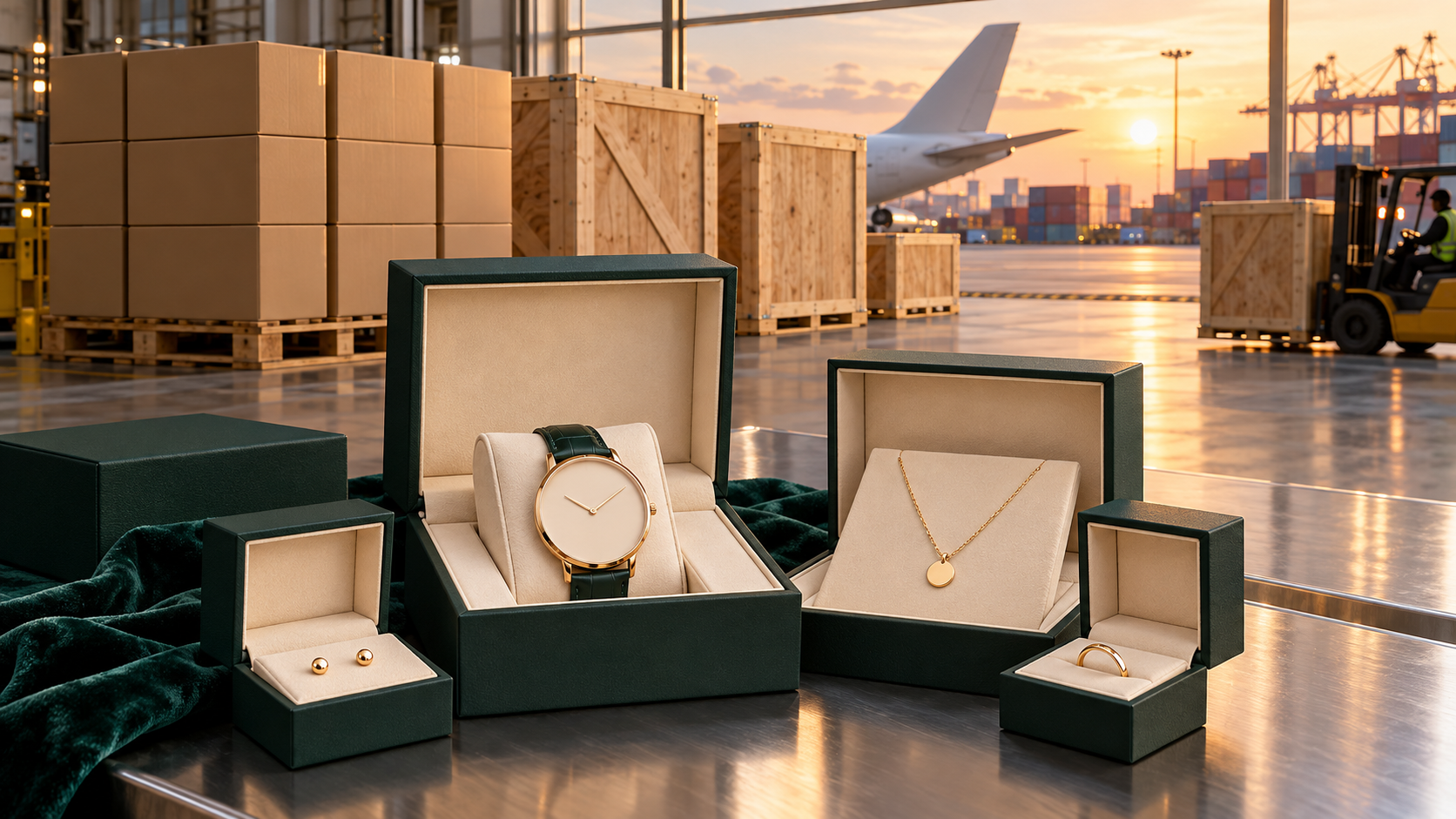
Why Does the Shipping Decision Matter as Much as the Production Decision?
Buyers tend to spend weeks perfecting a product specification and then fifteen minutes deciding how it will travel to their warehouse. That imbalance costs money. The freight decision affects four things that matter as much as unit price: landed cost, cash flow, launch dates, and the condition in which your goods actually arrive.
Start with landed cost. A watch that costs USD 8.50 ex-factory can land at USD 10.20 or USD 11.80 depending on how you move it, and that difference flows straight into your margin or your retail price. Jewelry behaves even less predictably, because small, dense shipments and bulky packaged sets sit at opposite ends of the dimensional-weight spectrum. Until you know your shipping mode, you do not truly know your cost of goods.
Cash flow is the second pressure point. Under the standard structure most Chinese manufacturers work with — including the 30% deposit and 70% balance before shipment that we confirm per order in our PI — your capital is committed well before the goods reach you. Sea freight may save freight cost but ties up inventory value for weeks longer; express may cost more per kilo but converts your goods into sellable stock fastest. Neither is "better" in the abstract. What matters is matching the mode to the order profile and your working-capital position.
Then there are dates. A reorder timed for Q4 retail cannot wait for a slow LCL consolidation, and a launch built around a trade-show sample deadline cannot tolerate a port delay. Freight is not a detail appended to production; it is the last leg of your production schedule. If you have not yet mapped the upstream half of that timeline, our guide to production lead times explains how sampling, mass production and final inspection sequence before shipping even begins.
Finally, condition on arrival. Watches and jewelry are compact and well suited to export packaging, but the journey still involves consolidation warehouses, container handling, and customs examinations. The mode you choose determines how many times your cartons are touched — and, in most cases, how much protective packaging and documentation discipline you need. The rest of this guide walks through each option so the decision becomes a calculation rather than a guess.
What Are the Three Main Shipping Options from China?
Every shipment leaving a Shenzhen watch or jewelry factory ultimately moves through one of three channels: express courier, air freight, or sea freight. They are not interchangeable. Each is built around a different economics model, and the right choice usually becomes obvious once you look at order size, urgency, and destination together.
Express delivery — DHL, FedEx, UPS and their peers — is a door-to-door service built on speed and simplicity. It is the default for sample shipments and urgent small orders, with typical transit of 3 to 7 days to most major markets. You pay a premium per kilo, but you buy convenience: one provider handles pickup, linehaul, customs brokerage and final delivery.
Air freight occupies the middle ground. Your goods fly, but they move as general cargo on scheduled airlines rather than inside a courier envelope, usually airport-to-airport with a forwarder managing the ground legs. Transit commonly runs longer than express once you include handling and clearance, but the per-kilo cost drops meaningfully as shipments grow. For mid-size production orders where weeks matter but door-to-door courier pricing no longer makes sense, air is the rational middle path.
Sea freight is the workhorse of wholesale. Full container loads (FCL) and less-than-container loads (LCL) move at a fraction of air cost per unit, at the price of time — typically 15 to 35 days in transit from Chinese ports depending on destination. For bulk production runs of watches and jewelry, where freight cost per piece directly shapes your landed margin, sea is usually where the numbers point.
| Mode | Typical transit | Best suited for | Key cost driver | Trade-off |
|---|---|---|---|---|
| Express (DHL / FedEx / UPS) | 3–7 days door to door | Samples, urgent small orders, replacement parts | Chargeable weight (actual vs. volumetric) | Fastest but highest cost per kilo; uneconomical beyond small volumes |
| Air freight | Roughly 5–12 days including handling and clearance | Mid-size orders, seasonal top-ups, high-value goods | Chargeable weight; fuel and security surcharges | Good speed-to-cost balance, but airport-to-airport requires forwarder and clearance handling |
| Sea freight (FCL / LCL) | 15–35 days depending on destination | Bulk production orders, replenishment, full collections | Container utilization or cubic meters (LCL) | Lowest cost per piece, but slowest and exposed to consolidation and port delays |
The table is a starting map, not a verdict. The next three sections examine each mode in the detail a buyer actually needs — how pricing is calculated, where the hidden costs hide, and at what point each option stops making sense.
When Is Express Delivery the Right Choice — and When Does It Stop Making Sense?
Express is the mode most buyers meet first, because the shipment that opens nearly every wholesale relationship is a sample. At Aurevo, samples move by DHL, FedEx or UPS as standard, arriving door to door in 3 to 7 days to most destinations. For a prototype or a pre-production sample of a Heritage Automatic Watch, nothing else competes: the goods are collected from our factory, cleared through customs by the courier's own brokerage, and delivered to your office or showroom with full tracking throughout.
Understanding chargeable weight
Express pricing is built on chargeable weight, and understanding it will save you from the most common courier surprise. Carriers charge whichever is greater: the actual weight of the shipment or its volumetric (dimensional) weight, calculated from carton dimensions at a carrier-specific divisor. Watches are dense, so a carton of 100 pieces usually weighs more than its dimensions suggest and bills at actual weight. Jewelry can be the opposite — a boxed set with inserts and gift packaging may occupy far more space than its kilograms imply, and the dimensional weight wins.
This is why a single sample carton sometimes quotes higher than expected. Bulkier packaging, branded boxes and presentation cases all inflate volumetric weight. It is rarely a problem at sample stage, but it is worth knowing before you commit to express for anything larger.
Where express earns its keep
Express is the right tool in a specific set of circumstances:
- Sample shipments — prototypes, confirmation samples, pre-production samples — where speed directly protects your development timeline.
- Urgent small orders: a top-up of a fast-selling SKU, a rush order for an event, or a fill-in shipment while sea cargo is still on the water.
- Replacement parts and after-sales stock — straps, buckles, clasps and batteries that we supply with orders — where small weight and high urgency favor a courier.
- High-value, low-volume consignments where the freight premium is small in absolute dollars and the reduced handling and faster customs clearance reduce risk.
In all of these, the math works because the shipment is small enough that the per-kilo premium is outweighed by what speed is worth to you. Express also minimizes handling touches, which matters for delicate items such as a finished custom logo men's watch traveling to a client presentation or a product launch.
A note on batteries
Watches containing lithium coin cells, and any shipment with standalone batteries, fall under air-transport dangerous-goods rules. In practice this means lithium battery shipments must be properly declared, packaged and labeled to the applicable IATA provisions, and carrier acceptance can vary by lane and service. Express couriers handle compliant battery shipments routinely, but quantities and packaging requirements are stricter than for ordinary cargo, and in some cases battery-equipped goods are more cleanly moved by other modes or as part of a properly documented air or sea consignment. Always tell your supplier upfront if your order includes batteries so the shipping plan accounts for it — it is far easier to build compliance in than to fix a held shipment.
When express stops making sense
There is a threshold — hard to state as one number because it depends on lane and season, but easy to feel — where courier pricing stops being a convenience fee and starts being a freight bill. As a working rule of thumb, once a shipment grows beyond a few cartons, compare express against air freight before committing. Buyers shipping 200 to 300 kilos by express are almost always overpaying.
Two further limits are worth noting. First, express is door-to-door but the consignee of record and import duties remain your responsibility as importer; the courier clears customs on your behalf but does not absorb duties or taxes. Second, volume commitments matter to courier rates — buyers who ship regularly typically negotiate account pricing, while one-off shipments pay list rates. If express is part of your replenishment rhythm, price it that way rather than per shipment.
The practical takeaway: use express for what it was built for — samples, urgency, small consignments — and treat it as a signal to reprice the mode the moment a shipment outgrows a few cartons.
When Should You Choose Air Freight Over Sea or Express?
Air freight occupies the middle ground that experienced buyers reach for more often than they expect. Express delivery works well for a few kilograms of samples, and sea freight rewards patience on full container loads, but a great deal of real-world volume falls between those poles: 150 to 800 kilograms of finished watches or jewelry that must reach a distribution center within two to three weeks. That is exactly the territory air freight was built for.
Transit on a typical Shenzhen-to-Europe or Shenzhen-to-US lane generally runs roughly 5 to 12 days door-to-door, depending on handling and clearance once consolidation, security screening, customs export, flight time and destination clearance are counted. The airline leg itself may take only 12 to 20 hours; the surrounding handling is what shapes your planning. In most cases, buyers who build a one-week buffer around the flight schedule are rarely disappointed.
How Chargeable Weight Actually Drives Your Air Cost
The single most common air freight surprise for newer importers is the gap between the scale reading and the invoice. Airlines charge on chargeable weight, which is the greater of actual gross weight and volumetric (dimensional) weight. Volumetric weight is calculated from carton dimensions — commonly by multiplying length × width × height in centimeters and dividing by 6,000, though the divisor varies by carrier and lane. A carton of lightweight leather-strap watches that measures 60 × 50 × 40 cm carries a volumetric weight of 20 kg even if it weighs 9 kg on the scale, and you pay for 20.
This is why jewelry shipments behave differently from watch shipments on the same flight. A master carton of sterling silver necklace pieces or a gemstone bracelet order is dense — actual weight usually governs, and the cost per piece is predictable. Watch cartons, with their inner boxes and void fill, are bulkier, so packaging efficiency directly moves freight cost. Reducing inner-box height by a few millimeters across 50 cartons can save real money on an air shipment. We confirm carton dimensions and estimated chargeable weight before dispatch so there is no invoice shock at destination.
Airports and Routing Around Shenzhen
Shenzhen is one of the strongest air cargo regions in the world. Shipments typically move via Shenzhen Bao'an or Hong Kong International, with Guangzhou as a third option depending on the forwarder's routing and space availability. Hong Kong, in particular, offers extensive long-haul capacity and well-established handling for consumer goods. The right airport is a routing decision made with your forwarder, balancing flight frequency, transit time and rate — it is confirmed per shipment rather than fixed in advance.
Documentation and Handling Requirements
Air shipments move on an airway bill (AWB) rather than a bill of lading, and the documentation set is leaner than sea freight: commercial invoice, packing list and, where your customs broker requires it, a certificate of origin. We prepare and provide all of these per shipment.
One point deserves particular attention: batteries. Nearly all quartz watches contain lithium coin cells, and lithium batteries are classified as dangerous goods in air transport. Small quantities installed in equipment generally travel under established provisions, but carriers impose packing, labeling and declaration requirements, and some lanes or airlines restrict them more tightly than others. This is a regulatory area where rules change, so it is best to flag battery content at quotation stage so the shipping plan and your forwarder can confirm the current requirements for the chosen routing. Buyers shipping large air volumes of quartz movements should always raise this early rather than at the airport counter.
When Air Beats Sea
Air freight earns its premium under three conditions. First, when the order is too large for express chargeable weight to be economical but too small to fill meaningful sea volume. Second, when the landed-cost difference is smaller than the value of earlier sell-through — a seasonal collection that reaches shelves three weeks sooner may repay the air premium several times over. Third, when cash flow timing matters: with T/T 30/70 terms, the 70% balance falls due before shipment, so a faster transit shortens the gap between paying out and selling. Air freight shortens that expensive idle period for inventory sitting in a container at sea.
Is Sea Freight the Right Choice for Your Wholesale Order?
For the bulk of wholesale volume leaving Shenzhen, sea freight remains the default — and for good reason. On a cost-per-kilogram basis, sea is typically a small fraction of air freight, and the economics improve further as volume grows. The trade-off is time: sea transit from South China ports generally ranges from 15 to 35 days depending on destination, with door-to-door timelines extending beyond that once consolidation, customs and inland haulage are included. US West Coast and Southeast Asian destinations sit at the shorter end; Europe, the Middle East and South America trend longer.
Sea freight is the only rational choice when volume is genuinely bulk — a full collection of several thousand pieces, a replenishment program of standard watches across multiple SKUs, or any order where per-unit freight cost directly determines whether the landed price supports your retail margin. Watches are compact and valuable relative to their weight, which softens the pain of slow transit; jewelry even more so.
FCL vs LCL: What the Difference Means for Your Order
Sea freight splits into two modes, and choosing correctly between them affects cost, speed and risk. FCL (Full Container Load) means your goods occupy an entire container — 20-foot or 40-foot — sealed at the factory and opened at destination. LCL (Less than Container Load) means your cartons share container space with other shippers' cargo, consolidated by a forwarder at origin and deconsolidated at destination.
| Factor | FCL (Full Container Load) | LCL (Less than Container Load) |
|---|---|---|
| Typical volume | Fillable container (roughly 25+ cubic meters for a 20ft) | 1–15 cubic meters |
| Cost basis | Flat rate per container plus local charges | Rate per cubic meter or per weight/measurement ton |
| Transit predictability | Direct service; sailing schedule governs | Depends on consolidation cutoffs; delays of several days to a week are common |
| Handling | Loaded once, sealed, unpacked at destination | Multiple handling steps at CFS warehouses on both ends |
| Damage exposure | Lower — goods not handled in transit | Higher — mixed cargo, more touches |
| Customs clearance | Whole container cleared together | Deconsolidation before clearance; can add days |
| Best for | Large orders, high-value collections, fragile packaging | Mid-size orders, first bulk shipments, buyers testing a market |
LCL consolidation deserves honest framing. The per-cubic-meter rate looks attractive, but the hidden costs are handling time and variability. Your cartons are received at a consolidation warehouse, positioned among other cargo, occasionally re-positioned, and the container only sails once the consolidation closes. At destination the same happens in reverse. Buyers who inspect carton condition carefully on arrival — as you should — will notice LCL cartons show more scuffs and corner damage than FCL cartons in most cases. For this reason, reinforced master cartons and additional inner protection are worth requesting for LCL shipments, and we can confirm the packaging setup with you before dispatch.
Port Pairing and the Shenzhen Advantage
Shenzhen's container ports — Yantian and Shekou chief among them — rank among the world's busiest, with frequent direct sailings to North America, Europe and major Asian hubs. The practical advantage for buyers is sail frequency: more sailings mean more consolidation options and less waiting for LCL cutoffs. The specific port and routing are decided with your forwarder per shipment, balancing sailing schedule, rate and destination port handling.
Which Incoterms Should You Agree On — and Who Pays for What?
Incoterms determine who arranges transport, who pays each leg, and — critically — where risk transfers from seller to buyer. We support EXW, FOB Shenzhen, CIF and DAP, confirmed per order on the PI. Choosing well is less about finding the "cheapest" term and more about deciding who controls which decision.
Under EXW (Ex Works), the buyer takes ownership of everything from our factory gate onward: booking the forwarder, export customs clearance in China, main carriage, insurance, import clearance and delivery. It offers maximum control and suits buyers with an established China logistics setup, but it asks the most of you and leaves us unable to manage export documentation on your behalf.
FOB Shenzhen (Free On Board) is the workhorse term for experienced importers. We deliver the goods, cleared for export, onto the vessel at the Shenzhen port nominated by you; from that point, risk and cost transfer to the buyer. You (or your forwarder) book the ocean freight and insurance. The appeal is a clean split: the manufacturer handles everything inside China, where local knowledge matters most, while you keep control of the international leg and its cost — often the difference between a good landed cost and an inflated one.
Under CIF (Cost, Insurance and Freight), we arrange and pay for carriage and insurance to your named destination port, but risk still transfers when goods are loaded on board at origin. This surprises some buyers: under CIF, if the container is damaged mid-ocean, the claim runs through the insurance policy arranged on the shipment, not through us as a liability. CIF suits buyers who prefer fewer logistics decisions and accept less control over carrier choice.
DAP (Delivered At Place) extends our responsibility to your named destination — a warehouse, a 3PL, a port — with import clearance and duties remaining your responsibility. It is the closest to a turnkey arrangement among the terms we support and is common with buyers consolidating into e-commerce fulfillment centers.
Incoterms also interact directly with cash flow under our standard payment structure of T/T 30% deposit and 70% balance before shipment. Because the balance falls due before dispatch regardless of Incoterm, the term you choose shapes what happens immediately after you pay: under FOB, your goods are available for loading the moment funds clear; under DAP, they are already moving toward you. Buyers balancing working capital against inventory timing should read the payment mechanics alongside freight planning — our guide to T/T, L/C and milestone payments covers that side in detail.
Which Shipping Mode Matches Your Order Profile?
The cleanest way to decide is to map the shipment to its purpose. A sample courier pack and a 40-foot container are different decisions with different economics, and most buyers cycle through all three modes as a product moves from development to steady replenishment. The order profiles below reflect how our typical wholesale programs actually develop.
| Order Profile | Typical Size | Recommended Mode | Why It Fits |
|---|---|---|---|
| Sample orders / prototypes | 1–10 pieces, a few kg | Express (DHL/FedEx/UPS), 3–7 days | Speed justifies the premium; chargeable weight on small cartons is manageable |
| First production run — standard watches | 100 pcs per style (MOQ) | Air freight or express, depending on chargeable weight | Small volume; buyer wants to validate market before committing to sea volume |
| First production run — custom watches | 300 pcs per style (MOQ) | Air freight for launches; LCL sea for cost-sensitive programs | Volume reaches the range where air is efficient and LCL sea becomes viable |
| First production run — custom jewelry | 200 pcs per style (MOQ) | Air freight or express | Dense, high-value cartons; air cost per piece stays proportionate |
| Replenishment orders | Recurring volume across SKUs | LCL sea freight, moving to FCL as volume stabilizes | Predictable demand tolerates 15–35 day transit in exchange for low unit freight |
| Full collections / seasonal bulk | Multiple styles, thousands of pieces | FCL sea freight | Lowest per-unit cost; container sealed at factory minimizes handling |
| Urgent replacement or launch top-up | Small to mid-size | Express or air freight | Time pressure overrides freight cost per piece |
A few patterns in this table are worth spelling out. MOQs exist partly to make production efficient — 100 pieces for standard watches, 300 for custom watches, 200 for custom jewelry — and the order sizes those MOQs produce happen to fall in the range where express and air freight are practical. That is convenient for a first order: you can validate a style with a modest quantity, shipped fast, before committing to container economics. Buyers working through the sampling process should plan the first production shipment at the same time they approve pre-production samples, because the freight booking and the final production milestone land close together.
The second pattern is the natural progression from air to sea. Programs that survive their first season almost always migrate toward LCL and then FCL as reorder confidence grows. A pragmatic rule of thumb many importers follow: use air to launch and to protect peak season, use sea for everything the calendar allows. If your reorder cycle runs 90 days and sea takes 25 of them, sea wins comfortably; if your cycle is 45 days, air may be the price of staying in stock.
Third, density matters when comparing profiles. Jewelry cartons are heavy relative to their size, which favors air freight; watch cartons, padded with inner boxes, are bulkier and can tip toward sea sooner than buyers expect. Carton dimensions and estimated weights can be provided with your quotation so the freight comparison can be made on real numbers rather than guesses — and so the landed cost you model matches the one that arrives.
How Should Your Goods Be Packed Before They Leave the Factory?
Shipping decisions get most of the attention, but a surprising share of transit damage traces back to decisions made at the packing bench, weeks before a container is booked. Wholesale watches and jewelry are compact, high-value goods, which means a single master carton can easily hold thousands of dollars of inventory. The packaging needs to survive stacking, humidity, handling by multiple parties, and the vibration of a long sea crossing — not just look presentable on arrival.
The standard export format we use, and the one you should expect from any serious manufacturer, is a three-layer system: each piece is protected in an individual poly bag or bubble wrap, placed into an inner box, and then packed into a master carton. The poly bag guards against scratching and moisture, the inner box prevents pieces from shifting against each other, and the master carton absorbs the rough handling of consolidation warehouses and port transfers. For delicate items — a gemstone bracelet with settings that can catch on neighboring pieces, for example — the inner-box layer does most of the protective work, and it is worth confirming with your supplier that pieces are boxed individually rather than loose-bagged.
Carton marks: small details that prevent big delays
Every master carton should carry clear shipping marks: the PO or order reference, carton number out of total (for example, "Carton 14/38"), destination port or consignee code, and gross weight. These marks matter more than most first-time importers realize. When your forwarder consolidates an LCL shipment, or when customs officers at destination want to spot-check a carton, the marks are what let anyone identify and locate your goods in minutes instead of hours. Mismatched or missing marks are one of the most common causes of LCL confusion at destination warehouses.
At Aurevo, carton marks and shipping marks are confirmed with the buyer before dispatch, so there are no surprises on the cartons that arrive at your forwarder's warehouse. If your market has labeling requirements — destination-language handling labels, handling symbols, or consignee-specific formats — this is the stage to specify them, not after the goods are sealed.
An insurance mindset starts at packing
Even with careful packing, freight is an environment you do not fully control. The buyers who recover smoothly from the occasional transit problem are the ones who treated packing as part of their risk plan from the start. Three habits are worth adopting:
- Photograph the pallets and cartons before dispatch. If the goods leave the factory documented, you can prove the condition in which they were handed to the carrier.
- Check carton condition on arrival before signing. Note any crush damage, water staining, or re-taped cartons directly on the delivery receipt — carriers take annotated receipts far more seriously than later complaints.
- Budget for cargo insurance as a line item, not an afterthought. On high-value compact cargo like watches, premiums are typically modest relative to the value at stake.
If you plan branded retail packaging rather than plain export boxes, that is a separate conversation with its own lead time and cost implications — our guide to custom packaging covers boxes, inserts and branding in depth. For shipping purposes, the plainer and more robust the outer layer, the better.
Which Documents Do You Need for a Smooth Customs Handoff?
Freight does not really end at the destination port or airport — it ends when customs clears your goods and the cartons are released. The documents that travel with your shipment determine how quickly that happens. A well-prepared document set is boring; a flawed one can hold a container for days and generate storage and demurrage charges that dwarf any freight savings.
Every Aurevo shipment is accompanied by a standard document set: a commercial invoice, a packing list, the transport document (bill of lading for sea freight or airway bill for air and express), and a certificate of origin where required. Additional certificates, such as material test reports, can be arranged on request where applicable. It is worth understanding what each document actually does, because the details are what customs brokers scrutinize.
The commercial invoice and packing list
The commercial invoice is the document customs uses to assess duty, so accuracy here is not optional. It should state the consignee, the Incoterm, the currency, a clear goods description (HS-relevant terms such as "quartz wristwatches, stainless steel case" rather than vague product names), unit values, and totals. Undervaluing to reduce duty is a false economy — it exposes you to penalties and re-valuation at destination. The packing list complements the invoice by mapping goods to cartons: how many cartons, what is in each, gross and net weights, and dimensions. Your forwarder uses it to build the manifest; your broker uses it to reconcile the declaration.
Bill of lading or airway bill
The bill of lading (B/L) is both a receipt for the goods and, in most cases, a document of title — whoever controls the original B/L controls the cargo at destination. Under letter-of-credit transactions this matters enormously; under standard T/T terms it is still the document your broker needs to take delivery. Airway bills serve the same function for air freight, though they are not documents of title. Check that the consignee and notify party details match your broker's expectations exactly, and confirm whether you want telex release (electronic) or original documents couriered — telex release is faster for most routine shipments.
Certificate of origin and beyond
A certificate of origin states where the goods were manufactured, and depending on your destination market it may unlock preferential duty rates under a trade agreement — or simply be mandatory regardless. Which certificates your market requires depends heavily on product category and destination, and it is worth reviewing our guide to certifications and compliance documents before your first order rather than after. For a fuller walkthrough of the clearance process itself — HS codes, duty calculation, broker roles — see our article on import duties and customs clearance.
One practical tip: review draft documents before the goods ship. Corrections after departure are possible but slow and occasionally expensive. Ten minutes spent checking the invoice against your PI is the cheapest customs service you will ever buy.
Should You Use Your Own Freight Forwarder — and What Does a Good One Actually Do?
Most established buyers eventually nominate their own freight forwarder, and there are good reasons for it. A forwarder you choose works for you: you see the actual freight quote rather than a supplier's marked-up version, you control routing and transit-time trade-offs, and you build a relationship with a partner who understands your import profile. Aurevo supports buyer-nominated freight forwarders as standard practice, and we coordinate handover at our dock accordingly — goods are released to your forwarder's warehouse with the agreed documents, packed and marked as confirmed.
That said, it helps to understand what a forwarder is actually selling, because the good ones do far more than book space. In practice, a competent forwarder will:
- Compare carriers and routings across the market, balancing transit time, cost and schedule reliability for each shipment rather than defaulting to one lane.
- Consolidate cargo from multiple suppliers into one shipment — the core value of LCL for buyers sourcing watches from one factory and packaging or accessories from another.
- Prepare and check documentation — verifying the invoice, packing list and transport documents against booking details before they reach customs.
- Handle destination clearance through their own brokers or partners, often including duties-paid (DDP-style) arrangements if you want them, though most B2B buyers prefer to clear under their own import account.
- Solve problems mid-transit — a missed vessel connection, a customs query, a container rolled to the next sailing. This invisible work is what you are really paying for.
If you are a newer importer without an established forwarder, working with your supplier's nominated forwarder is a legitimate starting point — just ask for the freight cost breakdown so you can benchmark it against market rates over time. Whichever model you choose, the important thing is clarity on who books, who pays and who is responsible at each leg, which is precisely what the Incoterm on your PI defines.
It is also worth asking a prospective forwarder two questions early: how they handle shipments containing button-cell batteries (relevant to quartz watches on air lanes, as covered earlier in this guide), and what their standard process is for LCL cargo insurance. The quality of the answers tells you a lot about how they will behave when something goes wrong.
How Do You Protect Your Shipment — and What Happens If Something Goes Wrong?
Even with good packing, honest partners and careful planning, freight involves parties and environments outside anyone's control. The goal is not zero risk; it is a clear chain of evidence and agreed remedies so that when something does go wrong, resolution is a process rather than a dispute.
Build the evidence chain before dispatch
Pre-shipment documentation is your first line of defense. Aurevo provides pre-shipment photos and videos before dispatch as standard, following our final random inspection. These images do double duty: they let you verify the goods before the balance payment is released (fitting naturally into the T/T 30/70 sequence, where the 70% balance falls due before shipment), and they establish the condition of the goods at the moment of handover. Combined with photographs of the packed cartons and pallets, this evidence cleanly separates factory-side issues from transit-side ones. If your order is large enough to justify it, third-party inspection by SGS, BV or TUV is welcome at the buyer's cost — an independent report at origin makes any later claim considerably stronger.
Cargo insurance: whose policy, whose claim
Who insures depends on the Incoterm. Under CIF, the seller arranges insurance to the named port — but note that standard CIF cover is typically the minimum level, so for high-value cargo many buyers buy additional cover on top. Under FOB or EXW, insurance is the buyer's responsibility, and most forwarders can arrange it for roughly a small percentage of cargo value. Whatever the arrangement, confirm who the beneficiary is and how a claim is filed before the goods ship. The moment to learn your forwarder's claims procedure is not while a water-damaged carton sits in a destination warehouse.
Claims on quality: the 30-day window
Transit damage and quality defects are handled differently, and it is worth keeping the two separate in your mind. For quality issues, Aurevo accepts claims within 30 days of receipt, supported by photos and batch numbers. Verified defects are compensated through replacement in your next order, a discount, or a refund of the affected value — the mechanism is agreed case by case. Inspect promptly on arrival; the 30-day window rewards buyers who make receiving inspection a routine, not a someday task.
Beyond the claim window, the longer-term protection is the 12-month warranty that covers all Aurevo watches and jewelry. That warranty is your safety net for defects that surface after the goods are in the market — movement failures, clasp problems, plating issues — and our guide to the 12-month warranty explains how it works in practice.
Spare parts as quiet insurance
One often-overlooked protection is supplied with the order itself: spare parts including straps, buckles, batteries and clasps accompany shipments. For a retailer, a spare strap resolves a customer complaint in five minutes at the counter instead of a warranty return across an ocean. Ask what spares are included for your product type, and consider requesting extra proportions of the components most likely to wear on your specific models — it is a small line item that meaningfully reduces after-sales friction.
What Are the Most Common Shipping Mistakes B2B Buyers Make?
Most freight problems we see are not exotic. They repeat across buyers and seasons, and nearly all of them are avoidable with a little forethought. Here are the five we encounter most often.
- Guessing at chargeable weight on samples and express shipments. A carton of watch boxes full of air can be billed on volumetric weight that far exceeds its actual weight. Buyers who request dimensions and weight per carton before booking express avoid the surprise invoice — and sometimes discover that a slightly tighter pack or splitting into two shipments is cheaper.
- Choosing the mode on freight cost alone. Sea freight is almost always cheaper per kilo, but it ties up your capital for weeks and delays revenue on a new launch. With T/T terms where the 70% balance is paid before shipment, the cash-flow cost of a slow shipment is real. Price the mode against landed cost and launch date, not the freight quote alone.
- Ignoring battery and lithium rules on air lanes. Quartz watches contain button cells, and air carriers apply specific rules to shipments containing batteries. Assuming standard air freight treatment without checking can mean a pulled shipment and a delayed order. Disclose batteries up front and let the forwarder confirm the compliant routing.
- Leaving document details until the last minute. Consignee names that don't match the import account, vague goods descriptions, missing HS-relevant details — each of these can stall clearance at destination and generate storage charges. Review draft documents against your PI before the goods depart.
- Skipping the arrival inspection. Signing for freight without checking carton condition, then discovering damage a week later, puts you in a weak position with both the carrier and your insurer. Note damage on the delivery receipt, photograph everything, and inspect contents against the packing list promptly — your 30-day claim window depends on it.
None of these require expertise so much as a checklist and a habit of confirming details in writing before money or goods move. Buyers who build those habits tend to treat freight as a solved problem — which is exactly what it should be.
Frequently Asked Questions About Shipping Watches and Jewelry from China
Can I use my own freight forwarder instead of one arranged by Aurevo?
Yes. We routinely support buyer-nominated freight forwarders, and in most cases this is the cleanest arrangement for importers who already have negotiated rates or a consolidation partner in China. Your forwarder handles booking, export customs declaration and documentation coordination on your behalf, while our side prepares the goods, export packaging and carton marks, and hands over against the agreed Incoterm. If you ship under FOB Shenzhen, your forwarder books the main carriage; under EXW, they also handle collection from our factory. Simply share your forwarder's contact details when the purchase invoice is confirmed so booking can start without delays between final inspection and dispatch.
Why did my small express shipment get charged for more weight than the carton actually weighed?
Express carriers and air freight lines charge on chargeable weight: the greater of actual weight and volumetric weight, calculated by dividing carton volume by a dimensional factor. Watches in bulky gift boxes are a classic trap. A carton of 20 sample watches with presentation boxes might weigh 8 kg but occupy the space of 20 kg of dense cargo, and you pay for the higher figure. This is also why a single carton sent by express often costs more than buyers expect relative to a mid-size air shipment. If you want to preview freight economics before ordering, ask us for carton dimensions and gross weight per order quantity, then compare modes against those real figures.
Are watches with lithium batteries safe to ship by air, and does it restrict my options?
Most quartz watches contain small button cells, which are classified as lithium batteries for transport purposes. In general, watches installed in equipment, in small quantities, are typically acceptable on both express and air freight when properly declared and packaged, but carriers impose rules on quantity limits, state of charge and labeling, and these rules are enforced inconsistently across lanes. Spare loose batteries are treated more strictly than batteries installed in products. In practice, this rarely blocks a shipment, but it can add documentation steps or a surcharge. Battery-related handling requirements are confirmed per shipment, and if a destination lane becomes difficult, sea freight is typically available as a fallback.
Is LCL sea freight worth it, or should I wait until I can fill a container?
LCL makes sense when your order volume falls below a few cubic meters and transit time matters less than landed cost. The trade-offs are real, though: your cartons are consolidated with other shippers' cargo at the origin, which adds handling, and destination de-consolidation plus customs clearance can extend the door delivery timeline beyond the port-to-port range. Carton condition on arrival also deserves attention, since consolidated cargo moves through more hands. For many buyers, a sensible pattern is to use LCL for replenishment orders and move to FCL once recurring volumes justify it. If you are approaching that threshold, we can help you compare the cubic volume of your order against LCL and FCL pricing from your forwarder.
What documents do I need to clear customs in my own market?
Every Aurevo shipment is accompanied by a commercial invoice, packing list and the bill of lading or airway bill, and we provide a certificate of origin where it benefits your duty position. Depending on your market and product category, your customs broker may additionally ask for material test reports or compliance documentation, which we can arrange on request where applicable. The details that cause the most friction at clearance are usually self-inflicted: inconsistent declared values between the invoice and the payment records, vague goods descriptions, or carton counts that do not match the packing list. Confirming these documents against your PI before dispatch, and reviewing our pre-shipment photos and videos, prevents most clearance delays.
Who is responsible if cartons arrive damaged or goods are missing?
Responsibility depends on the Incoterm confirmed on your PI, which is exactly why we confirm EXW, FOB Shenzhen, CIF or DAP per order rather than leaving it ambiguous. Under CIF or DAP, the seller arranges main carriage, and cargo insurance can be included; under FOB, you control the freight contract and the insurance decision. Regardless of the term, the practical protective steps are the same on our side: pre-shipment photos and videos before dispatch, sturdy poly bag plus inner box plus master carton export packaging, and shipping marks confirmed with you beforehand. On your side, inspect carton condition before signing the carrier's delivery receipt, and note any damage on the document immediately — claims lodged later are much harder to support.
Choosing the Right Shipping Route for Your Next Order
Shipping watches and jewelry from China is not a single decision but a sequence of them: a mode matched to your order profile, an Incoterm that puts freight control and cash flow where you want them, packaging and carton marks agreed before dispatch, and documents prepared for the customs handoff. Express serves samples and urgent small quantities in 3–7 days; air freight suits mid-size replenishment; sea freight, FCL or LCL, carries bulk orders in 15–35 days depending on destination. None of these choices is universally correct — the right answer depends on volume, urgency and how your T/T 30/70 payment schedule interacts with inventory timing.
What you should expect from a manufacturer is transparency at each step: chargeable weight estimates before you commit, pre-shipment photos and videos before balance payment, flexibility to work with your nominated forwarder, and a clear claims process with a 12-month warranty behind it. That is how we structure shipments for buyers across our 65+ export markets, and it is confirmed per order on the PI rather than promised in generalities.
If you are planning a production run — whether 100 standard watches, 300 custom pieces or 200 custom jewelry units — tell us the destination and timeline, and we will confirm the Incoterm, packaging and documentation that fit. Request a Quote from Aurevo and we will come back with freight options priced against real carton data from your order, not guesswork.

How Should You Price Wholesale Watches and Jewelry for Retail Profit? A B2B Buyer's Guide to Markups, Margins and Channel Pricing

How Do You Protect Your Watch and Jewelry Designs When Outsourcing Custom Manufacturing? A B2B Buyer's Guide to NDAs, IP Ownership and Tooling Agreements