How Do You Choose a Reliable Watch Wholesale Supplier for Your Retail Business?
1/15/2026
Choosing a watch wholesale supplier looks simple on the surface: compare prices, place a trial order, and go. In practice, retailers and distributors who skip a structured evaluation often discover problems after the money is spent — inconsistent finishing, movements that fail in the field, shipments that arrive weeks late, or a supplier who cannot scale when your orders grow. This guide walks through the questions a professional buyer should ask before signing with any watch wholesale supplier, so you can judge reliability on evidence rather than on a sales pitch.
Start With Verified Manufacturing Capability, Not Catalog Photos
Any supplier can show you attractive product photos. What matters is what happens behind them. Ask directly: does the company manufacture in its own facility, or does it trade from other factories? A manufacturer with in-house assembly lines can control quality control at every stage — case polishing, movement installation, water-resistance testing and final inspection — while a trading company simply passes your requirements along and adds a margin.
Concrete indicators help here. Ask how many production lines run in the factory, how many people work on the floor, and what the annual output is. For example, a factory running 16 lines with over 200 production staff can typically handle both steady repeat orders and seasonal peaks; a supplier who cannot answer these basic questions clearly is telling you something. If you source at scale, an on-site audit or a third-party factory inspection is worth the cost before the first container.
Judge Quality Control by Process, Not Promises
"High quality" means nothing on its own. A serious watch wholesale supplier will describe its quality control process in specific steps: incoming material inspection, movement testing, case and bracelet stress checks, water-resistance testing, and a final visual and functional inspection before packing. Ask what percentage of units are checked and whether inspection records are kept per batch.
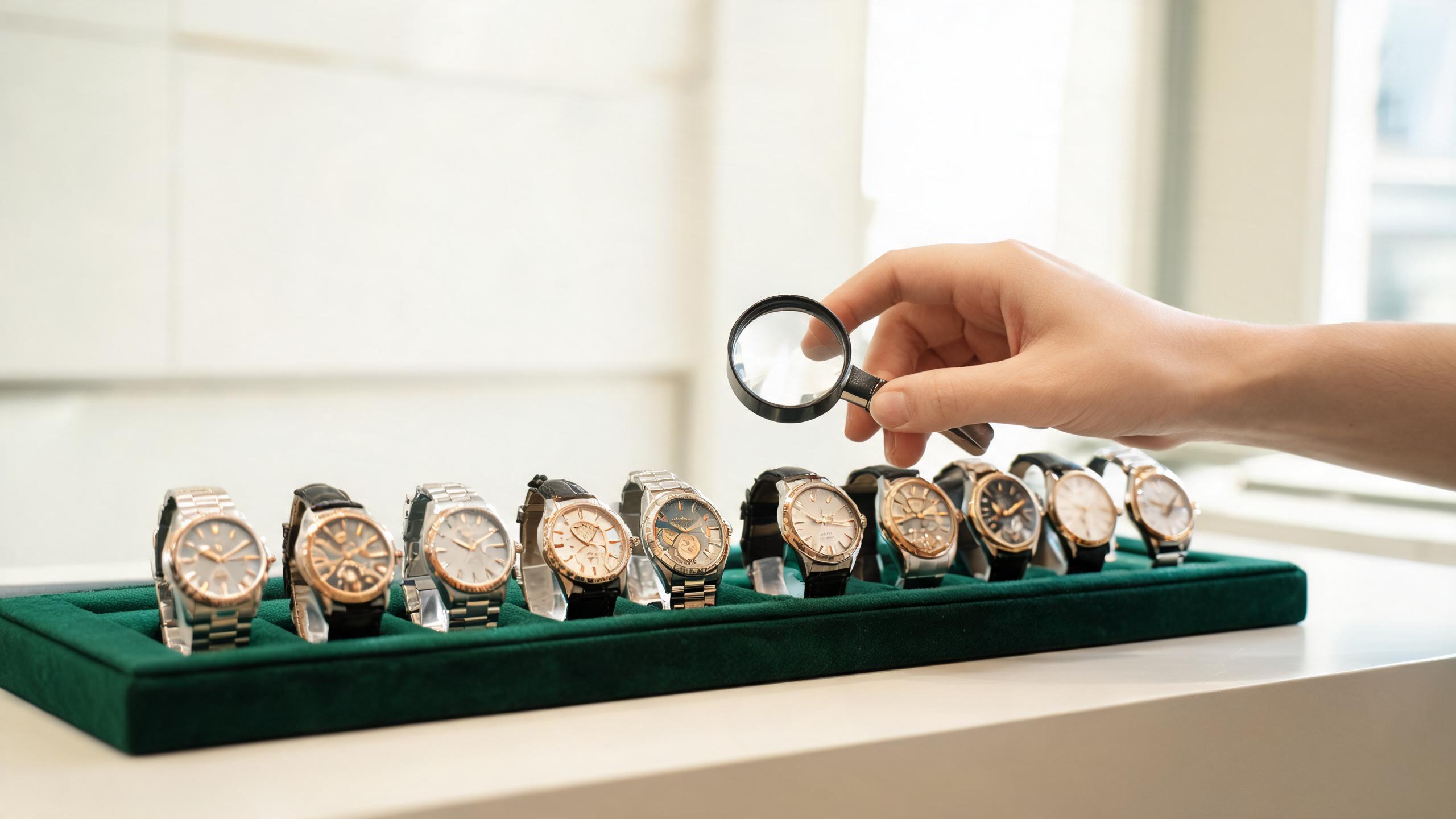
Then verify with samples. Order samples from the same production line that would handle your bulk order, not from a hand-picked showcase batch. Check the finishing details buyers notice: dial printing alignment, hands seated properly, bracelet links without sharp edges, crown action, and timekeeping over several days. A supplier confident in its process will welcome this level of scrutiny.
Understand MOQ and How Pricing Actually Scales
MOQ — minimum order quantity — determines whether a supplier fits your business stage. A new e-commerce seller may need a low MOQ to test designs; an established distributor may want volume pricing at higher quantities. Ask how the MOQ is applied: per model, per color, or across the order. Flexible MOQ terms per model are common among manufacturers who work with growing brands.
Equally important is how unit pricing scales. Request a tiered price list — for example, pricing at 100, 500 and 1,000 units per model — and confirm what is included: packaging, warranty terms, and whether customization costs extra. Transparent tiered pricing lets you forecast margins accurately and avoids the surprise of "sample price" quietly differing from "bulk price".
Confirm OEM, ODM and Private Label Support Early
If you plan to build your own brand, confirm customization capability before you commit. OEM means you supply the design and the factory produces to your specification; ODM means the factory adapts its existing designs to your brand; private label means applying your branding to existing models. Each model has different tooling costs, sampling timelines and MOQ requirements.
Ask to see evidence of customization work: custom dials, logo engraving on casebacks, branded crowns, bespoke packaging. A manufacturer that routinely handles OEM and ODM projects for clients in dozens of countries will have a defined sampling process — usually design confirmation, prototype, revised sample, then mass production — and will tell you honestly what is feasible within your budget rather than promising everything.
Check Lead Times and Logistics Realistically
Lead time — the production time from order confirmation to shipment — directly affects your inventory planning and seasonal sales. Ask for typical lead times at your order volume, and what happens during peak season when every buyer is racing the same holiday window. A reliable supplier quotes realistic lead times and communicates delays early, not after the deadline has passed.
On logistics, confirm which incoterms the supplier works with (FOB, EXW, DDP and so on), which ports or airports it ships from, and whether it has experience exporting to your market, including the paperwork your customs clearance requires. A manufacturer already shipping to 65+ countries will know the documentation routine for your region; a first-time exporter may not.
Evaluate Communication and Long-Term Fit
The best supplier relationship behaves like a partnership. Notice how the supplier communicates during the quotation and sampling stage: Are replies specific or generic? Does a named contact follow your project, or do you restart with a new person each time? Are problems acknowledged directly? These early signals predict how the supplier will behave when something goes wrong mid-order.
Also consider long-term fit: can the supplier grow with you, adding new models each season, supporting larger volumes, and offering both watches and complementary jewelry lines as your assortment expands? Switching suppliers is expensive; choosing one with room to scale protects the relationship you are building.
A Practical Checklist Before You Commit
- Verify the factory is real: production lines, staff numbers, annual output, and ideally an audit report.
- Review the quality control process step by step, then test it with production-line samples.
- Get MOQ and tiered pricing in writing, including what packaging and warranty are included.
- Confirm OEM/ODM/private label capability with real customization examples and a clear sampling process.
- Agree on realistic lead times and incoterms, and confirm export experience to your market.
- Judge communication quality during quoting and sampling — it predicts the whole relationship.
Working through this checklist takes a little longer upfront, but it filters out unreliable suppliers before they cost you a season of sales. If you are evaluating watch wholesale partners now, prepare these questions and send them to your shortlist — a professional manufacturer will answer each one with specifics, and that response itself is your first real data point.