Quartz or Automatic: Which Watch Movement Should You Choose for Your Wholesale or Private Label Collection?
10/1/2026
The Movement Decision Behind Every Watch You Sell
Ask a room of wholesale buyers which single decision shapes a watch program most, and you will rarely hear "the movement." Most buyers arrive focused on dial colors, strap materials, packaging and price tiers. Yet the movement — the mechanism inside the case that actually keeps time — quietly determines your unit cost, your service burden, your margin ceiling, and even the kind of retail customer your collection attracts. Choose it deliberately and the rest of the program falls into place. Choose it casually and you will spend the next two quarters explaining stock-keeping decisions you never consciously made.
That is why the question "quartz or automatic?" is not a technicality reserved for watchmakers. It is a commercial decision, and it deserves the same rigor you would apply to choosing a factory or negotiating a price tier. A quartz movement and an automatic movement can sit inside visually similar cases, at visually similar price points, and still lead to completely different businesses: one built on volume, variety and fast turns; the other built on perceived craft, higher positioning and slower, more deliberate sales.
This guide is written for that decision. Whether you are building a wholesale assortment of quartz watches, planning a private label line around a single automatic model, or mixing both, the sections below walk through how each movement works, what each costs to buy and to live with, how end consumers perceive them, and which product lines each movement fits best. Along the way we will use real examples from the Aurevo catalog — including a 40mm automatic dress watch with a 316L stainless steel case, sapphire crystal and an exhibition caseback, and several quartz models across men's and women's lines — so the comparison stays grounded in products you can actually source, not abstractions from a textbook.
Three questions run through the whole article:
- What does each movement actually do, and how does it do it?
- What does each choice mean for cost, MOQ, inventory, accuracy and after-sales?
- Which movement fits which kind of collection — and where does a mixed strategy make sense?
If you read only one section, make it the comparison table in the middle. If you are planning a private label program, do not skip the supplier questions near the end. And if you are still torn between "mostly quartz" and "mostly automatic," the section on building a mixed collection offers a practical starting ratio you can adapt to your own market.
One note on scope before we begin: every product-specific claim in this article comes from the Aurevo product catalog, and all Aurevo watches — quartz and automatic alike — carry a unified 12-month warranty. Where a figure is general industry context rather than a specification of a specific Aurevo model, the text says so explicitly. This is a sourcing guide, not a substitute for confirming the exact specification sheet of any model before you place an order; the final section explains exactly what to confirm and how.
What Is a Quartz Movement — and Why It Dominates Wholesale Catalogs
A quartz watch keeps time with a tiny quartz crystal that oscillates when an electrical current passes through it. The oscillation is extremely stable, and the watch's circuit counts those vibrations to drive a small stepping motor that moves the hands — in most designs, once per second, which is why the seconds hand on a classic quartz watch ticks in distinct steps. The whole system runs on a small button battery.
Two consequences follow from this architecture, and both matter enormously at wholesale scale.
First, accuracy is a solved problem. Because the crystal's frequency is stable and largely independent of how the watch is positioned or worn, a standard quartz movement keeps time far more closely than a mechanical movement can. As a broad industry reference — not a specification for any individual model — conventional quartz movements are commonly rated within roughly ±15 seconds per month. For a retail customer, that usually means adjusting the date a few times a year and almost never resetting the time.
Second, the parts count is small. A quartz movement contains a fraction of the components of a mechanical movement. Fewer parts mean lower manufacturing cost, thinner cases, easier assembly, and fewer things that can go wrong in the field. This is the engineering root of the commercial reality: quartz is the movement of volume. It lets a factory deliver consistent, accurate, low-maintenance watches at price points that make promotional programs, multi-style assortments and gifting lines financially viable.
It also explains why quartz dominates wholesale catalogs — including ours. The Aurevo line is deliberately quartz-heavy: a men's stainless steel quartz watch with a polished 40mm 316L case and matching steel bracelet; a classic ladies quartz watch with a clean white dial and gold-tone metal bracelet; a fashion quartz watch with a champagne-gold-tone case and slim bracelet, rated 3 ATM; and a Celeste quartz watch with a mother-of-pearl dial and gold-tone case built around a Japanese quartz movement, also rated 3 ATM. Four different personalities, one movement philosophy: dependable, affordable, easy to stock.
For a wholesale buyer, quartz also removes an entire category of after-sales conversations. There is no winding ritual to explain, no expectation to manage about wearing the watch daily, no movement servicing to schedule in the early years of ownership. The main maintenance event — a battery replacement — is inexpensive, widely available, and familiar to every consumer. From a pure "what will my customers experience in year one and year two" standpoint, quartz is the lowest-friction option you can put in a catalog.
The honest limitation is perceptual, not mechanical. Because quartz movements are inexpensive to produce, the market reads them as ordinary. A quartz watch can be beautiful, well-finished and profitable, but it rarely carries the romance that lets a brand justify a premium price on the movement alone. If your positioning depends on the story inside the case, that story has to come from design, materials and finishing — which is exactly where the automatic movement enters the conversation.
What Is an Automatic Movement — and What Buyers Actually Get
Remove the battery and replace the whole engine with springs and gears, and you have an automatic movement. Formally, an automatic (self-winding) watch is a mechanical watch whose mainspring is wound by the motion of the wearer's wrist: a rotating weight swings with everyday movement, winds the mainspring through a winding mechanism, and the stored energy is released through a gear train to advance the hands. No battery. If the watch sits unworn for a day or two, it stops, and the wearer restarts it by swinging the watch a few times or turning the crown.
Where does the accuracy go? This is the question buyers ask first, and the honest answer has two parts. Part one: all mechanical movements are less accurate than quartz — that is simply the physics of springs and gears versus a vibrating crystal. Part two: modern automatic movements, as a general industry reference rather than a specification of any particular model, are commonly rated within roughly −15 to +25 seconds per day, which for most wearers means resetting the time every few days to a few weeks depending on how the watch is worn. If absolute precision is the customer's priority, the automatic watch is not the tool for the job; its value lies elsewhere.
Where the value actually lies is in the experience. An automatic watch is alive on the wrist: the seconds hand sweeps in a fine, continuous glide rather than ticking once per second. There is a rotor you can hear whir softly when the watch moves, and on models with an exhibition caseback — a transparent window in the caseback — the wearer can literally watch the movement working. No battery to change, no battery to run out in a gift box during shipping season. For many consumers, that mechanical character justifies a higher price and a stronger emotional attachment, and that emotional premium is precisely what a private label brand can convert into margin.
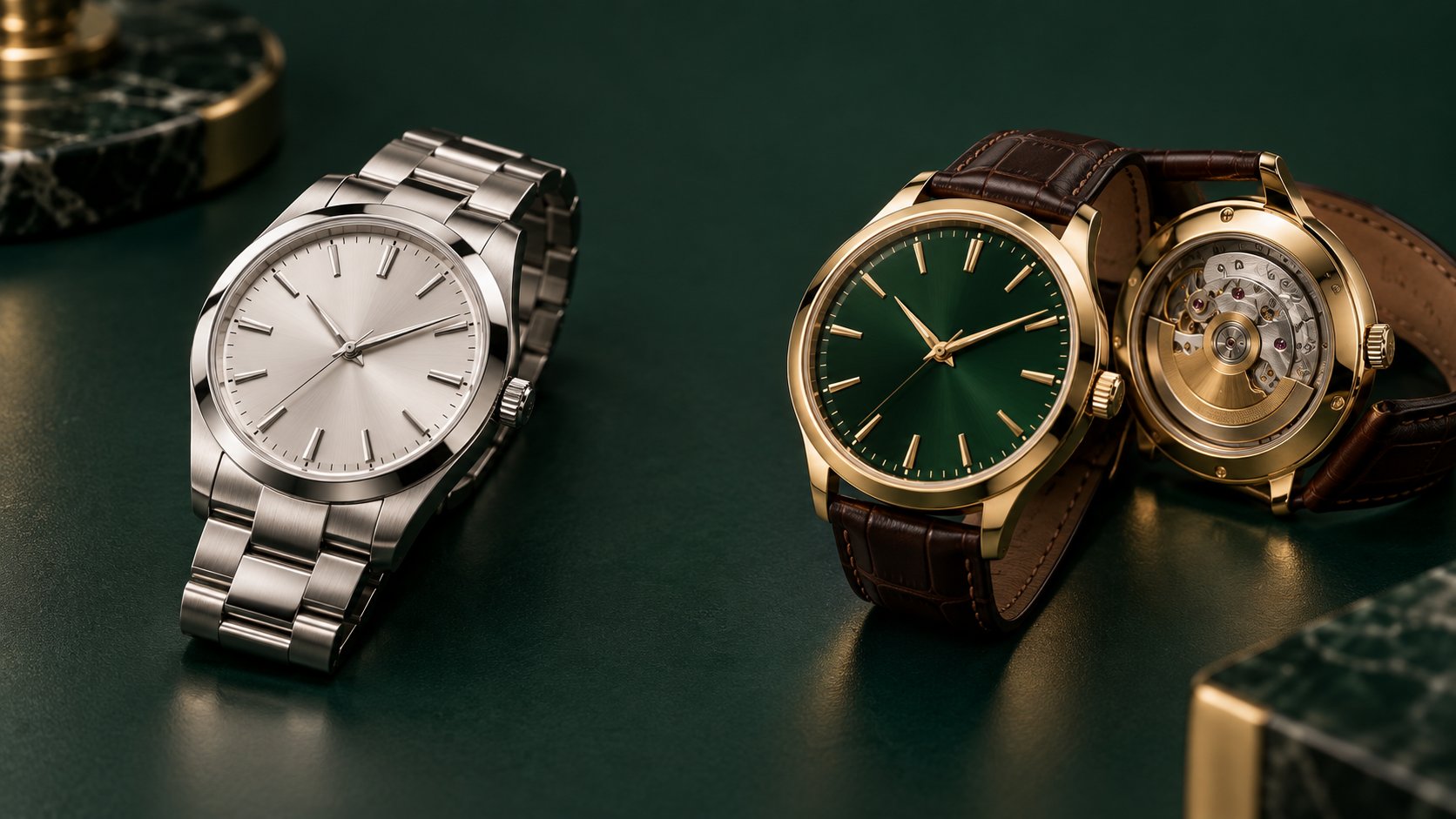
Now the catalog example. The Aurevo Heritage Automatic Watch is a 40mm men's dress watch with a 316L stainless steel case, sapphire crystal, an exhibition caseback and a genuine leather strap, positioned for wholesale, OEM/ODM and private label programs. Each specification here is a deliberate counterpart to a buyer question:
- 40mm case — the current mainstream size for men's dress watches, so the model reads modern without chasing a trend size that may fade.
- 316L stainless steel — the standard case material for quality watches, familiar to buyers, serviceable and hypoallergenic for most wearers.
- Sapphire crystal — far more scratch-resistant than mineral glass, which means the watch keeps looking new on the shelf and on the wrist, reducing perceived-quality complaints in the first year of a program.
- Exhibition caseback — the transparent caseback that lets the wearer see the movement at work; it is the single most persuasive physical proof of what the customer is paying a premium for.
- Genuine leather strap — a natural material that complements the mechanical story and reads as a dress watch rather than a tool watch.
Between quartz and automatic, the engineering difference is also a maintenance difference. A quartz watch has a predictable, inexpensive service event — battery replacement — and otherwise needs nothing. An automatic watch has no battery but does have a mechanical movement with oils and jewels that, as a general industry norm rather than an Aurevo commitment, are typically serviced every several years when the watch is heavily used; routine movement servicing of that kind sits outside the 12-month warranty and should be quoted separately if ever needed. Neither regime is inherently better; they are different cost curves. Quartz concentrates its cost of ownership in small, predictable, consumer-manageable events. Automatic concentrates value up front and spreads its care over a longer horizon that, for many enthusiasts, is part of the enjoyment.
For the wholesale buyer, the automatic movement changes the conversation you have with your retail customers. You are no longer selling timekeeping; you are selling mechanics, a visible mechanism, and the small ritual of setting a watch in the morning. Some of your buyers will pay more for exactly that. Others — pragmatists who want set-and-forget accuracy — will not, and that is fine, because those customers are the natural audience for the quartz half of a mixed collection.
Quartz vs Automatic at a Glance: The Comparison Buyers Ask For
The phrases "what is quartz movement vs automatic" and "what is quartz watch vs automatic" are among the most common questions buyers type into search engines before they ever contact a supplier. The table below condenses the answer into the dimensions that actually move a purchasing decision. Ratings are relative and directional, based on the general characteristics of each movement type and the Aurevo catalog's real product data; they are not laboratory measurements of any specific model.
| Dimension | Quartz | Automatic |
|---|---|---|
| Power source | Button battery | Wrist motion winding a mainspring |
| Typical accuracy (industry reference) | Roughly ±15 seconds per month | Roughly −15 to +25 seconds per day |
| Seconds hand | Ticks once per second | Sweeps smoothly |
| Maintenance events | Battery replacement every couple of years | Occasional movement servicing over years of use |
| Unit cost structure | Lower; supports volume pricing | Higher; supports premium positioning |
| Case thickness | Easier to keep slim | Usually a little thicker |
| Retail story | Dependable, precise, low-friction | Craft, mechanics, visible movement |
| Best fit | Multi-style assortments, gifting, promotional and fashion lines | Hero models, private label flagships, collector-oriented lines |
| Warranty at Aurevo | 12 months | 12 months |
Table 1. A movement-type comparison for wholesale decision-making. Accuracy figures are broad industry reference ranges for movement types, not specifications of individual Aurevo models; confirm each model's specification sheet before ordering.
Two rows deserve extra attention because they are the ones buyers most often misjudge. The accuracy row is not a quality judgment — a quartz movement's precision does not make an automatic watch "bad," just as an automatic watch's sweep and mechanics do not make quartz "boring." They optimize for different definitions of good. The retail story row is the one with the most commercial leverage: the movement type shapes the conversation your retail customers have with their own end consumers, and that conversation either supports or undermines the price you are trying to defend.
Cost, MOQ and Inventory: What Each Movement Does to Your Cash Flow
Movement choice reaches past the product into your working capital. Here is how it plays out in practice.
Unit economics
A quartz program buys you optionality. Because the movement cost sits at the low end, more of your budget goes to what customers actually see — dials, straps, case finishes — and you can field a broad assortment of styles at price points that clear retail psychology thresholds. A single style can be offered in multiple dial and strap combinations without the SKU economics falling apart. That is why fashion and gifting assortments are almost always quartz-first: the customer who buys three watches for three outfits is buying variety, and variety is cheapest to deliver on quartz.
An automatic program concentrates spend in the movement and its supporting specifications. The case usually needs to justify the mechanics — which is why our Heritage Automatic pairs its movement with sapphire crystal and a 316L case rather than basic mineral glass — and the retail price must sit in a band where mechanical character reads as value, not as an unexplained surcharge. Fewer SKUs, deeper story, higher per-unit revenue: that is the trade.
MOQ and product-line breadth
Both Aurevo watch programs — quartz and automatic alike — run with MOQ from 100 pieces, so the entry bar is comparable. The difference shows up in how you allocate those 100 pieces. With quartz, splitting an order across two or three styles is a common and rational strategy — the assortment benefits from breadth. With an automatic flagship, buyers more often commit the full quantity to one model, one or two dial variants, and invest in presentation, because the positioning depends on the model reading as deliberate rather than scattered.
Inventory risk
Quartz inventory is patient. A quartz watch does not degrade by sitting in a warehouse; its accuracy is unaffected by storage, and a battery swap at display time refreshes it. Automatic inventory carries a softer deadline: a movement stored for a long period may need attention before it performs its best on a customer's wrist, and fashion-driven buyers should remember that style relevance decays faster than any mechanism. In both cases the practical advice is the same — size orders to your sell-through, and favor suppliers who can support re-orders rather than forcing you into oversized single buys.
After-sales load
Across the first year of a program, quartz generates few surprises: the occasional dead battery, rarely anything else. Automatic watches generate a different texture of questions — "why did it stop overnight," "how should I wind it," "is +20 seconds a day normal." None of these are defects; all of them are conversations your retail training should prepare for. A supplier who provides clear wear-and-care copy and warranty support (Aurevo's warranty is a uniform 12 months across the catalog) absorbs much of this load before it reaches you.
Accuracy, Perceived Value and the Customer's Actual Expectation
It is tempting to rank movements purely on the numbers, but numbers only matter against expectations. Consider three retail archetypes.
The pragmatist wants a watch that is right twice a day and never thinks about it. Quartz wins this customer outright, and no amount of mechanical storytelling will convert them. Selling them an automatic watch without preparation creates returns and one-star reviews.
The enthusiast knows exactly what a mechanical movement is, may already own one, and buys partly for the mechanism. The sweeping hand and the exhibition caseback are not novelties to this customer; they are the product. Accuracy within a broad reference range is accepted — indeed, the discipline of wearing or winding a mechanical watch is part of its appeal. Selling this customer a basic quartz watch is not wrong, but it forfeits the margin the automatic segment exists to capture.
The gifter buys the box, the moment and the meaning. Both movements can serve this customer, but the automatic's story — "it winds itself as you wear it; there's a whole machine in there" — is disproportionately powerful in gifting contexts, which is one reason automatic lines often outperform their price class during holiday seasons.
Map your end-customer mix honestly against these archetypes and the movement question usually answers itself: pragmatist-heavy markets are quartz markets; enthusiast-heavy markets reward an automatic flagship; gifting-heavy markets can use both, with the automatic model as the halo piece that lifts the perceived value of the whole collection.
Perceived value also compounds through details that are cheap to specify at sourcing time and expensive to retrofit. Sapphire versus mineral glass, exhibition caseback versus closed steel back, genuine leather versus bonded leather — each is a small decision that either amplifies the movement's story or mutes it. When you evaluate any supplier's automatic model, look past the movement claim to the supporting cast around it; a mechanical caliber inside a case that undercuts it is a positioning problem waiting to happen.
Private Label Strategy: Matching the Movement to the Collection
If you are building a private label collection rather than reselling open catalog stock, the movement decision becomes a positioning decision. A search for a private label watch manufacturer usually begins with a style brief, but the experienced buyer's second question is always about what is inside the case — because that is what determines the price band you can defend and the customer you will attract.
Choose quartz when
- Your collection is style-led and broad: multiple silhouettes across men's and women's lines, updated seasonally.
- Your retail price band is accessibility-first, where dependable timekeeping at a friendly price is the promise.
- You are testing a market or a channel (cross-border e-commerce, gift programs, corporate orders) and need SKUs that are forgiving on inventory.
- Your brand story lives in design and materials — dial texture, bracelet finishing, color stories — rather than in mechanics.
Every Aurevo watch model — quartz and automatic alike — is available for private label and OEM/ODM programs with MOQ from 100 pieces, which makes quartz the natural testing ground: you can validate a design language across several SKUs before committing deeper capital.
Choose automatic when
- Your brand has (or wants) a hero product — one watch that anchors the collection's perceived quality and price ceiling.
- Your audience includes watch enthusiasts, collectors or gift buyers for whom mechanics carry emotional value.
- You want the exhibition caseback, sweeping seconds and mechanical story to do marketing work that no advertisement can fake.
- You can commit to retail training: your retail partners need a script for winding, accuracy expectations and wear habits.
The Aurevo Heritage Automatic Watch was specified for exactly this role: a 40mm 316L case, sapphire crystal and exhibition caseback give a private label brand the physical evidence to support a premium narrative, and the 12-month warranty applies on the same terms as the rest of the catalog.
Build a mixed collection
The strongest wholesale collections we see rarely pick a side. As an illustrative example rather than a data-backed rule, a practical starting structure for a boutique brand is a quartz-first core — several styles carrying the volume, the gifting traffic and the low-friction first purchases — plus one automatic flagship that lifts the collection's story and price perception, to be adjusted against your own market and sell-through. Retailers display the automatic piece at the center of the case; it sells less often and at higher value, and in doing so it makes the quartz pieces around it feel more intentional. There is no universal ratio, but a common pattern for an opening assortment is four to six quartz references and one automatic, rebalanced after the first season's sell-through data.
The Supplier Questions to Ask Before You Commit
Whatever movement you choose, the difference between a smooth program and a painful one is usually decided by the questions you asked before wiring the deposit. Use this checklist with any supplier — including us:
- Movement specification in writing. Ask which movement type and caliber family each model uses, and request the specification sheet rather than accepting a verbal "yes, quartz."
- Accuracy and battery-life expectations. For quartz, confirm the expected battery service interval. For automatic, ask what accuracy band and winding expectations the supplier documents for the model.
- Crystal and case materials. Confirm sapphire versus mineral glass and the case steel grade per model — these specs vary within one supplier's catalog, as they do within ours.
- Water resistance rating per model. Ratings differ across the line (our fashion and Celeste quartz models are rated 3 ATM); never assume one rating covers the catalog.
- MOQ, re-order terms and lead times for both the initial order and re-orders, especially for the automatic flagship where you will commit more per unit.
- Private label scope. Confirm exactly what the OEM/ODM program covers for your chosen models: dial branding, caseback marking, packaging, and any documentation.
- Warranty terms. Ask the duration and what it covers. Aurevo's catalog carries a uniform 12-month warranty across quartz and automatic models; make sure whatever you sell your retail customers aligns with your supplier's terms.
- After-sales support. Ask what wear-and-care copy, FAQ materials or training support the supplier provides for each movement type — this is what keeps returns down at retail.
Buyers searching "where to buy wholesale watches" or "where to buy bulk watches" usually compare on price and MOQ first. Those matter, but the questions above are what determine your cost of ownership after the container lands — and they are also the fastest way to tell a serious movement supplier from a catalog reseller.
Frequently Asked Questions
What is quartz movement vs automatic, in one sentence?
A quartz movement is battery-powered and uses a vibrating quartz crystal for highly accurate timekeeping with a ticking seconds hand; an automatic movement is mechanical, wound by the motion of the wearer's wrist, with a sweeping seconds hand and no battery.
Which is better for a first wholesale order?
For most buyers, quartz — it minimizes inventory risk, simplifies retail training and supports a broader style assortment at a lower unit cost. Add an automatic model once your collection needs a hero piece to lift positioning; both Aurevo program types start at MOQ from 100 pieces, so the entry commitment is comparable.
Do automatic watches stop if you do not wear them?
Yes — an automatic watch is powered by wrist motion, so if it sits unworn for a day or two its mainspring reserve runs down and it stops. The wearer restarts it by swinging the watch or winding via the crown. This is normal behavior, not a defect, and it is worth explaining to retail partners before the first automatic shipment arrives.
How often does a quartz watch need a new battery?
As a general industry reference rather than a specification of any individual model, a typical watch battery lasts roughly a couple of years, after which replacement is quick and inexpensive at virtually any watch shop or jeweler.
What is watch movement type, and why does it matter for private label?
"Movement type" is simply the category of mechanism inside the watch — most commonly quartz or automatic (mechanical self-winding). It matters for private label because the movement determines your cost structure, the accuracy expectation you must communicate, the maintenance story your retailers will tell, and the price band the finished watch can credibly occupy.
How accurate should I promise my customers?
Promise nothing in public that the specification sheet does not state. As broad references, quartz movements are commonly rated within roughly ±15 seconds per month and automatic movements within roughly −15 to +25 seconds per day — but confirm the figures your supplier documents for the specific model, and keep your customer-facing claims within that.
What warranty comes with Aurevo watches?
Every Aurevo watch — quartz and automatic alike — carries a uniform 12-month warranty. Confirm the coverage details for your specific program during quotation.
Inside the Movement: What Retail Staff Should Be Able to Explain
A movement is easier to sell when the people behind the counter can describe it in one confident paragraph. This section gives you that paragraph for each movement type, in plain language a retail associate can memorize, plus the follow-up questions customers actually ask.
The quartz explanation, in one paragraph
"Inside this watch is a tiny quartz crystal that vibrates when electricity from the battery passes through it — 32,768 times a second — and the watch counts those vibrations to keep the hands moving. That is why it is so accurate: it gains or loses only a few seconds a month, and every couple of years you simply have the battery swapped, which takes a few minutes at any watch shop."
Customers follow up with predictable questions. "Is the battery expensive?" — no, and replacement is widely available. "Will it lose time?" — only a few seconds a month, far less than you would notice day to day. "Does anything wear out?" — practically nothing, within the first years of ownership. Each answer reinforces the same message: this watch asks nothing of you, and it keeps working.
The automatic explanation, in one paragraph
"This watch has no battery at all. Inside there is a small swinging weight that winds the spring every time you move your wrist, so the watch powers itself as you wear it. The seconds hand glides in a smooth sweep — that is how you can tell it is mechanical — and through this window in the back you can watch the whole mechanism working. If you leave it off the wrist for a couple of days it will pause; you just swing it gently or turn the crown and set it again."
The follow-ups here are different in character. "So I have to wind it?" — only when it has been resting; daily wear keeps it running. "Why is it more expensive?" — because it contains a great many precision mechanical parts that must be assembled and adjusted, instead of a battery and a chip. "How accurate is it?" — mechanical watches run within a broader tolerance than quartz; part of the charm is the machinery, not the stopwatch precision. Retail staff who can deliver these answers convert curiosity into sales instead of hesitation.
One more detail worth teaching: the exhibition caseback
An exhibition caseback is a small feature with an outsized effect at the counter. When a customer turns the watch over and sees the movement, the conversation changes from claims to evidence — no salesperson can match that moment. If your assortment includes an automatic model, brief your retail partners to show the caseback early in the conversation. It also photographs beautifully for social content, which makes it one of the few product features that keeps generating marketing value after the sale.
Merchandising the Movement: Display, Copy and Assortment Roles
How you merchandise the movement matters almost as much as which movement you buy. The same watch can sell briskly or sit still depending on whether its shelf story matches what the mechanism can honestly promise.
Position quartz as the dependable core
In store displays and online listings, lead quartz models with what they guarantee: accuracy, ease, style choice. Phrases like "precision quartz movement," "just wear it," and "the style-first collection" set correct expectations and attract the pragmatist and multi-buy customer. Avoid borrowing mechanical romance for quartz models — calling a quartz watch "crafted like a fine machine" invites the exact comparison quartz cannot win, and experienced customers notice.
Position automatic as the hero piece
The automatic model should be displayed differently: more space, better lighting, the caseback visible. Its copy leads with the mechanism — "self-winding mechanical movement," "sapphire crystal," "see the movement through the exhibition caseback." Price it confidently. A hero automatic priced timidly does not become accessible; it becomes confusing, because the supporting specifications (case material, crystal, strap) were chosen to justify a premium band.
Let the assortment do the selling
The two movements are strongest when they reference each other. A retailer who buys your quartz core and your automatic flagship can build a display where the automatic sits at the center and the quartz styles radiate outward — the story being: "start anywhere; the one in the middle is where the collection is headed." Online, the automatic model earns its place in lookbooks and gift guides, while quartz carries the everyday-styles page. Each supports the other's price integrity.
Seasonal rhythms
Quartz volume peaks naturally around gifting seasons and promotion cycles, and it tolerates discounting without narrative damage. Automatic sales concentrate around the same seasons but behave differently: they reward storytelling, gift-with-meaning positioning and personal recommendation, and they are more resistant to discount-led promotion because the buyer's motivation is not price but significance. Plan your campaign calendars accordingly — deep promotions for the quartz core, story-led features for the automatic flagship.
Reading a Supplier's Specification Sheet Like a Buyer, Not a Browser
Before we close, one practical skill ties this entire guide together. When a supplier sends a specification sheet, most buyers scan for price and MOQ. The buyers who avoid costly surprises read it the way an engineer would, and it takes only a minute more.
Start with the movement line and read it literally. "Quartz" is a movement type, not a quality grade; if the sheet names nothing beyond that, ask what accuracy and battery interval the supplier documents. "Automatic" is likewise a type, not a performance claim; the meaningful follow-ups are the winding expectation, the accuracy band and what the warranty covers. Next, check the materials row: the case steel grade, the crystal type and the strap material each carry real cost and real customer-perception weight — a sapphire crystal over a basic mineral glass is one of the largest perceived-quality jumps available at sourcing time. Then the water resistance rating, read per model and per direction on the sheet: a number without a stated context (splash, hand-wash, swim) is a question, not an answer. Finally, confirm the paperwork: what the warranty covers and for how long, and what documentation ships with the goods, because these lines decide how many after-sales emails your team answers next year.
This habit costs nothing at the quotation stage and pays back across the whole life of the program. It also gives you a fair, identical framework for comparing suppliers — including us — on substance rather than on catalog photography.
The Bottom Line for Your Next Collection
Quartz or automatic is not a question with a single correct answer; it is a choice about which kind of business you are building. Quartz buys you breadth, predictability and low-friction retail — it is how most successful wholesale watch assortments begin. Automatic buys you story, positioning and a hero product that lifts everything displayed around it — it is how collections grow up. The buyers who win long-term do not treat the two as rivals; they sequence them: quartz-first for volume and learning, automatic for differentiation once the brand has a market.
Whichever direction your next collection takes, ground it in written specifications and a supplier who will answer the checklist above in detail. If you are weighing a quartz assortment, a private label flagship, or a mixed structure for your market, share your target styles, quantities and price band with our team — we will map the corresponding models, MOQ terms and specification sheets so you can decide on facts rather than adjectives.
How Should You Price Wholesale Watches and Jewelry for Retail Profit? A B2B Buyer's Guide to Markups, Margins and Channel Pricing
How Do You Protect Your Watch and Jewelry Designs When Outsourcing Custom Manufacturing? A B2B Buyer's Guide to NDAs, IP Ownership and Tooling Agreements