A custom watch budget is built from several distinct cost lines — design, tooling, movement, case, dial, strap, packaging, QC, and freight. This factory-side breakdown explains what moves each line up or down, where buyers commonly overspend, and how to compare quotations. Aurevo's verifiable process facts show what a real program involves.
Cost-structure explainer
Buyers evaluating a custom or private-label watch program usually start with one question: what will this actually cost? The honest answer is that a watch is not one price — it is a stack of cost lines, each driven by a different decision. Design, tooling, movement, case material, dial and strap customization, sampling, packaging, QC, and freight behave differently. Some scale with volume; some are one-time; some you can control directly. This breakdown walks through each line, explains which factor moves it, and shows where buyers tend to overspend. All figures should come from a quotation, not from a general article — request one for actual numbers.
- A custom watch budget is a stack of line items, not a single unit price.
- MOQ, movement choice, case material, and tooling are the biggest swing factors.
- Sampling and mass production schedules affect cash flow and launch timing, not just cost.
- Payment terms and Incoterms change your landed cost and risk profile.
- Only a quotation tied to your spec sheet can give real numbers.
What a custom watch budget is actually made of
Every custom watch program carries the same broad cost components. What changes between projects is how much each one weighs. A simple logo-printed dial on an existing case style and a fully tooled new case are different programs with different cost structures.
Aurevo runs this process from sampling through mass production. Custom watch MOQ starts at 300 pieces, while standard watches can start from 100 pieces. Quotations are valid for 30 days, tooling fees are payable in advance and refundable for qualifying volume orders, and production runs on 16 lines in an 18,000 m² facility with capacity above 200,000 watches per month.
Design and engineering
Design work covers the spec sheet, drawings, dial layout, and any technical files needed before a sample is made. The cost driver here is not the drawing itself — it is how much new engineering your design requires.
- Reusing an existing case and dial platform keeps engineering light. You are mostly changing colors, finishes, and logo placement.
- New case geometry or a new dial architecture requires more engineering hours and more sample iterations.
- Complex dials — multi-layer, applied indices, special finishes — add design and tooling complexity.
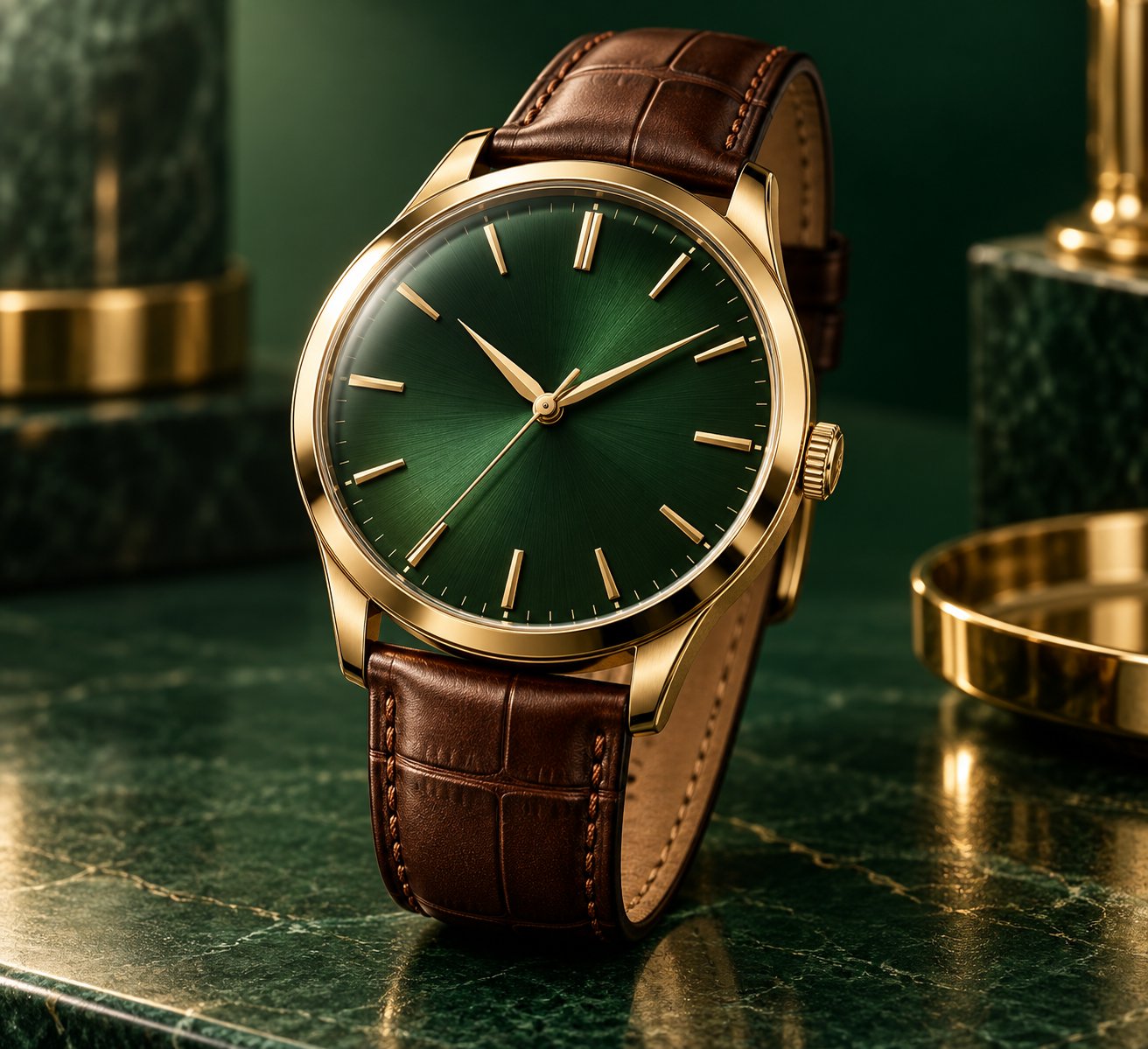
Aurevo's catalog includes 8,000+ styles. Starting from an existing style, such as a 40mm 316L gold-tone case with a quartz movement, deep green dial, and brown leather strap (SKU ATW-1007), keeps engineering focused on your branding rather than a new platform. That product supports logo printing on the dial, custom dial colors, and case finishing, with MOQ from 100 pieces.
Tooling and molds
Tooling is the line buyers most often underestimate. If your design needs a new case, bezel, or dial tool, that is a one-time cost separate from unit price. The main drivers:
- New case or bezel molds — required when existing tooling does not match your geometry.
- Dial and applied-index tools — needed for non-standard dial layouts.
- Number of tooling pieces — a watch with several custom components multiplies tooling lines.
Tooling fees are payable in advance. For qualifying volume orders, they are refundable — so the effective cost depends on your order volume. This is a direct reason to confirm the refund threshold before approving a design that needs new tooling.
Movement choice
The movement is a major unit-cost driver and a major positioning decision. Quartz movements are simpler and usually lower cost per unit. Mechanical and automatic movements add unit cost and may add assembly or QC time. The choice affects both your unit price and your brand positioning — it is not a place to guess.
Movement selection also interacts with case design. A movement with different dimensions may require a different case interior, which can push you into new tooling. Confirm movement availability and compatibility before finalizing the case drawing.
Case and materials
Case material and finishing are the most visible cost levers. Stainless steel is the common baseline. Plating, PVD, and gold-tone finishes add cost steps. Case size, thickness, and water resistance rating also move the cost line — a 3 ATM rating is a different construction requirement than a higher-pressure case.
Dial, strap, and logo customization
This is where most branding actually happens, and it is usually the most controllable cost line.
- Dial: logo printing, custom dial colors, and special finishes. More colors and more print positions add cost.
- Strap: leather, metal, or other materials. Material grade and hardware drive cost.
- Logo application: dial printing, caseback engraving, and buckle marking are separate steps. Each one you add is a cost line.
If your design adds a custom dial color and logo print to an existing platform, the incremental cost is usually modest. If it requires a new dial tool and applied indices, it moves into the engineering and tooling lines above.
Sampling and schedule
Sampling is both a cost and a timing item. Aurevo's sampling lead time is 7–15 working days, and mass production runs 20–40 working days. These schedules affect your cash flow and launch date, so they belong in the budget conversation.
Each sample round consumes time and, depending on the program, cost. The goal is to converge on an approved sample quickly. Approving a design before the spec is frozen is a common reason sample rounds multiply.
Packaging, QC, and freight
Packaging is often treated as an afterthought, but it is a real cost line. Boxes, inserts, printed materials, and any retail-ready presentation add cost and also affect freight volume.
QC is a structural cost. Aurevo operates 40+ QC stations across production. More customization and more components generally mean more inspection points. This is not a line to cut — it is the line that protects the units you ship.
Freight depends on the Incoterm and mode. Aurevo offers EXW, FOB Shenzhen, CIF, and DAP. Express transit is 3–7 days; sea transit is 15–35 days. Your choice changes both the cost and where risk transfers.
Cost driver summary
| Cost component | Main driver | Direction of impact |
|---|---|---|
| Design & engineering | New case/dial architecture vs. existing platform | New platform raises cost; reuse keeps it low |
| Tooling & molds | Number of new tools required | Each new tool adds a one-time cost; refundable for qualifying volume orders |
| Movement | Quartz vs. mechanical/automatic | Mechanical/automatic typically raises unit cost |
| Case & materials | Material, finish, size, water resistance | More material and more finish steps raise cost |
| Dial/strap/logo | Number of custom elements and print positions | More elements raise cost; on-platform changes are modest |
| Sampling | Number of rounds and spec changes | More rounds add time and cost |
| Packaging | Presentation level and freight volume | Retail-ready packaging raises cost and shipping volume |
| QC | Component count and customization depth | More customization means more inspection points |
| Freight | Incoterm, mode, destination | Express is faster and costlier; sea is slower and cheaper |
Where buyers waste money
- Over-tooling a first run. Buyers design a fully custom case when an existing platform plus a custom dial would have tested the market. This locks budget into tooling before demand is proven.
- Freezing the spec too late. Sample rounds multiply when the spec changes mid-process. Each round costs time and money.
- Ignoring the tooling refund threshold. Tooling is payable in advance and refundable for qualifying volume orders. If you do not plan to meet the threshold, treat tooling as sunk cost; if you do, factor the refund into your landed cost.
- Choosing a movement without checking case compatibility. This can push you into new tooling unexpectedly.
- Treating freight as a footnote. EXW, FOB, CIF, and DAP place different risk and cost on you. The Incoterm you accept changes your total budget.
- Cutting QC to save a line item. QC across 40+ stations is what keeps defect rates controlled at volume.
Payment terms and quotation validity
Payment structure affects cash flow planning. Aurevo's standard terms are T/T 30% deposit and 70% balance, with L/C at sight accepted for orders above USD 50,000. Quotations are valid for 30 days, so compare quotes against current pricing rather than an older sheet.
As a starting reference point, the Aurevo Custom Logo Men's Watch (ATW-1007) shows how an existing platform with logo printing, custom dial colors, and case finishing works as a low-tooling entry into a custom program. For a fully new design, review the OEM/ODM process and private-label options.
Frequently asked questions
How much does a custom watch cost?
It depends on your spec: movement type, case material, tooling needs, customization depth, packaging, and order volume. Aurevo does not publish fixed prices because every program is different. Request a quotation with your spec sheet and target quantity for actual figures.
How much does it cost to build a watch from scratch?
A from-scratch build with a new case and dial requires engineering and new tooling, which raises the upfront cost compared with adapting an existing style. Tooling is payable in advance and refundable for qualifying volume orders. The unit cost then depends on movement, materials, and volume.
How much does it cost to start a watch company?
Your startup budget should cover sampling, tooling if needed, a first production run, packaging, and freight. Standard watches can start from 100 pieces, and custom watch MOQ is 300 pieces. Sampling takes 7–15 working days; mass production takes 20–40 working days. A quotation tied to your design is the only way to size this accurately.
What is the minimum order quantity for a custom watch?
Custom watch MOQ is 300 pieces. Standard watches can start from 100 pieces.
What payment terms are available?
T/T 30% deposit and 70% balance is standard. L/C at sight is accepted for orders above USD 50,000. Quotations are valid for 30 days.
How long does production take?
Sampling is 7–15 working days. Mass production is 20–40 working days. Shipping adds 3–7 days by express or 15–35 days by sea, depending on the Incoterm and destination.
Getting an actual number
The cost lines above show what moves a custom watch budget and where buyers commonly overspend. To turn this into a real figure, send your spec — target style, movement preference, case material, dial and strap requirements, logo placement, packaging needs, quantity, and destination. You will receive a quotation valid for 30 days. Request a custom watch quotation.