
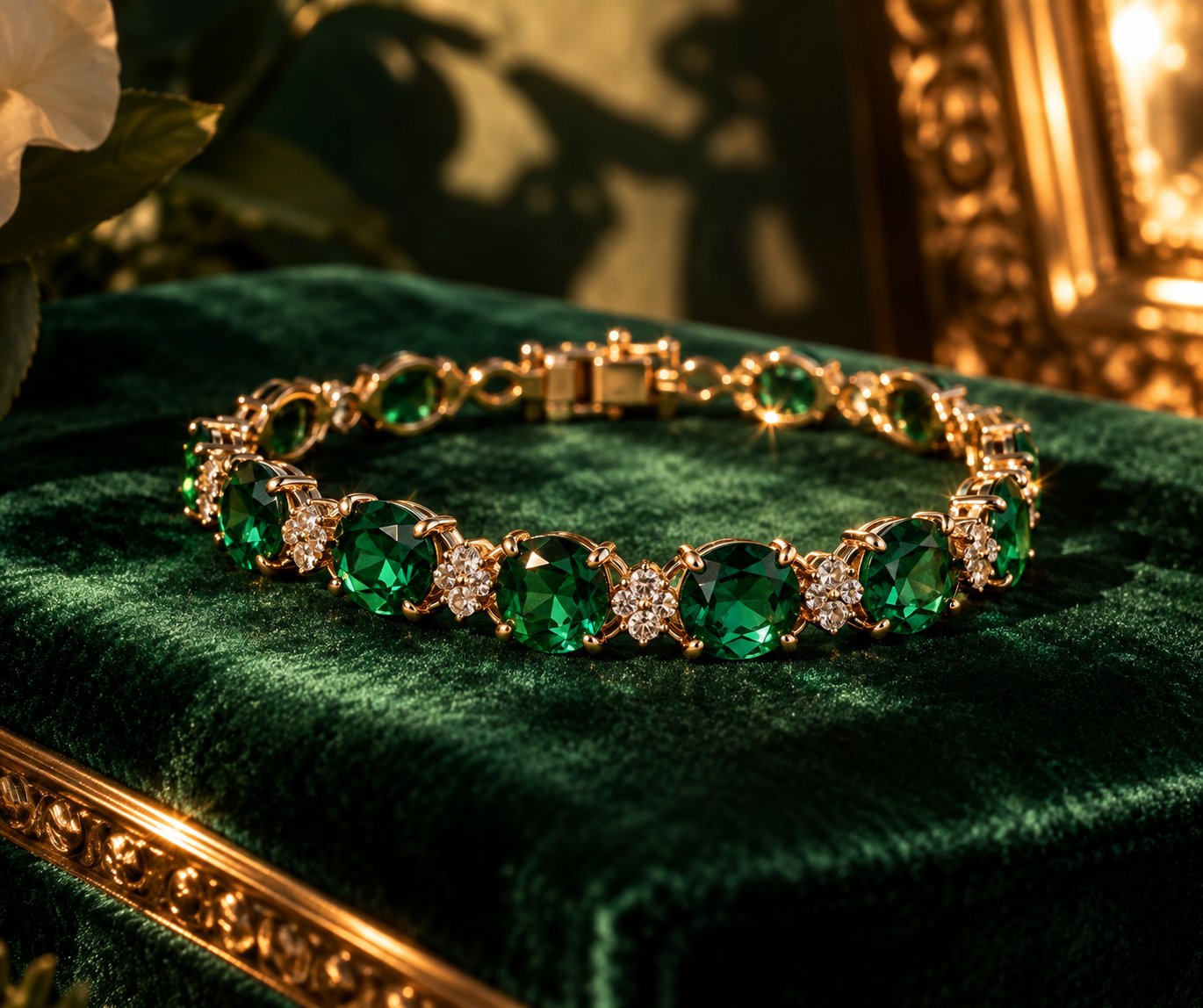
A buyer-side selection checklist for building a stone-set crystal bracelet line — stone type and cut, prong versus glued settings, plating tone consistency across a batch, clasp choice, and sizing and packaging confirmation. Each point is tied to what we actually inspect and produce, including two reference SKUs with confirmed MOQ, sample and production lead times, and 12-month warranty.
Most sample requests fail for reasons a buyer can catch before the order is placed: the stone cut doesn't read the way the buyer imagined, the setting is glued rather than pronged, one batch's plating tone drifts a shade from the last, or the clasp can't take the pull of a heavier stone row. This guide turns those failure points into a checklist you can run against physical samples. Every criterion below is one we inspect in-house across a jewelry inspection workflow, and each one maps to what a supplier has to confirm on paper before sampling starts.
What this checklist covers
- Stone type and cut: faceted versus smooth
- Setting type: prong versus glued
- Plating tone consistency across a batch
- Clasp selection and function
- Sizing, length and packaging confirmation
- The five-row selection checklist
- FAQ for wholesale buyers
Start With the Reference Specification, Not the Catalog Photo
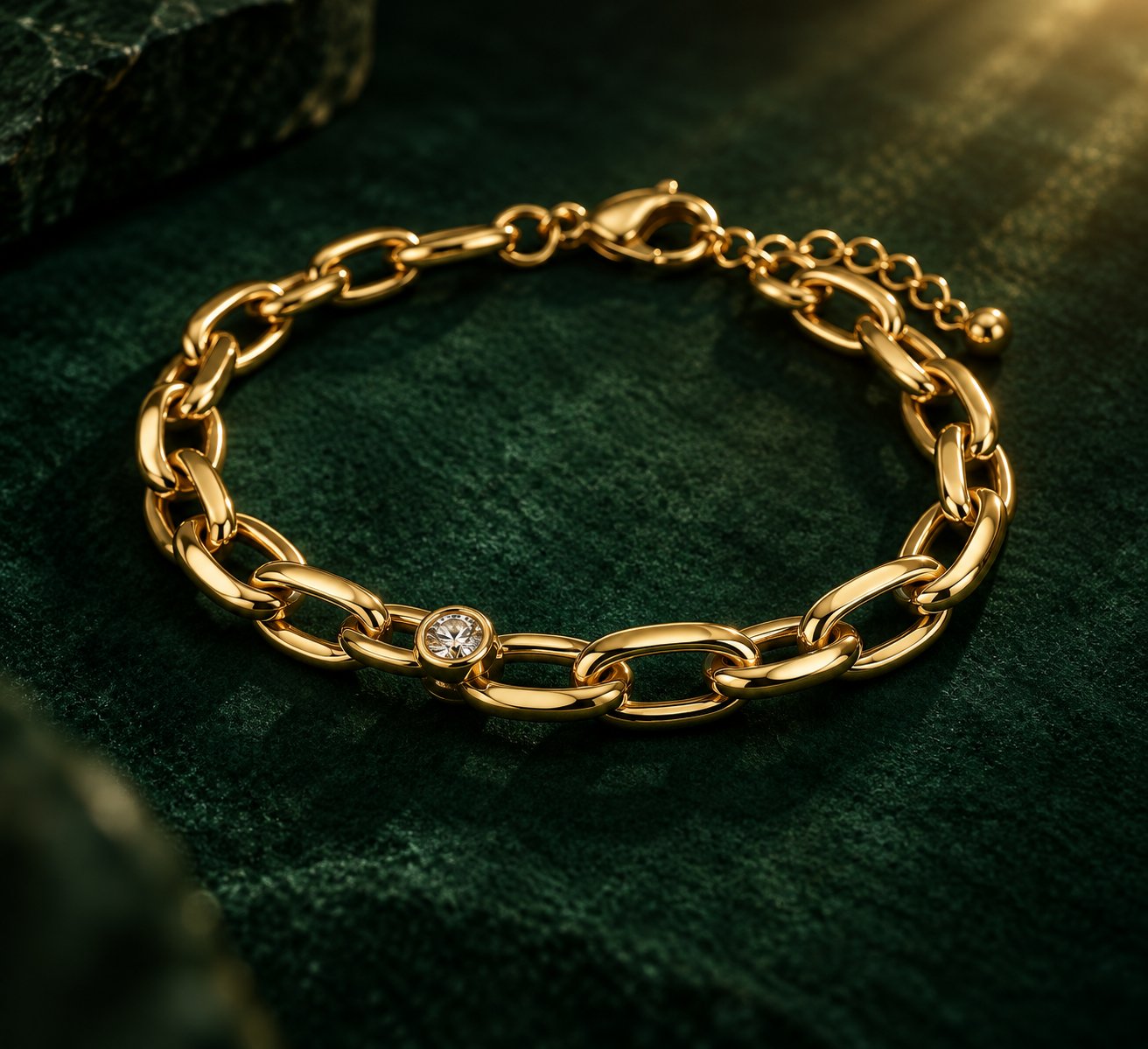
A crystal bracelet line is built from three decisions that get locked in before production: stone, setting, and clasp. Catalog photos compress those decisions into one attractive image, which is why buyers who order from photos alone often reject the first production run. Ask for the reference SKU and its specification instead. For example, the Aurevo gemstone bracelet (SKU AJB-5002) is gold-tone plated alloy with faceted green gemstones in prong settings, polished gold-tone links, and a lobster clasp, MOQ 100 pieces, 12-month warranty. A second, lighter reference, the Aurevo gold-tone bracelet (SKU AJW-5001), uses cubic zirconia accents with even spacing and secure prongs, same gold-tone alloy and lobster clasp, MOQ 200 pieces, 12-month warranty.
Those two SKUs bracket the design space well: one is a heavier gemstone row in prong settings, the other a spaced stone accent pattern. Reading your own target order against them tells you quickly which decisions you're actually making.
Stone Type and Cut: Faceted Versus Smooth
The first split is faceted versus smooth stones, and it decides how the bracelet behaves under light more than any other choice.
- Faceted stones break light into small, high-contrast points. They carry a formal, dress-jewelry read and look sharp in product photography, especially against gold-tone metal. SKU AJB-5002 uses faceted green gemstones for exactly this effect.
- Smooth, rounded beads give a softer, more casual surface. They photograph less dramatically but read as everyday wear and sit comfortably against the wrist.
For cubic zirconia accents, faceting is the default appearance buyers expect, which is why CZ is usually specified as a faceted stone rather than a smooth one. The practical question for a buyer is not which is better but which one your market buys: dress-oriented buyers lean faceted, daily-wear buyers lean smooth or spaced.
Color is the other half of the stone decision. On the gemstone bracelet, the gemstone color is customizable, which means the stone plan is a specification input you provide, not a fixed attribute. Bring the target color reference — a physical swatch or a Pantone-style reference — to the sampling stage rather than describing it in words.
Setting Type: Prong Versus Glued
After the stone, the setting determines whether the bracelet survives normal wear. Two constructions dominate stone-set bracelets.
Prong settings
A prong setting mechanically holds the stone with metal claws. It is the construction used on both reference SKUs: AJB-5002 sets its faceted green gemstones in prongs, and AJW-5001 sets its cubic zirconia accents in secure prongs with even spacing. Prong setting is what lets a buyer specify a stone and expect it to stay in place through repeated clasping and daily movement. It is also what makes the bracelet readable under inspection — a prong that is malformed or unevenly seated is visible immediately.
Glued settings
Adhesive-set stones rely on a bond rather than mechanical retention. They can be appropriate for very small accent stones or lightweight decorative pieces, but the buyer trade-off is real: glued stones add a failure mode that prong settings do not have. If a sample arrives with glued stones and you expected prongs, that is a specification mismatch, not a cosmetic difference. Confirm the setting type in writing on the order specification.
What we check on settings
Across more than 40 QC workstations and a six-step jewelry inspection, setting integrity is checked as its own step — not folded into a general visual pass. For a prong-set bracelet, the inspection looks at whether each stone sits at a consistent height and whether prongs are evenly formed along the whole row. Buyers can run the same check with a loupe on the sample.
Plating Tone Consistency Across a Batch
Gold-tone consistency is the criterion buyers notice last and complain about first. Two bracelets can each pass as "gold-tone" in isolation yet look mismatched when placed side by side in the same retail display.
Plating finish is a dedicated inspection step in our six-step jewelry inspection. What matters for your order is how that check applies at batch level:
- Tone, not just color family. Ask for confirmation that the plating tone is uniform across the batch, not simply that every unit is gold-tone.
- Link and stone contrast. On a design like AJB-5002, polished gold-tone links surround faceted green stones. The link finish and the stone setting must be judged together, because a link that reads slightly brassy next to a cool green stone changes the whole product.
- Sample-to-batch continuity. The tone you approve on the sample is the tone production should match. If a second reference SKU is part of the same line, keep the approved samples on hand for the production comparison.
This is where a pre-shipment inspection earns its cost. Comparing ten finished pieces from the batch against the approved sample catches tone drift before the shipment leaves.
Clasp Choice and Function
Both reference SKUs use a lobster clasp, and there is a straightforward reason to start there: a lobster clasp is a positive-locking closure that resists accidental opening better than a simple spring ring or a hook. For a stone-set bracelet with any weight to it, that matters.
Clasp selection should follow four questions:
- Does the clasp match the weight of the piece? A dense gemstone row puts more tension on the closure than a spaced CZ accent pattern.
- Is the clasp size proportional to the chain or link? An undersized clasp is a handling complaint; an oversized one unbalances the design.
- Does it open and close cleanly? Clasp function is an inspection item in its own right — we check that it latches, holds, and releases without binding.
- Is the finish consistent with the rest of the bracelet? The clasp is a plated component too, so it falls under the same tone check.
If your market expects a different closure type, raise it at the specification stage. Clasp function is also listed as a distinct inspection step, which means a change of clasp type changes what the inspector verifies.
Sizing, Length and Packaging Confirmation
Length and packaging are not design details — they are order terms, and they are confirmed per order rather than assumed from a catalog. Two bracelets labeled "7 inch" from different suppliers can still differ at the wrist, and packaging that fits a loose-bead sample may not fit a boxed set with a stone row.
Before sampling, confirm:
- Exact length. State the finished length, not a size label. Because length is confirmed per order, the specification you submit is what gets made.
- Packaging format. Poly bag, pouch, or gift box; with or without a branded insert. Packaging is confirmed per order as well, so it belongs in the same specification document as the stone and clasp.
- Quantity and MOQ alignment. MOQ differs by SKU — 100 pieces for AJB-5002, 200 pieces for AJW-5001 — so a mixed order needs its quantities broken out per SKU.
- Lead time planning. Sample lead time for AJB-5002 runs 7–15 working days, and production runs 20–40 working days. Build both into your launch calendar before the sample is approved.
The Five-Row Selection Checklist
Use this table on the sample bench. Each row is a decision you either confirm or send back before production.
| Checkpoint | What to confirm on the sample | Reference |
|---|---|---|
| Stone type and cut | Faceted or smooth; target color verified against a physical swatch | AJB-5002: faceted green gemstones, color customizable |
| Setting type | Prong or glued, stated in writing; stones seated at even height with consistent prong formation | AJB-5002 and AJW-5001 both prong-set |
| Plating tone | Tone uniform across the sample set, not just within the gold-tone family | Gold-tone alloy on both SKUs; plating finish is a dedicated inspection step |
| Clasp | Type, proportional size, clean latch and release, tone matched to the piece | Lobster clasp on both SKUs |
| Sizing and packaging | Exact length stated numerically; packaging format and branded insert confirmed | Length and packaging confirmed per order |
What a Manufacturer's Inspection Adds to Your Checklist
Your sample review is one check at one point in time. Production inspection is what keeps the decision stable across a batch. Shenzhen production since 2012, with 18,000+ m² of facility, 16 production lines, and more than 40 QC workstations, means the setting, finish, clasp, and assembly checks happen as discrete steps rather than as one general look.
For a stone-set bracelet, that structure is the relevant point: the four things most likely to fail — plating finish, gemstone setting, clasp function, and assembly — each have an assigned inspection step. When you evaluate any supplier for a crystal bracelet wholesale program, ask which of those four gets a separate check, and ask for the sample-to-batch comparison to happen before shipment.
FAQ
What is the minimum order quantity for a stone-set crystal bracelet?
It depends on the design. Our gemstone bracelet AJB-5002 starts at MOQ 100 pieces; the gold-tone CZ bracelet AJW-5001 starts at 200 pieces. For a mixed line, break out quantities per SKU.
Can the gemstone color be customized?
Yes — gemstone color is customizable on AJB-5002. Provide a physical color reference so the sample can be matched against it rather than against a verbal description.
How long does sampling and production take?
For AJB-5002, sample lead time is 7–15 working days and production is 20–40 working days. Plan both stages into your launch date, and allow time to review the sample before production is released.
What warranty applies?
Both reference SKUs carry a 12-month warranty.
Are length and packaging fixed?
No. Exact length and packaging are confirmed per order, which is why both belong on the specification you submit before sampling.
Next Step
To move from checklist to sample, send three things: your target quantity, your market, and your stone preference. With those, we can confirm the specification — stone and cut, setting type, plating tone, clasp, exact length, and packaging — before sampling begins.
- Target quantity per design or SKU
- Market, so the stone and clasp choices fit the buying context
- Stone preference, including faceted or smooth and the color reference