How Do You Choose a Custom Watch Manufacturer for Your Logo Watch Program?
2026. 10. 9.
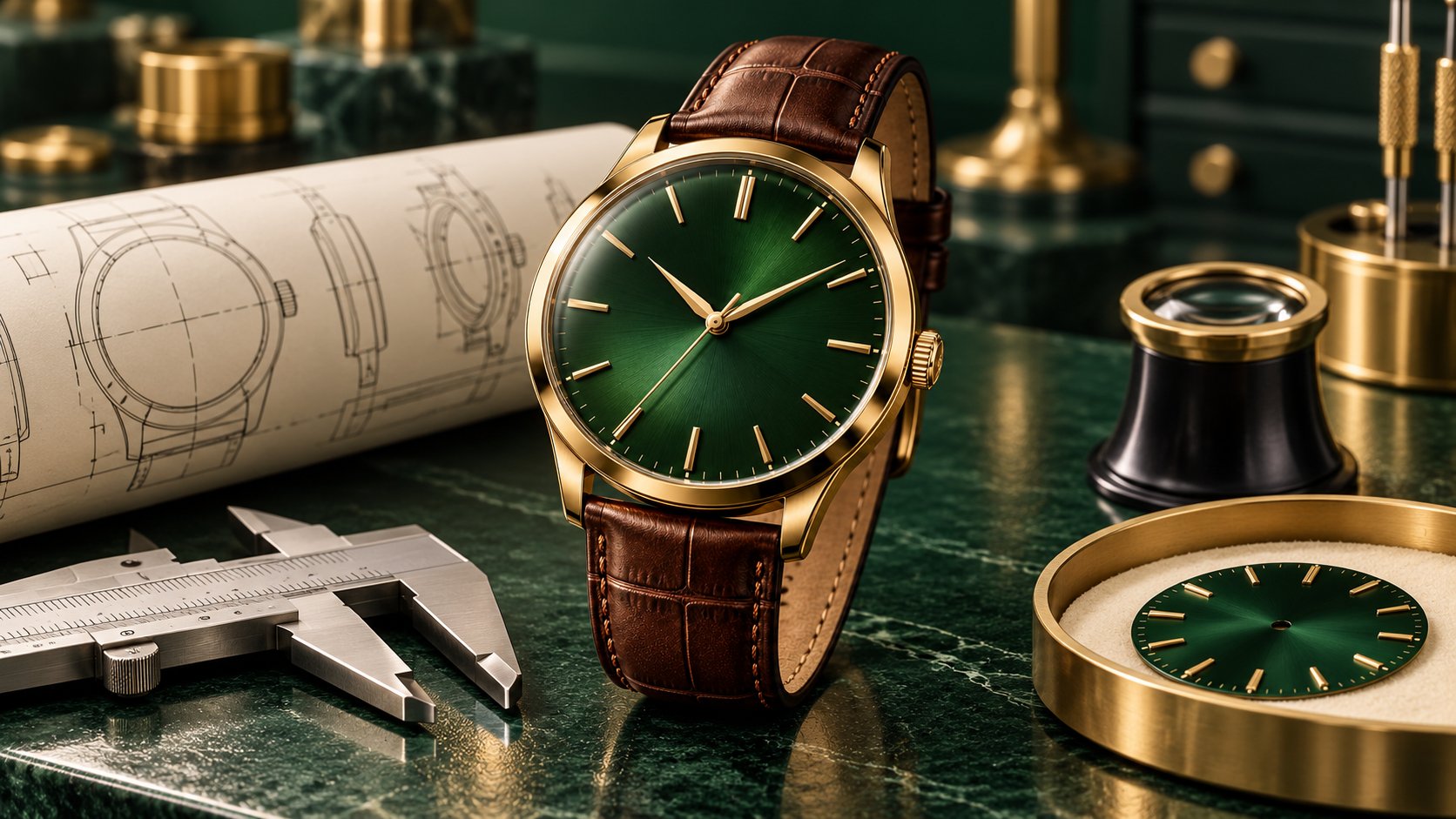
How do you choose a custom watch manufacturer for your logo watch program? Most buyers begin with a list of suppliers. The buyers whose programmes ship on time begin with two documents instead: a written brief that describes the watch they intend to sell, and a capability audit that proves the factory can actually build it. Everything else follows from those two things. A logo watch programme is not a product purchase. It is a small manufacturing project with your brand name printed on the most visible square centimetre of the finished goods, and the factory you choose decides how that square centimetre looks at unit one, unit three hundred and unit three thousand.
This guide is written for brand owners, retailers, distributors, importers and e-commerce sellers sourcing watches to carry their own logo. It covers what a custom watch manufacturer is genuinely being asked to deliver, how to read capability evidence instead of catalogue photography, how dial logo feasibility is really assessed, and how a custom order travels from drawing to mass production with the sign-off points that keep the programme under your control.
Two framing notes. First, every production parameter quoted here — order minimums, sampling windows, production windows, payment structure, inspection capacity and warranty length — comes from the working OEM and ODM programme of Aurevo, a Shenzhen watch and jewellery manufacturer, so you can see how the principles map onto real numbers rather than theory. Second, this article deliberately does not repeat the pricing walkthrough, the general wholesale supplier checklist or the OEM versus ODM comparison that already exist elsewhere on this site. The focus is narrow and practical: capability audit and order execution.
What a Custom Watch Manufacturer Is Actually Being Asked to Do
The phrase custom watch manufacturer covers a wide range of businesses. At one end sits a trading company that owns a catalogue, takes your logo request, forwards it to a factory it does not control, and adds a margin. At the other end sits a manufacturer that owns assembly lines, buys movements on standing contracts, controls plating and dial work through its own floor or a controlled supply chain, inspects in house, and ships under its own export documentation. Both will quote you a logo watch. Only one can be held to a schedule, a sample and an inspection standard.
The difference matters in a logo programme because your brand carries the result. If plating fades on unit eight hundred of a three thousand piece run, your customer does not contact a factory in Shenzhen. They contact you. So the question you are really asking when you evaluate a custom watch manufacturer is not can you make a watch, but can you make the same watch, to the same standard, at the volume I need, and prove it before the balance payment falls due.
That question breaks down into a short list of capabilities you should be able to verify directly.
- Owned production, or controlled production with named partners. Ask which steps happen on the manufacturer own floor: case finishing, dial printing or logo application, assembly, timekeeping checks, water resistance tests, packing. Aurevo, for reference, runs watch production across multiple assembly and inspection stages with capacity above 200,000 units per month, inside an 18,000 square metre facility with 16 production lines.
- Component sourcing depth. A manufacturer that buys movements, cases, dials, hands, glass and straps on standing contracts can hold a production schedule. One that buys per order can slip for reasons that have nothing to do with your project.
- Dial and logo capability. This is the most programme specific capability of all, and it deserves a dedicated feasibility conversation rather than a yes on a quotation form.
- In house or contractually controlled inspection. Ask how many inspection points exist and whether records are kept per batch. Aurevo operates more than 40 quality control stations and applies a six step watch inspection process across production.
- Export and documentation routine. A manufacturer serving many markets treats commercial invoices, packing lists, bills of lading, certificates of origin and, where applicable, material test reports as routine work. Aurevo supports orders across 65 plus export markets with a team of more than 220 employees, which is the kind of volume that turns documentation from a favour into a process.
- Capacity to absorb your reorder. The second order is the real test. Ask what share of monthly capacity a single programme of your size would consume.
None of this can be confirmed from a website, and all of it can be confirmed in a forty five minute video call with the production manager plus one sample.
Why the Manufacturer, Not the Middleman, Sets Your Ceiling
Every commercial term in a logo watch programme traces back to the factory process. Sampling windows, minimum quantities, plating options, dial printing colours, packaging development and inspection depth are engineering realities before they are commercial ones. If you negotiate with an intermediary, you are negotiating over a process you cannot see, and the concessions you win may simply be absorbed by removing something invisible: a plating step, an inspection point, a batch of movements. Working directly with the manufacturer shortens the distance between the decision and the physical result.
The Three Questions That Separate Manufacturers From Resellers
Ask these before you ask about price. First, which steps of my watch do you perform in your own facility, and which do you subcontract? Second, how many production lines do you run, how many people work on the floor, and what is your monthly output? Third, can you show me an inspection record for a recent batch of a comparable model? A manufacturer answers with numbers, floor layouts and documents. A reseller answers with adjectives.
Write the Logo Watch Brief Before You Shortlist Any Factory
Buyers routinely shortlist three factories and then discover, three weeks later, that the three quotations are not comparable. The cause is almost always the same: there was no brief. A quotation is only as precise as the request behind it, and no amount of supplier comparison can repair a vague specification.
A usable logo watch brief fits on one page and answers a fixed set of questions. Write it once, then send the identical version to every factory you approach. That single discipline is what makes the answers comparable.
The Decisions That Belong in Your Brief
- Model basis. Are you customising an existing, already engineered platform, or commissioning a new design? Be explicit about which. Customising a proven model such as the Aurevo Custom Logo Men's Watch means the case, dial and strap geometry are already validated and the programme only has to absorb your logo and colour choices. A new design opens the door to new tooling and a longer sampling cycle.
- Logo treatment. Where does the logo go — dial, caseback, crown, buckle, strap or packaging — and by what method? You may not know the answer yet, and that is fine. Stating a preference forces the technical conversation early, which is exactly where it belongs.
- Colour control. Dial colour is the most brand sensitive and least forgiving variable in the whole product. State whether you need a match to a specific reference colour or will accept the nearest standard from the manufacturer range.
- Quantities. Give your first order quantity and your realistic annual volume separately. Factories plan differently for a one off run and for a programme they expect to repeat.
- Packaging. Bulk packing, individual boxes, branded gift boxes, instruction cards, barcodes — each adds a development step, and packaging is the classic late surprise in a custom programme.
- Target market and destination. This drives documentation and, in some cases, testing requirements. Say where the goods will be sold, not only where they will land.
- Commercial expectations. The payment structure you can work with, your preferred Incoterms, and the date by which you need goods in your warehouse.
What a Good Brief Changes About the Answers You Get
A precise brief does three things. It makes quotations comparable, because each factory is pricing the same specification. It surfaces feasibility problems early, so a manufacturer can tell you in one reply that your requested dial treatment needs a longer setup rather than three weeks later after sampling has begun. And it sets the reference point for every later conversation: when the first sample arrives, you are checking it against a document you both agreed, not against a memory of an email.
One further practical point: attach your logo file. Vector artwork in AI, EPS, PDF or SVG format is what a dial printer needs. A low resolution PNG cannot become a print plate without being redrawn, and redrawing is where logo shapes quietly change. If your brand standards allow it, also send a simplified version of the logo for the dial, in case the factory advises that the full detail version will not print cleanly at the dial size.
How to Read Capability Evidence Instead of Catalogue Photography
Every manufacturer has beautiful photographs. Fewer have answers. The skill in an audit is to ask questions whose answers cannot be generated by a marketing department, and to check the numbers you receive for internal consistency.
The Numbers That Actually Mean Something
Manufacturing capacity arrives in a handful of countable figures: number of production lines, floor area, headcount, monthly unit output, annual output, and the number of export markets served. Aurevo, for reference, states 16 production lines inside an 18,000 square metre facility, more than 220 employees, capacity above 200,000 watch units per month, output of 375,000 plus pieces per month, 4.5 million plus pieces per year, and orders shipped to more than 65 markets. Treat those as a starting point rather than a conclusion. The purpose of asking is not to collect impressive numbers but to see whether they reconcile with each other and whether the person answering knows them without checking.
Do two calculations yourself. Divide monthly output by the number of lines: does the implied throughput per line make sense for the product type? Divide headcount into output: is the labour content plausible for a watch? When figures are inflated for effect, the ratios usually expose it, and a manufacturer that cannot explain its own capacity is a manufacturer that will struggle to explain your production schedule.
Questions That Force Specifics
- Walk me through what happens to my watch between final assembly and packing.
- How many units per batch do you check, and where do the inspection records live?
- What percentage of last quarter shipments were delayed, and why?
- Which component suppliers do you use, and how many of them are single source?
- What is the largest single programme you have run this year, in units?
- If my dial colour needs to be matched to a reference, who signs off the match?
- Who is my contact, and how are escalation decisions made when something goes wrong?
The last question matters more than buyers expect. A manufacturer that routes every message through a shared inbox, or where nobody owns your project, will struggle with a custom programme, because custom programmes are decision heavy. Aurevo assigns a dedicated sales engineer per account, with order status updates at production milestones and responses within 24 hours on working days. That structure exists precisely because design, sampling and inspection decisions cannot wait in a general queue.
The Four Capability Zones to Audit Separately
Custom watch production is not one capability. It is four, and they fail independently. Audit them one at a time, and ask for evidence in each.
Zone One: Case, Metalwork and Finishing
The case is where material declarations live and where visible quality is decided: stamping or machining, brushing and polishing, drilling, plating, and the assembly of crown and caseback. If your programme involves gold tone finishing, this zone determines how the finish behaves over time. Ask what the plating specification is, whether plating is done in house or by a partner, how thickness is controlled, and what routine testing the supplier performs on its own initiative. On the Aurevo Custom Logo Men's Watch, the case is 316L stainless steel with a gold tone plated finish at 40 millimetres diameter, which is the industry standard material choice for a platform intended to carry a logo. The same manufacturer group also operates a jewellery production area covering casting, CNC processing, stone setting, polishing, plating, engraving and final finishing, which matters to buyers whose brand sells more than one category.
Zone Two: Dial Printing and Logo Application
This is the zone that decides whether your logo actually looks like your logo, and it is covered in detail in the next section. For audit purposes, ask what methods are available, what artwork formats are required, how colour is controlled, and what the reject rate is on dial printing. A factory that prints dials as routine work will have precise answers about colour matching and print registration. One that quietly outsources will not.
Zone Three: Assembly and Movement Installation
Assembly covers movement installation, hand setting, dial and case fitting, gasket and caseback closing, and, for mechanical movements, hand assembly and regulation. If your programme uses quartz movements, the risk profile is lower but not zero: battery type, hand alignment and dust control all show up in the finished product. Ask how movements are received and tested before installation, and whether timekeeping is verified after assembly or only at final inspection. The capability evidence you are looking for is a dedicated assembly stage with defined inspection points, not a bench count.
Zone Four: Inspection, Packing and Export
The last zone is where custom programmes most often disappoint, because it is where the manufacturer standard and the buyer expectation meet. Ask what is inspected, by whom, against what criteria, and what documentation you receive. Ask how packing is specified: bulk packing versus individual presentation boxes, protection for leather straps and plated surfaces, and carton marks. Ask what export documents accompany the shipment and what additional certificates are available on request. At Aurevo, standard export packing combines an individual poly bag or bubble wrap with an inner box and a master carton; custom gift boxes, logo printing, instruction cards and barcodes are available to buyer requirements; carton marks and shipping marks are confirmed before dispatch; and each shipment is accompanied by a commercial invoice, packing list, bill of lading or airway bill, and certificate of origin, with further certificates such as material test reports arranged on request where applicable.
Dial Logo Feasibility: The Test Most Logo Watch Programmes Fail
More logo watch programmes are delayed at the dial than at any other stage, and the cause is nearly always a mismatch between what the brand designed and what a dial can physically carry at a given volume. Treat feasibility as a technical conversation rather than an aesthetic one, and it stops being a risk.
What to Send the Factory for a Feasibility Answer
- Vector logo artwork, plus a written note stating which file version is authoritative.
- The intended logo position on the dial and its approximate size in millimetres.
- A colour reference for the logo and, if relevant, for the dial background.
- The dial finish you want: flat, sunray, textured, or an existing configuration from the manufacturer range.
- Your quantity, because the method that makes sense at one volume may not at another.
- Whether the logo must survive water exposure, sit under a domed crystal, or remain legible in low light.
A competent manufacturer replies with the methods available, the ones it recommends for your volume, any artwork changes needed, and the questions still outstanding. That reply is itself a useful audit artefact: it shows whether dial work is a routine capability or an improvisation being worked out on your project.
Matching the Method to the Volume and Effect You Need
Dial logo work falls into a few practical families. Printing the logo directly onto the dial, with pad printing as the common method, is the standard approach for logo programmes at wholesale volumes: it handles most logos repeatably and sits comfortably alongside an already engineered dial. Applying a separately manufactured metal badge produces a more premium three dimensional effect and suits higher retail price points, but it introduces a custom component with its own minimum and lead time. Engraving is typically reserved for metal surfaces such as the caseback, where durability matters more than colour. Beyond the logo itself, any change to the dial background — a bespoke colour matched to your brand — introduces a new print setup, which is a feasibility and timing question rather than a decorative one.
The practical advice for brand owners is simple. If your logo has many fine colours, ask the factory whether a simplified version for the dial would print more cleanly and consistently; this is one of the few places where a small design compromise buys a materially more reliable product. If you need an exact brand colour, ask for a physical colour match on a dial sample — not a screen rendering — before the mass production order is placed.
From Drawing to Mass Production: The Order Path, Stage by Stage
A well run custom watch order follows a sequence, and each stage should produce a document you keep. The sequence below is the working flow of Aurevo project orders: inquiry, quotation, sample confirmation, proforma invoice and deposit, mass production, final inspection, balance payment and shipment. Here is what each stage should give you, and what to watch at each one.
Read the whole path before you start. Buyers who understand stages four to eight before they begin sampling negotiate differently at stage two. The order process is a chain of approvals, and each approval either narrows or widens your room to correct course.
Stage One: Inquiry and Requirement Clarification
You send the brief; the manufacturer returns questions. Judge this stage on the quality of those questions. A factory that asks about dial colour reference, packaging, destination market and logo placement in the first exchange is telling you it has run this process before. One that replies with a catalogue and a price list has not.
Stage Two: Quotation and Its Validity Window
The quotation should itemise what is included: unit price basis, logo treatment, dial specification, strap, case finishing, packing, and the period for which the price holds. Aurevo quotations are valid for 30 days, which is a normal and reasonable window, because component prices move and a quotation with no expiry is not a commitment. Read the quotation as a specification document first and a price document second. If the specification is vague, the price is not enforceable.
Stage Three: Tooling, Fixtures and Process Confirmation
If your design can be produced from existing tooling, this stage is short. If it needs new tooling — a new case shape, a custom crown, a special caseback, a bespoke packaging insert — expect a separate tooling line and a discussion of ownership and refund terms. Ask what the tooling actually consists of, who holds it, and what happens to it if you later move production. In custom programmes at Aurevo, tooling fees are payable in advance and refundable for qualifying volume orders, which is the pattern worth looking for: the manufacturer shares part of the volume risk with you.
Stage Four: Sampling and Sample Approval
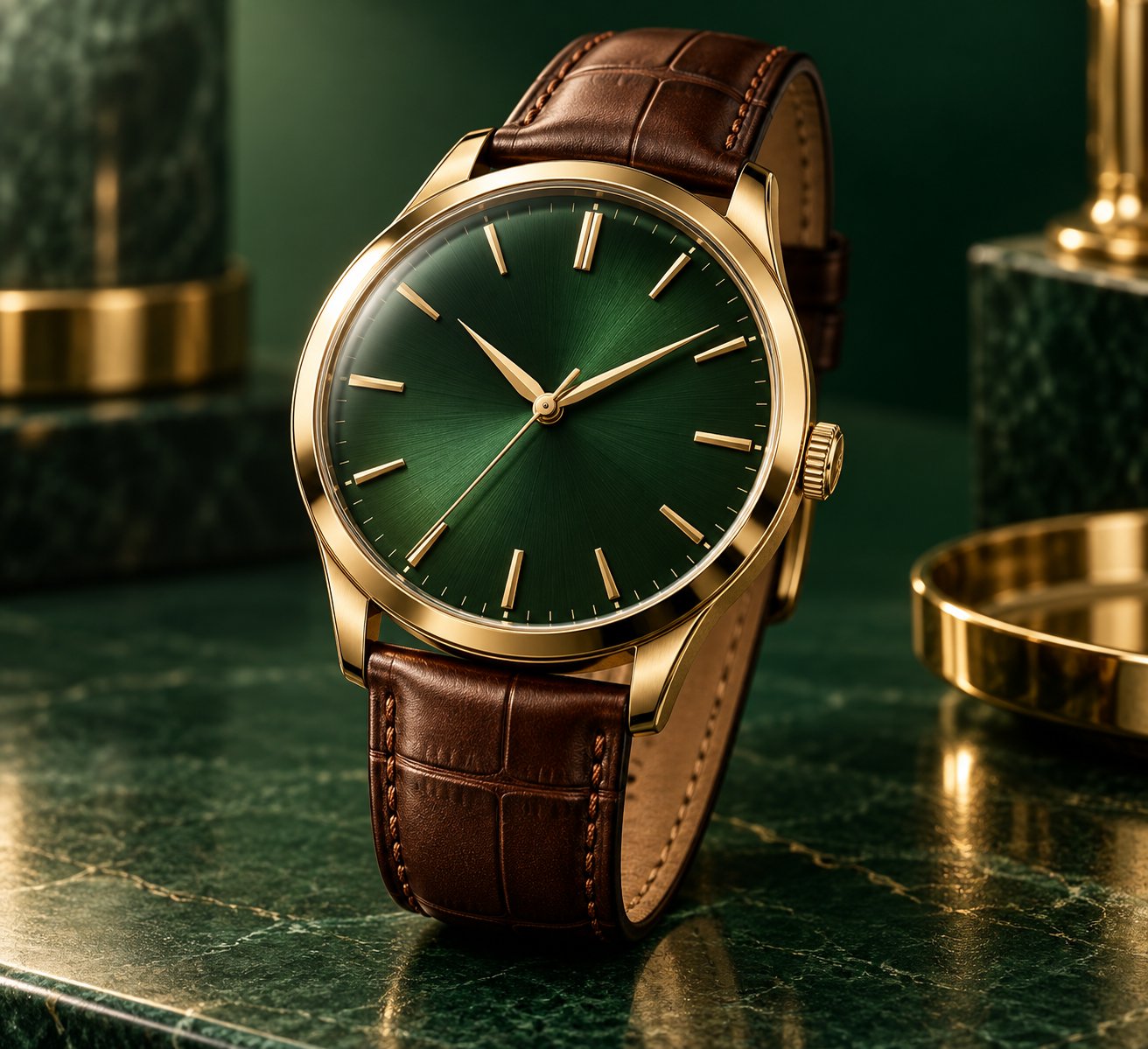
Sampling is where a project becomes a product. The sample should be built to your full specification — logo, dial colour, finishing, strap and, where practical, packaging — because the sample you approve becomes the reference for everything that follows. Sampling at Aurevo runs 7 to 15 working days. Two rules make this stage work. Approve against the written brief rather than a general impression, and approve in writing, with photographs of the accepted sample filed alongside the brief, so that correct has one shared definition.
Stage Five: Proforma Invoice and Deposit
Once the sample is approved, the proforma invoice fixes the commercial terms: specification, quantity, unit price, tooling, packing, inspection standard, delivery terms, lead time and payment schedule. Read it line by line, because this document, not the earlier quotation, governs the order. The standard Aurevo structure is a 30 percent deposit by T/T before production with the 70 percent balance before shipment, and letters of credit at sight are accepted for orders above USD 50,000.
Stage Six: Mass Production
Mass production at Aurevo runs 20 to 40 working days depending on quantity and the level of customisation. During this stage, ask for the milestone updates your manufacturer has promised — material received, production started, assembly under way, inspection scheduled — and actually use them. A programme with no visibility during production has no early warning system, and early warning is the entire value of the stage. If your order is seasonal, work backwards from your in store date and build a buffer for inspection and shipping, not only for production.
Stage Seven: Final Inspection and Pre-Shipment Confirmation
Before shipment, the production batch should pass final inspection against the approved standard, and you should receive evidence. Photographs and videos supplied for confirmation before dispatch are standard practice at Aurevo. Ask what the inspection covers, what the defect rate target is, and how it is recorded. Defect rate targets are agreed in the proforma invoice and the AQL level is confirmed per order. On larger programmes or where your brand is exposed, arrange third party inspection: Aurevo welcomes SGS, BV or TUV inspection at the buyer cost, which is the correct posture, because a manufacturer that resists third party inspection is telling you something.
Stage Eight: Balance Payment and Shipment
The balance falls due before shipment under a 30 70 structure. This is the point at which every earlier control either protects you or does not, because your remaining leverage drops sharply once goods are on the water. Choose Incoterms deliberately: EXW, FOB Shenzhen, CIF and DAP are all workable and are confirmed per order, and each distributes cost and risk differently. Express carriers handle samples and urgent small orders in 3 to 7 transit days, air freight suits mid size orders, and sea freight in FCL or LCL takes 15 to 35 days depending on destination and suits bulk. Buyer nominated forwarders are supported, which matters if you already have a logistics relationship you want to keep using.
The Sign-Off Points Where Buyers Lose Control of a Custom Order
Studying failed custom programmes, the same pattern recurs: the buyer stayed engaged through sampling and then went quiet. Control in a custom order is not maintained by being present. It is maintained by requiring a specific artefact at each transition, and there are seven of them.
- An agreed written brief, sent before the first quotation is requested.
- A quotation that itemises specification rather than only price, with a validity window.
- A tooling decision in writing, including ownership and refund conditions.
- A physical sample approved in writing, with photographs kept on file.
- A proforma invoice that names the inspection standard, packing specification, Incoterms and payment schedule.
- Production milestone updates at agreed intervals, with the right to ask questions and get dated answers.
- Pre-shipment evidence — photographs, videos and inspection records — before the balance is released.
If a manufacturer resists any of these, treat the resistance as information rather than as an obstacle to work around. Programmes do not fail because buyers asked for too much documentation. They fail because both parties assumed the other would remember the same thing.
Sampling Discipline: What a Pre-Production Sample Must Prove
A pre-production sample is not a photograph opportunity. It is a physical test of five things, and each one should be checked deliberately rather than glanced at.
- Logo fidelity. Compare the printed or applied logo against your artwork at actual scale, in daylight and under indoor light. Check edge definition, colour density and centring on both the dial and, where present, the caseback.
- Colour match. If you specified a dial colour, check the physical dial against your reference — not against a screen, and not against a different model dial in the same room.
- Finish and material feel. Inspect plating, brushing, polishing, plated edges and strap stitching. Run a fingernail along case edges to feel for burrs that photographs cannot show.
- Function. Check timekeeping over several days, crown action, hand alignment, strap and buckle operation, and water resistance appropriate to the specification.
- Packaging, where it is included. Confirm box construction, insert fit, printing and labels, because packaging comes through a different supply chain and fails independently of the watch.
Then treat the approved sample as a document. Keep one unit sealed and labelled as the golden sample, and reference it in the proforma invoice. When the production batch arrives, the question does this match the sample becomes answerable rather than arguable, and that distinction is worth more than any discount you might negotiate.
On the commercial mechanics: sampling carries a fee, and the sample is prepared specifically for your approval. Ask how the fee is handled in your case, because policies vary by manufacturer and order size, and ask what the sample includes before you approve it, so that you are not approving a simplified version of the product you intend to sell.
Keeping Mass Production Aligned With the Approved Sample
Consistency between the sample you approved and the batch you receive is the core quality question in any custom programme. In practice it is managed by agreeing inspection nodes in writing before production starts rather than by hoping the factory remembers.
The Nodes to Agree Before Production Begins
- Incoming material and component checks. Does the batch of dials, straps or movements match the specification the sample was built from?
- In-line inspection during production, so that drift is caught while the batch is still in progress and correctable.
- Final random inspection before packing, against the approved sample and agreed accept criteria.
- Pre-shipment confirmation, with photographic and video evidence sent to you for approval.
- Record keeping, so that a question about a specific batch can still be answered months later.
Aurevo production runs in line inspection during production plus final random inspection before shipment, supported by more than 40 in house quality control stations, with third party inspection by SGS, BV or TUV welcomed at the buyer cost. Defect rate targets are agreed in the proforma invoice and the AQL level is confirmed per order. Whatever the numbers in your own programme, insist that they appear in the order documents rather than in a conversation.

What Consistent Should Mean in Your Programme
Consistency is not zero defects. It is a defined standard that the batch demonstrably meets. Write your standard in terms a factory can inspect: logo placement within a stated tolerance, dial colour matched to the approved sample, plating free of visible defects at normal viewing distance, timekeeping within the stated range, strap and buckle function correct, and packing matching the approved specification. Vague standards produce vague inspection and expensive arguments.
Custom Minimums and Lead Time: Planning a Launch on Real Numbers
Custom programmes have minimums and lead times for structural reasons, and the sensible approach is to treat them as planning inputs rather than as negotiating positions. What you control is how you phase your launch around them.
How Customisation Depth Moves the Minimum
In a typical programme the minimum scales with how far you move from an already engineered platform. Aurevo order structure is 100 pieces for standard watches, 300 pieces for custom watches and 200 pieces for custom jewellery. The pattern is the one to look for anywhere: a stock platform carrying your logo has the lowest minimum because almost nothing new has to be set up, while a fully custom configuration has a higher one because components, tooling and line setup have to be justified by volume. For a fuller treatment of the mechanics, see the existing guide on how minimum order quantity works when you buy wholesale watches and jewellery.
For a launch, this suggests a two step strategy. If your brand is new to watches, consider proving demand on an existing platform carrying your logo, and reserving a fully custom configuration for the second or third order, when you have real sell through data to justify it. If you already know your volumes, go custom from the start and treat the higher minimum as the cost of differentiation.
Building a Lead Time That Survives Reality
Production lead time is only part of the calendar. Aurevo figures give a workable model: sampling of 7 to 15 working days, mass production of 20 to 40 working days depending on quantity and customisation, express transit of 3 to 7 days for samples, sea freight of 15 to 35 days for bulk, and a quotation validity of 30 days. Build your calendar backwards from the date goods must be in market: sampling, sample approval and any revision, production, final inspection, pre-shipment confirmation, shipment, customs clearance, then your own inbound handling and listing time. Buyers who slip are almost always buyers who counted only the production window.
Two buffers earn their keep. Allow at least one revision cycle in sampling, because first samples sometimes need adjustment and a plan with a single sample round has no room for learning. And allow for the seasonal peak, when every buyer and every supplier is competing for the same capacity; in the weeks before major retail periods, the export calendar rather than the factory calendar becomes the binding constraint.
The Paperwork That Proves a Programme Is Under Control
Custom programmes are paper heavy, and the paperwork is not bureaucracy. It is the mechanism by which decisions become enforceable. A manufacturer with genuine process maturity produces documents without being chased for them.
At quotation stage you should receive an itemised specification with a validity period. At tooling stage, a written statement of what the tooling comprises, who owns it, and under what conditions the fee is refundable. At sampling stage, a sample approval record referencing your brief and your artwork. At order stage, a proforma invoice setting out specification, quantity, price basis, packing, inspection standard, Incoterms, lead time and payment schedule. During production, milestone updates at agreed intervals. Before shipment, inspection evidence and photographic or video confirmation. With the shipment, the commercial invoice, packing list, bill of lading or airway bill and certificate of origin, with further certificates such as material test reports arranged on request where applicable.
Read that list as a maturity test rather than as administration. It is also a practical way to compare two manufacturers whose quoted unit prices sit close together: the one whose paperwork is complete is usually the one whose production is controlled, and that difference tends to surface in your return rate rather than on your invoice.
Warranty and After-Sales Terms in a Custom Programme
Warranty matters differently in a custom programme than in a stock purchase, because the product carries your brand and your customer expectation is set by your marketing rather than by the factory. Aurevo applies a 12 month warranty across its product range, including custom logo watch programmes, which gives you a defined period on which to build your own customer facing promise. For the broader picture of what buyers should expect from wholesale warranty terms, see the existing guide on what warranty to expect when buying wholesale watches and jewellery.
Three things are worth confirming in writing alongside the warranty period. First, how claims are raised: Aurevo policy allows quality claims within 30 days of receipt supported by photographs and batch numbers, with verified defects compensated by replacement in the next order, a discount, or a refund of the affected value. Second, what spare parts come with the order, since straps, buckles, batteries and clasps are supplied for after sales service, which lowers the cost of handling individual customer issues. Third, who bears the cost of inspection disputes, given that third party inspection is welcomed at the buyer cost. Knowing those boundaries before you order is what allows you to price and word your own warranty commitment confidently.
Red Flags in a Logo Watch Programme, and How to Test Them
Most problems in custom watch sourcing are detectable before money changes hands, provided you know what you are testing for. These are the signals worth acting on, and each comes with a low cost way to check it.
- Numbers that do not survive arithmetic. If capacity claims do not reconcile with line counts or headcount, ask for the underlying figures. A manufacturer should be able to explain output in terms of lines, shifts and product types.
- Vague answers on dial work. If the answer to how will you apply my logo is a method name with no discussion of artwork, colour control and reject rate, escalate the question to whoever actually runs the dial process.
- Reluctance to sample to full specification. A sample that omits your logo, dial colour or packaging has not tested your project, only the factory generic capability.
- No written inspection criteria. If defect targets and accept criteria cannot be stated in the proforma invoice, they cannot be enforced after shipment.
- Resistance to third party inspection. Welcoming inspection at the buyer cost is the normal posture. Resistance is a warning worth taking seriously.
- Silence during production. Milestone updates are how you discover a slip while you can still react, and their absence usually predicts a surprise later.
- No named owner for your project. Custom programmes need a decision maker who knows your file, your approved sample and your tolerances.
For each flag there is a cheap test. Ask for a comparable recent sample. Ask to see an inspection record. Ask for the production schedule in writing. Ask for a video call with the person who will actually run your order. The answers cost the manufacturer a little time and tell you a great deal about the next twelve months.
Should You Shortlist One Manufacturer or Three?
Conventional advice says always get three quotations. For a logo watch programme, that advice needs qualifying, because the cost of a wrong comparison is real and the benefit of a third quote is not always what buyers assume.
Approaching three manufacturers is worthwhile when you have a complete brief and are early in the process, when you are genuinely unsure whether your specification is achievable, or when your brand has unusual requirements in dial work, packaging or materials. In those cases, three comparable quotations based on one brief give you a realistic picture of the market and, just as usefully, three different technical opinions on feasibility.
It is less useful when you already know the specification and the manufacturer can already produce it. Sampling consumes factory time, and buyers who sample with four factories to save a few cents per unit often spend more in samples, freight and management attention than they save. A more efficient sequence for most programmes is to qualify two manufacturers on capability evidence, sample with both if the specification is unfamiliar or technically unusual, and then concentrate your programme on the one whose sample and communication were stronger.
One rule matters more than the count. Whatever number of manufacturers you approach, send the same brief and score the answers against the same criteria. Different briefs produce different quotations, and different quotations cannot be compared — they can only be argued about.
Ways Buyers Themselves Delay a Custom Order
Delays in custom programmes are usually attributed to factories, and sometimes that is fair. Just as often, the delay originates on the buyer side, and recognising the pattern is the fastest way to protect your own launch date.
- Late logo artwork. Dial work cannot begin without print ready vector artwork and a decision about which version is authoritative. Buyers who send a low resolution file in week one and the correct vector in week four lose three weeks.
- Unresolved colour decisions. Colour is the decision buyers find hardest to finalise, and it is the one that blocks dial printing entirely. Take the physical colour match conversation seriously at sampling and make the decision there, not after production has been scheduled.
- Packaging defined last. Packaging development runs on a separate track. If a bespoke box or branded insert is part of your product, raise it in the brief rather than after the sample, or accept a delayed shipment date.
- Slow sample feedback. The sampling window belongs to the factory, but the evaluation window belongs to you. Turn sample feedback around in days, with written comments, and the whole calendar moves.
- Payment and document timing. A deposit that clears late, or an Incoterms decision left open until goods are ready, moves the shipment date just as effectively as a production delay.
- Scope changes after the proforma invoice. A change to dial colour, logo treatment or packing after the order is confirmed resets sampling and, often, production. Make changes before the invoice, or accept them as a new order.
None of this requires more work; it requires sequencing. The buyer side of a custom programme is a series of decisions with dates, and treating it that way is worth more than any negotiation tactic.
Working Across Time Zones and Languages
Most custom watch programmes are run across time zones and, frequently, across languages. That is a manageable operating condition, and manufacturers who serve international buyers are structured for it, but it changes how you should communicate.
Three practices make a measurable difference. First, put specifications in writing and attach photographs, rather than relying on calls. Colours, tolerances and logo placement are all easier to agree in a document that both sides can reopen later than in a conversation that both sides remember differently. Second, agree the cadence of updates at the start — Aurevo works to order status updates at production milestones, with responses within 24 hours on working days through a dedicated sales engineer — so that silence never has to be interpreted. Third, keep one point of contact on your side as well. A factory coordinating with three people in your company will receive three versions of the same instruction, and one of them will be wrong.
Choosing a Partner You Can Scale With
The first order is a test; the second order is a relationship. When you evaluate a custom watch manufacturer, weigh the ability to grow with you, because switching factories mid programme is expensive: new tooling decisions, new sampling cycles, new colour approvals and a fresh set of quality unknowns at exactly the moment your brand has no room for them.
Scale shows up in concrete ways. Breadth of range matters, because a manufacturer with a large ready to order catalogue alongside its OEM and ODM work — Aurevo wholesale programmes draw on a collection of more than 8,000 watch and jewellery styles — gives you room to add models without restarting the sourcing process. Cross category capability matters to brands that sell more than one product family, since the same manufacturer group covering jewellery production, including casting, CNC processing, stone setting, polishing, plating and engraving, allows you to consolidate suppliers and reduce both cost and coordination load. Repeatability matters: capacity above 200,000 watch units per month, more than 40 quality control stations and programmes running across 65 plus markets are evidence that the manufacturer is built for repeat volume rather than one off orders. And service structure matters: a dedicated sales engineer per account, milestone updates and responses within 24 hours on working days is the difference between managing a programme and chasing one.
If your brand is building a range rather than a single watch, it is worth looking at how the platform models fit together. Alongside the custom logo men's watch, models such as the Aurevo Classic Leather Watch, the Aurevo Steel Quartz Watch and the Aurevo Ladies Bracelet Watch show how a logo programme can extend across a collection without a new engineering project each time. If you are still deciding how much of the process to hand over, the existing comparison of OEM, ODM and private label manufacturing models is worth reading alongside this guide.
Frequently Asked Questions
How do I know if a factory can really make a custom watch rather than just resell one?
Ask which production steps happen inside the facility, what the line count and monthly output are, and whether the factory can show an inspection record for a recent comparable batch. Then test the answer: order a sample built to your full specification. A reseller relays your request and returns a price. A manufacturer asks technical questions about your dial, logo artwork, colour reference and packaging before quoting.
How long does a custom logo watch order take from start to finish?
In the Aurevo programme, sampling runs 7 to 15 working days and mass production runs 20 to 40 working days depending on quantity and customisation, with quotations valid for 30 days and shipping of 3 to 7 transit days by express or 15 to 35 days by sea. Build your plan backwards from the date goods must be in market, and include one revision cycle in sampling plus time for final inspection and pre shipment confirmation.
What should I send the factory before asking for a quotation?
Your brief: model basis, logo placement and method preference, dial colour requirement, first order and annual quantities, packaging specification, destination market, vector logo artwork, and your commercial expectations on payment structure and delivery terms. The more precise the brief, the more comparable the quotations become, and the fewer surprises you meet later.
Is printing the logo or applying a metal badge better for the dial?
Printing onto the dial, with pad printing as the common method, is the standard approach for logo programmes at wholesale volumes and handles most logos repeatably. A separately manufactured metal badge gives a more three dimensional effect and suits higher price points, but it is a custom component with its own minimum and lead time. The right answer depends on your logo detail, your volume and your target retail position, which is why feasibility should be settled before the order rather than after.
How do I make sure mass production matches the approved sample?
Approve the sample in writing against your brief, keep a sealed golden sample referenced in the proforma invoice, and agree the inspection nodes and accept criteria in writing before production starts: incoming material checks, in line inspection, final random inspection, and pre shipment confirmation with photographic evidence. Where your brand is exposed, add third party inspection.
What order quantity should I expect for a custom watch programme?
Expect the minimum to scale with how far you move from an existing platform. Aurevo structure is 100 pieces for standard watches, 300 pieces for custom watches and 200 pieces for custom jewellery. If you are launching, proving demand on an established platform carrying your logo and reserving a fully custom configuration for a later order is a common and sensible path.
What warranty applies to a custom logo watch?
Aurevo applies a 12 month warranty across its products, including custom logo watch programmes. Alongside that period, confirm in writing how claims are raised, what evidence is required, what spare parts are supplied, and who bears the cost of inspection disputes, so that your own customer facing warranty is priced and worded on facts rather than assumptions.
Do I need to visit the factory?
A visit is valuable if you can make one, but it is not the only way to verify capability. A video call with the production manager, a sample built to full specification, an inspection record from a comparable batch, and openness to third party inspection together give most buyers enough evidence to decide. Manufacturers serving international buyers are used to being evaluated this way, and a willingness to be evaluated is itself part of the evidence.
Ready to Start Your Logo Watch Programme?
If you are sourcing watches to carry your own logo, the most useful next step is not a price list. It is a technical conversation. Send your brief: the model basis you have in mind, your logo artwork, your dial colour requirement, your target quantity, your packaging plan and your destination market. A manufacturer that is right for your programme will come back with feasibility questions, a sampling plan and a realistic schedule.
You can start with two concrete reference points: the Custom Logo Men's Watch (ATW-1007) for an existing platform that starts at a 100 piece minimum, and the guide on what quality checks to expect from a wholesale watch and jewellery manufacturer if you want to align your inspection expectations before you approach a factory.