How Does Minimum Order Quantity Work When You Buy Wholesale Watches and Jewelry?
2026. 9. 30.
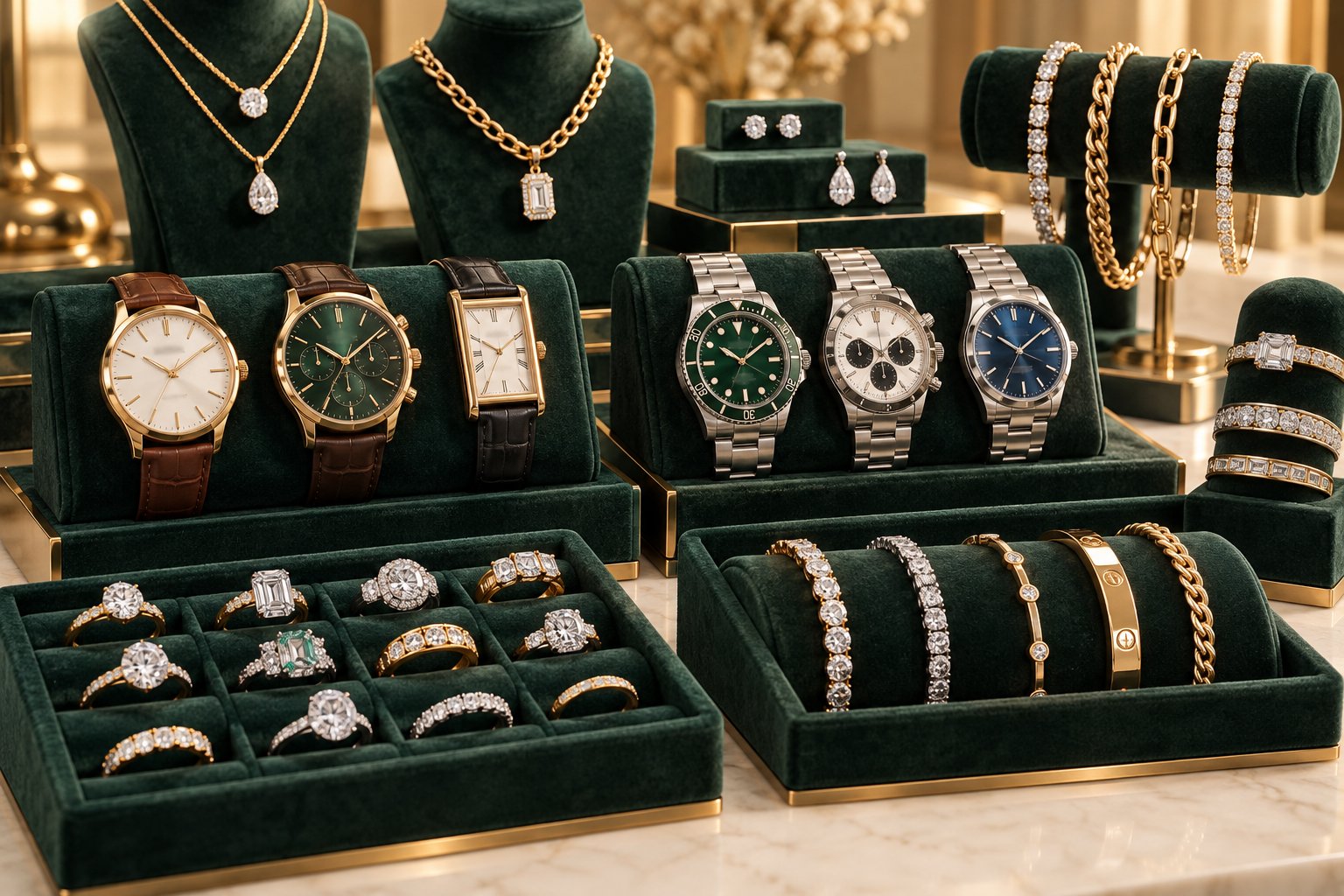
Every buyer who sources watches or jewelry from a manufacturer eventually runs into the same three letters: MOQ. Minimum order quantity. It appears on every quotation, every product page and every factory price list, and it is often the first number a new buyer compares between suppliers. Yet many buyers treat MOQ as a hurdle to negotiate around rather than a number to understand. That is a mistake. Knowing why a minimum exists, how it is calculated, and what it means for your cash flow, your inventory risk and your product strategy will make you a stronger negotiator and a more profitable retailer.
This guide explains how minimum order quantity works in the wholesale watch and jewelry trade, using the real structure of an experienced Shenzhen-based manufacturer as a reference. Whether you are opening your first boutique, expanding an e-commerce catalog, or launching a private label brand, you will finish this article knowing exactly what to ask a supplier before you commit to your first bulk order.
What Is a Minimum Order Quantity in Watch and Jewelry Wholesale?
A minimum order quantity, usually abbreviated as MOQ, is the smallest number of units a supplier is willing to produce and sell for a given product in a single order. If a wholesale watch carries an MOQ of 100 pieces, the supplier will not accept an order of 40 or 60 pieces of that model. If a jewelry line is set at an MOQ of 200 units, ordering 150 is not an option at standard terms.
MOQ is not an arbitrary obstacle. It is the production volume at which a manufacturer can hold the price stable, keep material purchasing efficient, and run quality control at a reasonable cost per unit. Below that volume, either the unit price has to rise or the supplier loses money on setup work that does not change with quantity. Understanding this trade-off is the foundation of every MOQ conversation you will ever have with a factory.
It helps to separate three related terms that buyers often confuse:
- MOQ (minimum order quantity): the smallest unit count you can order of a product, per model or per SKU.
- Sample order: a small, often one-piece order used to evaluate quality before committing to a bulk run. Samples are priced higher per unit and usually ship separately.
- Reorder: a follow-up bulk order of a model you have already produced. Reorders typically move faster than first orders because tooling, materials and QC standards are already established.
In the watch and jewelry category, MOQs are moderate compared with many other consumer goods. Watches and fashion jewelry are compact, high-value-per-kilogram products, and a production run of one to two hundred units is enough for a factory to justify tooling preparation, movement or stone sourcing, assembly and inspection. That is why a manufacturer like Aurevo can offer MOQs starting from 100 pieces across most watch models and from 100 to 200 units across most jewelry lines, depending on the model.
Why Do Suppliers Set Minimum Order Quantities at All?
Buyers sometimes assume factories set MOQs to filter out small customers. The real reasons are more practical, and knowing them helps you judge whether a quoted MOQ is reasonable.
Setup and preparation work does not shrink with quantity
Before a single watch case is polished or a single stone is set, a factory invests fixed preparation: confirming technical drawings, preparing assembly jigs, programming inspection standards, and in customized programs, cutting dials, printing logos or preparing molds. Those steps cost roughly the same whether the order is 30 units or 300. Spreading that fixed cost across more units is what allows the factory to quote a stable wholesale price. At very low volumes, the fixed cost per piece becomes so large that the quoted price would no longer be competitive.
Material purchasing has its own minimums
Watch movements, genuine leather straps, sapphire crystals, sterling silver stock and cubic zirconia stones are all purchased from upstream suppliers in batches. A factory buying movement lots, strap hides or silver sheet in small fragmented quantities pays more per unit and faces longer lead times. A production batch of 100 or 200 pieces aligns naturally with how materials are sourced, which is why those numbers appear so frequently in watch and jewelry price lists.
Batch consistency and quality control require a run
Color matching, plating tone, stone calibration and polish finishing are controlled at batch level. A plating bath produces a consistent color across the pieces processed together; calibrating zircon stones happens per lot. Producing 12 pieces in one batch and 30 in another weeks later invites shade differences between deliveries, which is exactly the problem retailers fear most: a reorder that does not match the first delivery. A meaningful MOQ protects batch consistency, and with it, your product reviews and repeat purchase rate.
Inspection economics
Reputable manufacturers inspect watches and jewelry at multiple stations: incoming material checks, in-process assembly checks, and final inspection of each finished piece before packing. The administrative and labor cost of setting up inspection for a production run is largely fixed. A minimum run keeps per-unit inspection cost realistic while still allowing 100% final inspection, which is the standard serious buyers should expect for watches and jewelry.
How MOQ Works Across Watch and Jewelry Product Lines
MOQ is set per product model, not per brand and not per shipment. In an established catalog, you will see the pattern clearly: complexity, materials and customization level determine where each model sits. Here is how the structure looks across a typical B2B watch and jewelry catalog like Aurevo's:
| Product line | Typical MOQ | What drives the level |
|---|---|---|
| Men's and ladies' watches (quartz, automatic, leather and steel models) | From 100 pieces | Movement sourcing, case and strap preparation, assembly and multi-station QC |
| Pendant necklaces (gold-tone and sterling silver) | 100 to 200 units | Chain sourcing, pendant finishing, stone setting where applicable |
| Rings (fashion and gemstone styles) | 100 to 200 units | Size curve production, plating, stone setting and sizing checks |
| Earrings (studs and hoops) | 100 units or pairs | Post and clasp components, plating, stone calibration |
| Bracelets (gold-tone and gemstone) | 100 to 200 units | Link or chain assembly, clasp sourcing, stone setting |
Notice that watches sit consistently at 100 pieces while several fashion jewelry models are set at 200. That difference is typical of the trade. Jewelry styles often involve finer components, more stone-setting labor per piece, and a wider size or color curve, which raises the efficient batch size slightly. Neither number is high by industry standards; both are deliberately set at levels where a first-time retailer can build a viable starter assortment without overcommitting capital.
When you compare suppliers, ask for the MOQ of each specific model you care about rather than a single company-wide number. A supplier who answers precisely, model by model, is demonstrating exactly the kind of production discipline that the MOQ system exists to support.
Per-SKU MOQ Versus Per-Order MOQ
One of the most useful clarifications you can request from a supplier is whether the MOQ applies per SKU or per order. The two models create very different purchasing experiences.
Per-SKU MOQ means each model must individually meet its minimum. If you want three necklace styles at an MOQ of 100 each, your total order is at least 300 units. This is the most common structure in watch and jewelry wholesale because production, plating and stone setting are organized around individual models.
Per-order MOQ means the minimum applies to the combined order value or quantity, letting you mix models freely as long as the total clears the threshold. Some suppliers offer this for stock programs or for established repeat customers, but for made-to-order production, per-SKU minimums remain the norm because each model triggers its own preparation work.
There is also assortment flexibility within a SKU, which matters enormously for rings and watches. Many suppliers will allow you to split one model's MOQ across the available size or color range. A ring model with an MOQ of 200, offered in US sizes 6 through 10, might be produced as a size curve weighted toward the sizes your market sells most. A watch model might be split between two strap colors within the same 100-piece run. Policies vary, so confirm two things in writing before ordering: whether sizes and colors can be mixed inside one SKU's MOQ, and whether mixed splits carry any surcharge.
What Your First MOQ Order Should Look Like
If you are planning a first order, resist the temptation to spread a small budget across too many models. A focused first order outperforms a scattered one for three reasons.
First, depth sells better than breadth at the start. Ten necklace models at 20 units each leave you unable to restock a style that sells, and unable to present a confident, well-stocked display. Three models at or above MOQ give you proper presentation stock, buffer against defects and breakage, and a meaningful read on which style direction your customers prefer.
Second, a focused order simplifies quality comparison. When your first delivery contains one or two models in depth, you can inspect consistency across the batch: plating tone, stone setting, strap stitching, clasp action. That tells you far more about a factory than a mixed carton of samples ever will.
Third, your reorder decision becomes cleaner. After a season with three models in real depth, your sales data points clearly at which model to reorder, at what quantity, and with which size curve adjustment. Scattered shallow orders produce noisy data and cautious reorders, which keeps you stuck in sample-order economics.
A practical starter structure for a boutique or online store sourcing from a catalog with MOQs of 100 to 200:
- Two to four models across the categories your customers actually ask about, each at or above its MOQ.
- Within each model, split the quantity across your market's dominant sizes or the two strongest colorways.
- Keep roughly 10 to 15 percent of units as buffer stock against defects and display wear, rather than planning to sell every unit.
- Reserve part of your budget for a reorder of the best seller within the first season. Fast replenishment of a proven style builds more revenue than adding a fourth new model.
MOQ for OEM, ODM and Private Label Programs
MOQs change when you move from catalog products to customized production, and the direction is always upward. This is one of the most common surprises for first-time brand builders, so it is worth understanding in detail.
Why customization raises the minimum
Private label and OEM programs add fixed preparation work that catalog orders do not have: custom dial printing or logo application, custom molds or cases in some programs, branded packaging, custom strap materials and dedicated movement configuration. Each of those steps has its own minimum efficient batch. A custom dial printing plate, for example, is economical across a run of hundreds, not dozens. A custom mold must amortize its tooling cost across the units produced. When a manufacturer quotes a higher MOQ for a customized program, it is passing through these real upstream minimums, not inflating the number for margin.
What a realistic customized MOQ covers
For a private label watch program built on an existing case and movement platform, expect MOQs to start above the catalog level, because logo application, dial customization and branded packaging are added to a production run that must still meet its base minimum. For fully custom ODM development, where the product itself is designed with you, the minimum rises further because tooling and development work must be recovered across the order. A transparent supplier will break this down for you: base production MOQ, additional customization minimums, and which costs are one-time tooling versus per-unit.
How to approach your first customized program
Start with the lightest customization that still delivers your brand goal. If your objective is a branded product, a private label program on an existing model, with your logo on the dial, caseback and packaging, achieves it at the lowest MOQ. Full ODM development makes sense once your brand has sales data showing which features your market values. This staged approach keeps your first customized order near the entry minimum and puts your capital into marketing and inventory depth instead of tooling you may not yet need.
One more caution: whatever customization level you choose, confirm in writing that customized orders carry the same warranty and inspection terms as catalog orders. A twelve-month warranty on customized production should be stated explicitly in your order confirmation, not assumed.
How to Plan Cash Flow and Inventory Around MOQ
MOQ planning is ultimately a cash flow exercise. The unit price is only one input; the real question is how much working capital your first order locks up and how quickly it converts back into cash.
Work through the arithmetic before you negotiate anything. Take the models you plan to order, multiply each MOQ by its quoted unit price, and add freight, duties and any customization fees. That total is your inventory investment. Then estimate your monthly sell-through per model based on your traffic, price point and category benchmarks. Divide your order quantity by monthly sell-through to get months of stock. For watches and fashion jewelry, a first order that represents three to six months of expected sell-through is a healthy target. Below three months, you risk stockouts on your first winner; above six months, your capital sits idle and your markdown risk grows with every slow month.
Two further habits protect your cash:
- Phase your categories. If you sell watches and jewelry, you do not need both categories at full depth in month one. Many buyers open with watches, which carry higher price points and stronger gifting demand, then add jewelry lines in the second order once the watch sell-through is known.
- Match your size curve to your market. Ring sizes, watch case diameters and strap lengths all have regional norms. Order the curve your market wears, not the full factory range. This single decision often determines whether an MOQ order feels heavy or comfortable.
Suppliers experienced in B2B export are used to these conversations. Asking a factory to help you model months-of-stock on a candidate order is not a sign of inexperience; it is the behavior of a professional buyer, and good suppliers answer it with real numbers from comparable programs.
Sampling Before You Commit: The Step Too Many Buyers Skip
An MOQ is a commitment, and the professional way to approach any commitment is to verify quality first. This is what sample orders are for. Before placing a bulk order, order samples of the exact models you intend to buy, at the exact specifications you intend to order.
Evaluate samples the way your customer will experience the product, and the way you would defend it in a warranty claim. For watches: weight and finishing of the case, dial printing quality, strap material and stitching, clasp action, timekeeping accuracy, and packaging. For jewelry: plating tone and smoothness, stone setting security, clasp and chain strength, and how the piece photographs under retail lighting. Photograph and weigh your samples on arrival; those records become your quality baseline for the bulk run.
Lead time matters here too. A manufacturer that delivers samples in 7 to 15 days, as is typical for established watch and jewelry suppliers, lets you complete evaluation and still place your bulk order within the same planning cycle. Build the sample round into your launch calendar from the start rather than treating it as a delay.
When samples arrive, test against your intended selling claims. If you plan to market a watch as a dress watch, wear a sample through a working week. If you plan to sell jewelry as daily-wear fashion, wear it, store it, and check the plating after contact with hand sanitizer or perfume. Sample testing is where you earn the right to write confident product copy later.
Five Common MOQ Mistakes Buyers Make
After years of watching B2B buyers work through first orders, the same unforced errors appear repeatedly. Avoiding them costs nothing.
- Spreading the budget across too many models. Covered above, and worth repeating: shallow assortments produce weak data, weak displays and weak reorders. Concentrate.
- Ignoring the size and color curve. A 200-unit ring order evenly split across five sizes leaves you with slow-moving extremes. Ask the supplier for the size distribution of comparable markets and weight your curve accordingly.
- Skipping the sample round to save two weeks. The bulk order is the expensive mistake when it goes wrong, not the sample order. Samples in 7 to 15 days are cheap insurance.
- Treating MOQ as the only number that matters. A low MOQ with inconsistent batch quality is more expensive than a standard MOQ with disciplined QC, because returns, refunds and reviews cost more than the difference in unit price. Judge MOQ together with inspection standards, warranty terms and communication quality.
- Not confirming terms in writing. MOQ, mixed sizes, unit price, lead time, inspection standard and warranty period all belong in the order confirmation. Memory is not a contract.
Can You Negotiate MOQ? A Realistic View
Buyers ask this constantly, so here is the honest answer: sometimes, and only along specific levers. A manufacturer's MOQ reflects production economics, so the negotiation that works is one that changes the economics, not one that simply asks for a discount on the minimum.
The levers that genuinely work:
- Accept a higher unit price at lower volume. Many suppliers will produce below standard MOQ at an adjusted per-unit price that covers the fixed costs across fewer units. If your cash position is tight, trading price for volume is a legitimate tool.
- Choose models closer to their efficient batch. Catalog models already in regular production carry lower effective minimums than styles requiring new preparation. Starting with proven catalog models is the easiest legitimate MOQ reduction.
- Consolidate your order. If you can combine two purchase cycles into one larger order, you may unlock better terms overall. But only do this if your sell-through analysis supports the larger inventory position.
- Commit to a reorder plan. Suppliers value predictable repeat business. A stated intention to reorder a proven model, backed by real purchase history, is the strongest long-term lever for flexible terms.
The levers that do not work: asking the factory to absorb its setup costs, or negotiating the MOQ without touching any other variable. If a supplier agrees instantly to any MOQ at any price, treat that as a warning sign about how they handle production economics elsewhere.
Quality Control and Warranty Across a Bulk Run
An MOQ order is not just a purchase; it is a quality event. Understanding what happens inside the factory between your deposit and your delivery helps you ask the right verification questions.
In a disciplined watch and jewelry operation, quality control runs at multiple stations: incoming materials are checked before assembly, workmanship is checked during production, and every finished piece is inspected again before packing. For watches, that includes movement function, timekeeping, water-resistance specification checks and strap attachment. For jewelry, it includes plating quality, stone security and clasp function. Batch-level checks, plating tone and stone calibration among them, are what keep your reorder consistent with your first delivery.
Warranty is the other half of the quality conversation. A manufacturer confident in its production stands behind it with a clear, uniform policy. Aurevo applies a twelve-month warranty across its watch and jewelry products, and that is the number to confirm in your order documents. When evaluating any supplier, ask three warranty questions: what period applies, what the warranty covers, and how warranty claims are handled for international B2B orders. Uniform terms across the whole product range are a sign of mature process; vague or varying answers are not.
Finally, connect QC and warranty to your own obligations. Inspect every carton on arrival against your sample baseline, record any issues with photographs within a defined window, and store products in conditions that do not create damage the warranty does not cover. The supplier's quality system and your receiving discipline together determine what your customers actually experience.
MOQ, Unit Pricing and Volume Tiers: How the Numbers Fit Together
MOQ answers one question: how many units. But every quotation also answers a second question: at what price. The two are linked, and professional buyers read them together.
Wholesale pricing in this trade generally moves in tiers. At or just above the MOQ, the unit price reflects the full burden of setup, materials sourcing and inspection spread across the smallest efficient batch. As order quantity rises, those fixed costs spread further, and suppliers typically reward the larger volume with a lower per-unit price. The tiers differ by supplier, by product and by season, so the exact structure must come from the quotation, not from an assumption. What does not vary is the direction: the MOQ order carries the highest unit price you will be quoted for that model, and larger orders improve it.
This has a direct planning implication. When you compare two suppliers, do not compare a 100-piece price from one against a 500-piece price from another. Compare prices at the same quantity, ideally at the quantity you actually intend to order, and ask each supplier where the next price tier begins. A supplier who volunteers tier breakpoints is showing you their cost structure, which is a useful signal of transparency.
Volume tiers also interact with customization. A private label program quoted at a higher MOQ may carry a second, lower price tier once the order clears the cost of dial plates and packaging setup. If your brand plan includes growing into a customized program, ask the supplier to quote the volume ladder for the customized version at the same time as the base MOQ price. You will then know exactly how much cheaper each additional hundred units becomes, and that number feeds directly into your cash flow model.
A Worked Example: Sizing a First Order With Simple Arithmetic
Numbers make this concrete. The following example is an illustration of the planning method only; every real figure must come from your own quotation, because prices, MOQs and freight all vary by model, program and destination.
Suppose a boutique plans to open with two watch models and one jewelry line from a catalog where watches carry an MOQ of 100 pieces and the selected jewelry model sits at 200 units. The buyer quotes three unit prices: suppose the watch models are quoted at a modest per-unit wholesale price and the jewelry model somewhat lower. Multiply each MOQ by its quoted unit price and add the three totals; that sum is the product cost of the first order. Add sea or air freight based on the packed weight the supplier provides, plus duties and clearance at the destination, and you have the full landed investment.
Now model the sell-through. If the boutique expects, based on its own traffic and price point, to sell roughly 30 watches a month across both models and about 40 jewelry units a month, then the 200 watch pieces represent a little under seven months of stock and the 200 jewelry units represent five months. That comparison tells the buyer two useful things: the watch order is slightly heavy relative to early demand, so the buyer might split the 100-piece MOQ per model across two colorways rather than deepening one; and the jewelry line is well sized, so no adjustment is needed there.
The same arithmetic works in reverse for reorders. Once real sales data replaces estimates, months-of-stock becomes a simple weekly check: remaining units divided by the trailing four-week sell rate. When that ratio approaches the reorder lead time, it is time to place the next order. Buyers who set this check up as a calendar reminder rarely face stockouts; buyers who reorder on instinct usually do.
MOQ, Lead Time and Your Ordering Calendar
MOQ is a quantity commitment, but quantity only converts into revenue after production, inspection, packing and shipping. Working backward from your launch date is the discipline that keeps an MOQ order from arriving too late to matter.
Build the calendar in stages. First, model selection and sample orders: an experienced supplier that ships samples in 7 to 15 days lets you complete evaluation within roughly two to three weeks including shipping and inspection. Second, the bulk order itself: after samples are approved, confirm the final specifications, the size or color split within each MOQ, and the production schedule in writing. Third, production and inspection: ask the supplier for the production window at the time of quotation and hold it to the confirmation. Fourth, freight and customs: sea freight takes longest but costs least per unit; air freight compresses the schedule at a higher per-unit cost, which matters most for a first order that needs to reach shelves on time.
Two calendar rules are worth adopting permanently. Rule one: never let your on-hand stock fall below your reorder lead time plus freight time; the worked example above shows how to monitor this weekly. Rule two: place reorders by sales data and seasonality, not by cash availability alone. An order placed because money happens to be free often arrives at exactly the wrong point in the selling season.
How Seasonality Affects MOQ Planning
Watches and jewelry are strongly seasonal categories, and MOQ decisions should be timed to that rhythm rather than made in isolation.
Gifting demand peaks predictably: the year-end holiday season dominates in most Western markets, with additional peaks around Valentine's Day, Mother's Day and regional festive seasons depending on where you sell. Because production queues fill ahead of those peaks, order placement timing matters as much as order size. A buyer who places a 200-unit order when the factory is in peak-season backlog will wait longer than a buyer who places the same order in the quiet window after the peak. Ask your supplier which months are their busiest and plan first orders and reorders outside the rush whenever your calendar allows.
Seasonality also affects which models to load into an MOQ order. Classic dress watches and everyday jewelry styles sell steadily across the year, which makes them safe first orders; more seasonal fashion pieces sell in bursts and are better added in a second order once the steady lines are established. And because MOQ applies per model, the seasonal calendar argues for the same concentration principle discussed earlier: fewer models, bought at full MOQ in the right season, outperform many models bought at odd times in shallow quantities.
Finally, use seasonality in your favor when negotiating. A supplier with quiet-season capacity has real room to discuss terms; the same supplier at peak season does not. Buyers who understand the factory's calendar negotiate more effectively than buyers who negotiate only against their own.
Questions to Ask a Supplier Before You Accept an MOQ
Before signing any first order, put these questions to the supplier in writing. The quality of the answers tells you as much as the numbers themselves.
- What is the exact MOQ for each model I plan to order, and does it apply per SKU?
- Can I split each model's MOQ across sizes or colors, and does the split carry a surcharge?
- What unit price applies at the MOQ, and where does the next volume tier begin?
- What does the quotation include: packaging, inspection, freight terms and any customization fees?
- What is the sample price and sample lead time for each model, and can sample costs be credited against the bulk order?
- What warranty period applies to the products in this order, and how are warranty claims handled internationally?
- What are your production lead time and your busiest months, so I can plan reorders around them?
A supplier who answers these directly, model by model and number by number, is demonstrating the production discipline that a meaningful MOQ system is supposed to reflect. A supplier who answers vaguely, or who drops the MOQ instantly under mild pressure, is showing you where their economics are thin.
Frequently Asked Questions About Wholesale MOQ
Can I mix different models to meet one MOQ?
Usually not for made-to-order production, because MOQ applies per model or SKU. Most suppliers, including Aurevo, set minimums per product so that each model's preparation, materials and QC are covered. Within a single model, sizes and colors can often be mixed; confirm the split policy in writing before ordering.
What is a typical MOQ for wholesale watches?
For established manufacturers producing quartz and automatic watches, MOQs from 100 pieces per model are standard, and that is where Aurevo's watch lines start. Customized private label programs start higher because logo and dial customization add fixed preparation work.
What is a typical MOQ for wholesale jewelry?
Jewelry MOQs vary by model: simpler styles start from 100 units, while models with more stone-setting labor or a wider size curve are set at 200 units. Ask for the specific number of each model you plan to order rather than relying on a company-wide figure.
Can I order samples before committing to the MOQ?
Yes, and you should. Samples are priced per piece above bulk rates and typically ship in 7 to 15 days from an experienced supplier. Evaluate them against the checklist in this guide, then place your bulk order with a documented quality baseline.
Does the MOQ change for reorders?
Often the standard MOQ still applies to reorders, but reorders move faster because materials, tooling and inspection standards are established. Discuss reorder terms when you place your first order; a clear reorder plan is good for both sides.
How does MOQ work with private label orders?
Private label adds customization steps such as logo application, dial printing and branded packaging, each with its own efficient batch size, so expect the minimum to start above the catalog level. A transparent supplier will separate the base production MOQ from the customization minimums so you can see exactly what drives the number.
Does a larger order within the same MOQ system get a better unit price?
Generally yes: unit pricing moves in volume tiers, and the MOQ-level order sits at the highest per-unit price for that model. Ask the supplier to quote the price at your intended quantity and to identify where the next tier begins, so your cash flow model uses the right number.
Who pays freight on an MOQ order, and how should I budget it?
Freight terms vary by quotation and destination, so confirm the incoterms with your order confirmation. Budget freight, duties and clearance as part of your landed cost per unit rather than as an afterthought; on compact, high-value products like watches and jewelry, the freight share of landed cost is usually modest, but duties and clearance fees depend entirely on your market.
Plan Your First Order With Real Numbers
Minimum order quantity is not a wall between you and the products you want to sell. It is the production floor on which stable pricing, batch consistency and proper inspection all stand. Buyers who understand it plan sharper first orders, negotiate from knowledge instead of hope, and build supplier relationships that survive their second and third purchase cycles.
If you are planning a first wholesale order of watches or jewelry, the practical next step is a conversation with real numbers: the models you are considering, the quantities that fit your budget, and the size curve your market wears. Share your target categories and expected volumes, and the team can respond with the specific MOQ, unit pricing and lead time for each model, along with sample arrangements. A clear quote is easier to evaluate than a generic price list, and it is the fastest way to turn this guide into a purchase order.