Where to Buy Wholesale Jewelry: A Complete B2B Sourcing Guide for Retailers and Brands
2026. 9. 22.
Where to Buy Wholesale Jewelry: A Complete B2B Sourcing Guide for Retailers and Brands
If you run a jewelry boutique, an online store, a department store buying desk, or a brand that wants to launch its own jewelry line, the question "where to buy wholesale jewelry" is one of the first and most important decisions you will make. The answer shapes your margins, your product quality, your delivery reliability, and ultimately the trust your customers place in your name. Yet most sourcing guides stop at a list of marketplaces and leave the hard part — how to actually evaluate a supplier, negotiate terms, and protect your brand — unexplained.
This guide is written for B2B buyers who need a practical, evidence-based path from "I want to sell jewelry" to "I have a reliable wholesale jewelry supplier and a product line I can scale." We will walk through the different types of wholesale jewelry suppliers, the questions you must ask before you commit, how to evaluate samples and quality control, how minimum order quantities and pricing really work, and how to choose between ready-made wholesale pieces and custom OEM, ODM, or private label manufacturing. Throughout, we will use the real product categories and manufacturing capabilities of a Shenzhen-based watch and jewelry manufacturer as a concrete reference, so the advice stays grounded in how the industry actually operates rather than in generic theory.
By the end of this article, you will know exactly what to look for, what to ask, and how to structure your first wholesale jewelry order so that you can buy with confidence and build a product line that your customers trust.
Why "Where to Buy Wholesale Jewelry" Is the Wrong Question to Ask Alone
When a buyer searches "where to buy wholesale jewelry," they are usually looking for a list of names — a marketplace, a directory, a supplier. But the real question underneath is more specific: "Where can I buy jewelry at wholesale prices from a supplier I can trust, at a quality my customers will accept, and at terms that fit my business?" A list of names does not answer that. Two buyers can visit the same supplier and have completely different experiences depending on how they evaluate quality, negotiate minimums, and manage the relationship.
The most useful way to reframe the question is to separate it into three parts. First, what kind of jewelry do you need and at what volume? Second, what kind of supplier fits that need — a marketplace, a trading company, a factory, or a manufacturer that also offers private label? Third, how do you verify that supplier before you commit money and inventory? Each part has its own set of facts and its own risks. A buyer who skips the first two and jumps straight to "which website should I use" is likely to repeat the same mistakes: ordering from a source that cannot scale, receiving inconsistent quality, or paying for a middleman markup that erases their margin.
This guide treats sourcing as a process, not a single answer. We will give you the framework and the specific questions, and we will show you how the pieces fit together using real examples from the wholesale jewelry industry.
The Main Types of Wholesale Jewelry Suppliers
Before you can decide where to buy wholesale jewelry, you need to understand the landscape. Wholesale jewelry suppliers fall into several broad categories, and each one serves a different buyer profile. Choosing the wrong category is one of the most common and expensive mistakes a new buyer makes.
1. Online B2B Marketplaces
Marketplaces such as Alibaba, Made-in-China, and Global Sources aggregate thousands of suppliers in one place. They are useful for discovery and for comparing prices across many vendors quickly. The trade-off is that a marketplace is a directory, not a quality guarantee. The supplier behind a listing may be a factory, a trading company, or a reseller, and the listing photos may not reflect the actual product you receive. You must do your own due diligence on every supplier you find through a marketplace.
Marketplaces work best for buyers who already know exactly what they want, have a clear specification, and are prepared to vet suppliers carefully. They are less ideal for buyers who need guidance, customization, or a long-term manufacturing partner, because the marketplace model tends to reward the lowest price rather than the most reliable partner.
2. Trading Companies and Agents
A trading company does not manufacture jewelry itself. It buys from multiple factories and resells to you, often handling export, logistics, and communication. Trading companies can be convenient because they offer a wide catalog and handle the complexity of dealing with multiple factories. The downside is that you are paying a markup, and you have less direct control over quality and production. If a problem arises, you are dealing with an intermediary rather than the people who actually made the product.
Trading companies can be a reasonable starting point for very small orders or for buyers who need a broad assortment without committing to a single factory. But for buyers who plan to scale, build a brand, or control quality, working directly with a manufacturer is usually the better long-term path.
3. Direct Manufacturers and Factories
A direct manufacturer designs and produces the jewelry itself. This is the category that matters most for serious B2B buyers, because it gives you the most control over quality, cost, customization, and consistency. A manufacturer can produce ready-made wholesale pieces from its existing catalog, and it can also produce custom pieces under your brand through OEM, ODM, or private label arrangements.
Working directly with a manufacturer has several advantages. You eliminate the middleman markup. You can visit or audit the factory, request samples, and see exactly how quality is controlled. You can negotiate minimum order quantities and pricing directly. And you can build a relationship that allows your product line to evolve as your business grows. The main requirement is that you must be prepared to do the work of evaluating the manufacturer — checking its product quality, its production capacity, and its reliability.
4. Wholesale Distributors and Cash-and-Carry Suppliers
Some suppliers operate as distributors that stock finished jewelry and sell it in bulk, often with lower minimums and faster turnaround than a factory. These can be useful for buyers who need to restock quickly or who want to test a market without committing to a large custom order. The trade-off is that you have less ability to customize, and the product is the same as what many other retailers are selling, which can limit differentiation.
What to Look for in a Wholesale Jewelry Supplier
Once you understand the types of suppliers, the next step is knowing how to evaluate a specific candidate. This is where the E-E-A-T principles — Experience, Expertise, Authoritativeness, and Trustworthiness — become directly useful. These are the same signals that search engines use to judge content, but they are also the signals a smart buyer should use to judge a supplier.
Experience: Does the Supplier Have a Track Record?
Experience is about demonstrated history. How long has the supplier been manufacturing jewelry? Do they have a stable product line, or do they chase every trend? A manufacturer with years of experience in a specific category, such as gold-tone fashion jewelry or sterling silver pieces, is more likely to produce consistent quality than a newcomer that claims to make everything.
Ask for specifics and verify them: how many years in operation, what product categories they specialize in, what markets they export to, and whether they have worked with brands similar to yours. A concrete way to verify experience is to request shipment records or customer references for similar products over the past few years, rather than relying on the supplier's own description. A supplier that can point to a clear specialization — for example, a manufacturer that produces gold-tone pendant necklaces, sterling silver necklaces, and fashion rings as a core line — is demonstrating real experience in that niche.
Expertise: Does the Supplier Understand Materials and Production?
Expertise is about knowledge and skill. A good jewelry manufacturer understands the materials it works with — the difference between gold-tone plating and solid gold, the properties of 925 sterling silver, the behavior of cubic zirconia and other stones, the importance of nickel-free posts for sensitive skin. This expertise shows up in the products themselves and in the supplier's ability to answer your technical questions.
When you talk to a supplier, ask about the materials and finishes they use. For example, a manufacturer that offers gold-tone hoop earrings with nickel-free posts is demonstrating an understanding of a real buyer concern — skin sensitivity. A manufacturer that can explain the difference between a polished finish and a brushed finish, or that can tell you how a stone is set, is showing genuine expertise.
Authoritativeness: Is the Supplier Recognized and Established?
Authoritativeness is about recognition and standing. This can include certifications, a professional website, a physical factory, and a reputation within the industry. A manufacturer with a real production facility, a professional online presence, and a clear company identity is more authoritative than an anonymous listing with no verifiable details.
Look for evidence of a real operation: a company name, a physical address, a professional website, and consistent branding. You can verify this by checking that the company registration information matches the factory address, and by confirming the physical facility through a visit or a verified factory audit. As an example, Aurevo describes itself as a Shenzhen-based manufacturer of watches and jewelry providing wholesale, OEM, ODM, and private label production for international B2B businesses; a buyer should verify this self-description through registration records, a factory audit, or samples rather than taking it at face value.
Trustworthiness: Can You Verify What They Claim?
Trustworthiness is the most important and the hardest to assess. It is about whether the supplier does what it says. The best way to test trustworthiness is through concrete verification: request samples, ask for references, and check whether the supplier is transparent about its production process, quality control, and terms.
A trustworthy supplier will be happy to send samples, will clearly explain its minimum order quantities and pricing, and will be transparent about lead times and quality control. A supplier that is vague, evasive, or unwilling to provide samples is a red flag regardless of how good its website looks.
How to Evaluate Jewelry Quality Before You Commit
Quality is the single most important factor in whether your jewelry business succeeds. A beautiful product photo means nothing if the actual pieces arrive with inconsistent plating, crooked stones, or clasps that fail. Here is how to evaluate quality at each stage of the sourcing process.
Start with Samples
Never commit to a large order without first requesting samples. A sample lets you see the actual product — the weight, the finish, the color, the construction — rather than relying on a photo. When you request a sample, ask for the exact product you plan to order, and examine it carefully for the details that matter: the consistency of the plating, the security of the clasps, the setting of the stones, and the overall finish.
For example, if you are ordering gold-tone pendant necklaces, check that the chain is smooth and the pendant is securely attached. If you are ordering hoop earrings, check that the posts are nickel-free and the hinge clasp is secure. If you are ordering rings, check that the band is smooth and the stone is set straight. These are the details that determine whether your customers are satisfied or whether they return the product.
Understand the Materials
Jewelry quality is largely determined by materials. Gold-tone jewelry uses a base metal with a gold-colored plating; the quality depends on the base metal and the thickness and durability of the plating. Sterling silver is 92.5% silver, which is why it is often called 925 silver; it is a higher-value material that requires careful handling to avoid tarnishing. Cubic zirconia is a popular and affordable stone that can look very close to a diamond when well cut and set.
When you evaluate a supplier, ask about the specific materials used in each product. A manufacturer that can tell you exactly what base metal, what plating, and what stones it uses is more trustworthy than one that gives vague answers. This information also matters for your product descriptions and for compliance with regulations in your target market.
Check Quality Control Processes
A reliable manufacturer has a quality control process that checks products at multiple stages of production. Ask how the supplier inspects its products, what checks are performed, and what happens if a defective piece is found. A manufacturer that inspects at multiple quality control stations and has a clear process for handling defects is demonstrating a commitment to consistency.
For example, a manufacturer that checks the finish, sizing, and stone setting of each piece before it is packed is more reliable than one that ships without inspection. This is especially important for products like rings, where sizing must be consistent, and for pieces with stones, where the setting must be secure.
Understanding Minimum Order Quantities and Pricing
Minimum order quantity (MOQ) and pricing are the two numbers that most directly affect your cash flow and margins. Understanding how they work will help you negotiate effectively and avoid surprises.
What Is a Minimum Order Quantity?
The MOQ is the smallest quantity a supplier will produce or sell for a given product. MOQs vary widely depending on the product and the supplier. For ready-made wholesale pieces from a catalog, MOQs are often lower — for example, around 100 pieces per design. For custom OEM or private label production, MOQs are typically higher because the supplier must set up tooling and production for your specific design, so the applicable minimum depends on the product and the process.
When you compare suppliers, pay attention to the MOQ for the specific products you want. A lower MOQ lets you test a market with less risk, while a higher MOQ may give you a better per-unit price but requires more upfront investment. Choose a supplier whose MOQ fits your budget and your sales forecast.
How Pricing Works
Wholesale pricing is usually quoted per unit and depends on several factors: the materials, the complexity of the design, the quantity ordered, and the level of customization. Ready-made pieces from a catalog are typically the most affordable because they are produced in volume. Custom pieces cost more per unit because of the additional design and production work.
When you receive a price quote, ask what it includes. Does it include packaging? Does it include the cost of the stones and materials? Does it include quality inspection? Understanding what is and is not included will help you compare quotes fairly and avoid unexpected costs.
Negotiating Terms
Negotiation is a normal part of B2B sourcing. You can often negotiate on price, MOQ, payment terms, and lead time, especially if you are placing a larger order or building a long-term relationship. Be respectful and realistic: a supplier that offers a fair price and reliable quality is worth more than one that offers the lowest price but cannot deliver consistently.
When negotiating, focus on the total value of the relationship rather than just the unit price. A slightly higher price from a reliable manufacturer that delivers consistent quality and supports your brand is often a better deal than a lower price from an unreliable source that costs you in returns and lost customers.
Ready-Made Wholesale vs. Custom Manufacturing
One of the most important decisions you will make is whether to buy ready-made wholesale pieces or invest in custom manufacturing. Both have their place, and many successful brands use a combination of both.
Ready-Made Wholesale Pieces
Ready-made pieces are products that a manufacturer already produces and sells in bulk. They are the fastest and most affordable way to start selling jewelry, because there is no design or tooling cost and the MOQ is usually lower. You can order a proven design, such as a gold-tone pendant necklace or a pair of stud earrings, and start selling quickly.
The trade-off is that ready-made pieces are the same as what many other retailers are selling, so you have less differentiation. To stand out, you can combine ready-made pieces with a few custom pieces, or focus on curating and presenting the ready-made pieces in a distinctive way.
Custom Manufacturing: OEM, ODM, and Private Label
Custom manufacturing lets you create jewelry that is unique to your brand. There are three main models, and understanding the difference is essential.
OEM (Original Equipment Manufacturing) means you provide the design and the manufacturer produces it to your specification. You own the design, and the manufacturer handles production. This gives you full control over the product but requires you to have a design ready.
ODM (Original Design Manufacturing) means the manufacturer provides the design and you choose from its existing designs, often with minor modifications. This is faster and easier than OEM because you do not need to create a design from scratch, but you have less control over the final product.
Private Label means you take a ready-made or custom product and put your own brand name on it. The manufacturer produces the product, and you brand it as your own. This is a popular model for retailers and brands that want to build their own identity without investing in full product design.
Each model has its own trade-offs in cost, speed, and control. A manufacturer that offers all three — wholesale, OEM, ODM, and private label — gives you the flexibility to start with ready-made pieces and evolve into custom production as your brand grows.
Building a Product Line: Real Jewelry Categories to Consider
To make this guide concrete, let us look at the real jewelry categories that a wholesale manufacturer typically produces. These are the product types that consistently sell well for retailers, boutiques, and private label brands, and they are a good starting point for planning your own product line.
Necklaces
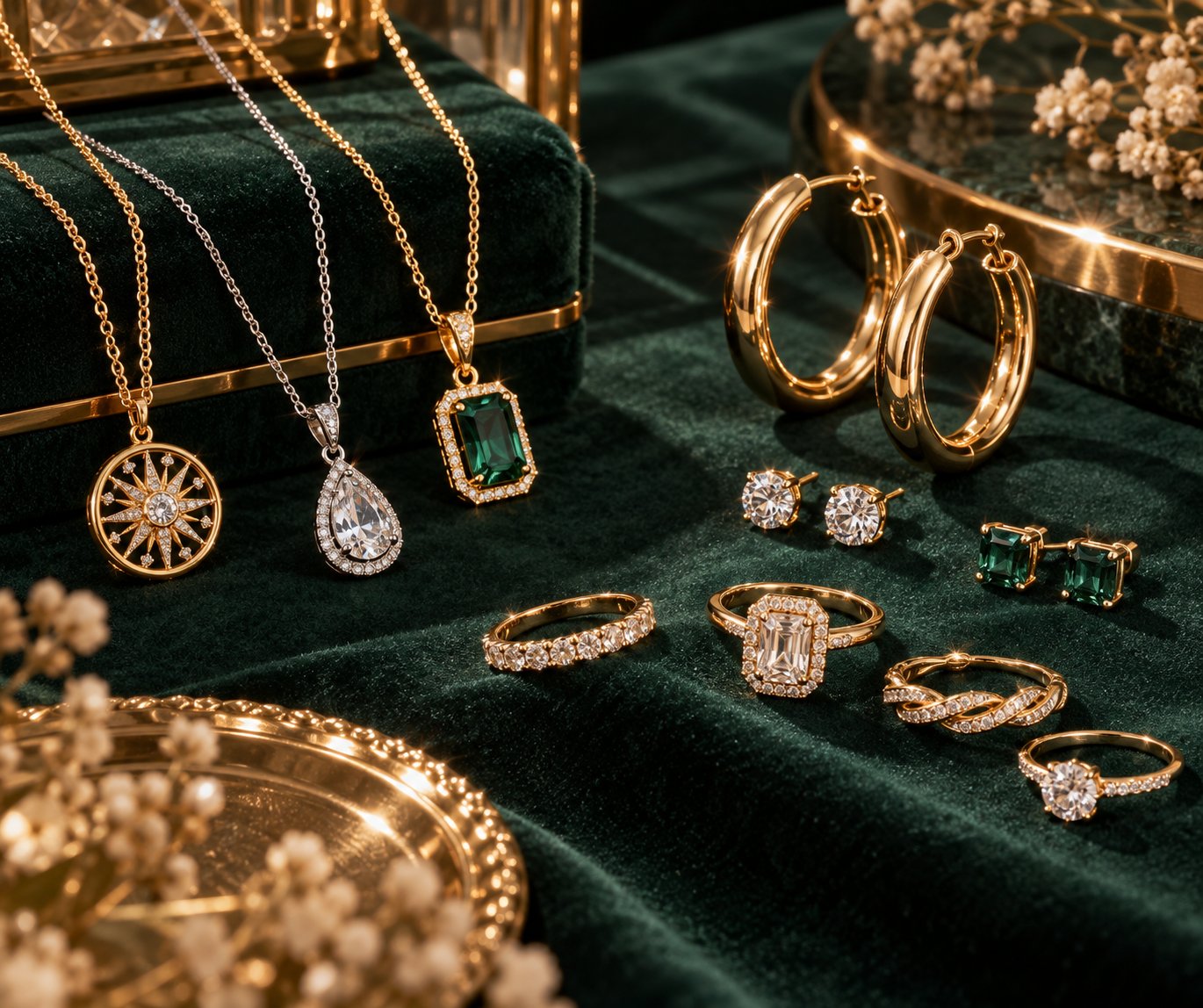
Necklaces are a staple of any jewelry line. They come in many styles, from simple chains to pendant necklaces with stones. A gold-tone pendant necklace with a fine chain and an elegant pendant is a versatile piece that moves across seasons and customer profiles. A sterling silver pendant necklace with a polished teardrop pendant is a higher-value option that appeals to customers looking for silver jewelry. A gold-tone pendant necklace with a cubic zirconia accent adds a touch of sparkle at an accessible price point.
When sourcing necklaces, pay attention to the chain quality, the security of the clasp, and the finish of the pendant. These details determine whether the necklace looks premium and lasts.
Earrings
Earrings are another essential category. Stud earrings with faceted clear gemstones are a classic and versatile choice. Gold-tone hoop earrings with a polished finish and nickel-free posts appeal to customers with sensitive skin. The quality of the posts and the security of the clasp are critical for earrings, because these are the parts that come into direct contact with the skin.
When sourcing earrings, ask about the material of the posts and whether they are nickel-free. This is a real buyer concern, and a manufacturer that addresses it is demonstrating both expertise and care.
Rings
Rings are a popular category, from simple band rings to fashion rings with stones. A gold-tone fashion ring with a polished band and a cubic zirconia stone is an accessible and attractive option. A 925 sterling silver band ring with a mirror-polished finish is a higher-value choice. Sizing consistency is critical for rings, so choose a manufacturer that checks sizing at multiple quality control stations.
When sourcing rings, verify the sizing range and the consistency of the finish. A ring that is not sized correctly or that has an uneven finish will disappoint customers.
Bracelets
Bracelets round out a jewelry line. A gold-tone bracelet with cubic zirconia accents and a lobster clasp is a popular fashion piece. A gemstone bracelet with faceted stones adds color and variety. The security of the clasp and the consistency of the links are the key quality factors for bracelets.
How to Structure Your First Wholesale Jewelry Order
Once you have chosen a supplier and a product line, it is time to structure your first order. A well-structured first order reduces risk and sets the foundation for a successful long-term relationship.
Start Small and Test
For your first order, start with a small quantity across a few proven designs rather than a large quantity of one design. This lets you test the market, evaluate the supplier's quality on a real order, and learn what sells before you commit to larger volumes. A supplier with a reasonable MOQ, such as 100 pieces per design, makes this testing approach practical.
Request Samples First
Before placing your first order, request samples of the exact products you plan to buy. Examine them carefully for quality, and if possible, test them with your target customers. Samples are a small investment that can save you from a costly mistake.
Clarify All Terms in Writing
Before you commit, make sure you understand and agree on all the terms: the unit price, the MOQ, the lead time, the payment terms, the packaging, and the quality control process. Get these terms in writing so there is no ambiguity later. A professional supplier will be happy to provide a clear quotation and order confirmation.
Understand Payment and Trade Terms
Payment and trade terms are a normal part of any wholesale order, and understanding them helps you avoid surprises. Common arrangements include a deposit with the balance due before shipment, letters of credit for larger or riskier orders, and platform-backed payment protection on some marketplaces. Trade terms such as FOB, CIF, and EXW define who pays for shipping and insurance and where responsibility transfers. These are industry-standard practices; the specific terms and any deposit ratio should be agreed with your supplier in writing before you commit, and you should confirm what is included in the quoted price.
Plan for Lead Time
Wholesale jewelry production takes time. Ready-made pieces may ship quickly, but custom production and larger orders take longer. Ask about the lead time for your specific order and plan your inventory accordingly. A supplier that can provide samples for ready-made pieces in roughly 7 to 15 days, depending on the product and whether shipping time is included, and that produces orders on a predictable schedule, is demonstrating reliability.
Common Mistakes to Avoid When Buying Wholesale Jewelry
Even experienced buyers make mistakes. Here are the most common ones and how to avoid them.
Choosing Price Over Quality
The lowest price is rarely the best deal. A cheap piece that arrives with inconsistent quality, fails quickly, or causes customer returns will cost you more in the long run than a slightly more expensive piece that is reliable. Focus on value — the combination of price, quality, and reliability — rather than price alone.
Skipping Samples
Ordering a large quantity without seeing a sample is one of the riskiest things you can do. A photo can be misleading. Always request a sample and examine it carefully before committing to a large order.
Ignoring Quality Control
Quality control is not just the supplier's job. You should have your own process for checking the products you receive, especially on your first few orders. Inspect a sample of each batch for consistency, and report any issues to the supplier promptly.
Not Understanding the Terms
If you do not fully understand the MOQ, the pricing, the lead time, or the payment terms, ask. Ambiguity leads to surprises. A professional supplier will explain everything clearly, and you should never be afraid to ask questions.
Putting All Your Eggs in One Basket
While building a strong relationship with one supplier is valuable, it is also wise to have a backup. If your primary supplier has a production issue or a delay, a backup supplier can keep your business running. This is especially important for products that are central to your sales.
Building a Long-Term Relationship with Your Supplier
The best wholesale jewelry relationships are long-term partnerships, not one-off transactions. A supplier that understands your brand, your customers, and your quality standards becomes a valuable partner in your growth.
Communicate Clearly and Consistently
Clear communication is the foundation of a good relationship. Be specific about your requirements, your quality standards, and your expectations. Provide feedback on samples and orders, both positive and negative. A supplier that listens and responds is one you can build with.
Give Feedback on Quality
When you receive an order, give the supplier honest feedback on the quality. If something is excellent, say so. If something needs improvement, explain what and why. This feedback helps the supplier improve and shows that you are a serious, engaged partner.
Plan Ahead for Growth
As your business grows, your needs will change. You may want to move from ready-made pieces to custom production, or from a small MOQ to larger volumes. A good supplier will grow with you, offering new products and capabilities as your needs evolve. Discuss your growth plans with your supplier so they can support you.
Frequently Asked Questions About Buying Wholesale Jewelry
Here are answers to the questions buyers most often ask when they are trying to figure out where to buy wholesale jewelry.
What is the difference between wholesale and retail jewelry?
Wholesale jewelry is sold in bulk to businesses at a lower per-unit price, while retail jewelry is sold to individual consumers at a higher price. Wholesale buyers purchase from manufacturers or distributors and resell the jewelry to their own customers, earning a margin on the difference.
How much does it cost to buy wholesale jewelry?
The cost depends on the materials, the design, the quantity, and the level of customization. Ready-made pieces from a catalog are typically the most affordable, while custom pieces cost more. The best way to get an accurate price is to request a quotation from a supplier for the specific products you want.
What is a good minimum order quantity for wholesale jewelry?
A good MOQ depends on your budget and your sales forecast. Many manufacturers offer MOQs of roughly 100 to 200 pieces per design for ready-made catalog pieces, while custom OEM or private label production typically requires higher minimums that depend on the design and tooling. A lower MOQ lets you test a market with less risk, while a higher MOQ gives you a better per-unit price.
Can I put my own brand name on wholesale jewelry?
Yes. This is called private label. You take a ready-made or custom product and put your own brand name on it. Many manufacturers offer private label as part of their services, along with OEM and ODM production.
How do I know if a wholesale jewelry supplier is reliable?
Request samples, ask for references, and verify the supplier's claims. A reliable supplier will be transparent about its production process, quality control, and terms, and will be happy to provide samples. Look for evidence of experience, expertise, and a real operation.
How long does it take to receive a wholesale jewelry order?
Lead times vary. Ready-made pieces may ship quickly, while custom production and larger orders take longer. Ask your supplier for a specific lead time for your order and plan your inventory accordingly.
Do I need to worry about nickel in jewelry?
Nickel is a common allergen, and many customers are sensitive to it. If you are sourcing earrings or other pieces that touch the skin, look for nickel-free options. A manufacturer that offers nickel-free posts is addressing a real buyer concern.
What is the difference between OEM, ODM, and private label?
OEM means you provide the design and the manufacturer produces it. ODM means the manufacturer provides the design and you choose from it. Private label means you put your own brand on a ready-made or custom product. Each model has different trade-offs in cost, speed, and control.
Conclusion: Your Path to Buying Wholesale Jewelry with Confidence
The question "where to buy wholesale jewelry" does not have a single answer, but it does have a reliable process. Start by understanding the types of suppliers and choosing the one that fits your needs. Evaluate each candidate using the E-E-A-T framework — experience, expertise, authoritativeness, and trustworthiness. Request samples and examine quality carefully. Understand the MOQ and pricing before you commit. And build a long-term relationship with a supplier you can trust.
Whether you are buying ready-made gold-tone pendant necklaces, sterling silver pieces, fashion rings, or earrings, or you are investing in custom OEM, ODM, or private label production, the principles are the same: verify quality, understand the terms, and build a partnership. A reliable wholesale jewelry supplier is not just a vendor — it is a partner in your success.
If you are ready to start sourcing, the next step is to reach out to a manufacturer with a clear specification of what you need, request samples, and begin the conversation. With the right approach, you can build a jewelry product line that your customers trust and that grows with your business.
Sourcing for Different Sales Channels
Where you sell your jewelry affects how you should source it. A physical boutique, an e-commerce store, and a cross-border seller each have different needs in terms of volume, packaging, lead time, and product mix. Understanding these differences will help you make better sourcing decisions.
Sourcing for a Physical Boutique or Retail Store
If you run a physical boutique, your customers expect to see and touch the jewelry before they buy. This means product quality and finish are especially important, because a customer who picks up a piece and feels a rough edge or a loose stone will put it down. For a boutique, you should prioritize suppliers that produce well-finished pieces with consistent quality, and you should order a curated assortment of styles that your customers can browse and try on.
Boutiques often benefit from a mix of ready-made pieces and a few custom or private label pieces that give the store a distinctive identity. Because a boutique carries a limited number of styles, you can afford to order smaller quantities of each and refresh your assortment regularly to keep the display interesting.
Sourcing for an E-commerce Store
If you sell online, your customers cannot touch the product, so your product photography and descriptions carry the burden of conveying quality. This means you need products that photograph well and that match their descriptions. Consistency is critical for e-commerce, because a customer who receives a piece that looks different from the photo is likely to leave a negative review.
For e-commerce, you should prioritize suppliers that produce consistent, well-finished pieces and that can provide clear product information you can use in your listings. You may also want to order a wider variety of styles in smaller quantities to test what sells, then reorder the winners in larger volumes.
Sourcing for Cross-Border and International Selling
If you sell across borders, you need to consider shipping, customs, and compliance in addition to product quality. Different markets have different regulations on materials, labeling, and safety. For example, the European Union restricts nickel release in jewelry that comes into prolonged contact with the skin, and some markets require specific hallmarks or labeling for silver content. Ask your supplier for the documentation you need, such as a material declaration or a test report, and confirm which requirements apply to your target market before you commit.
When sourcing for international markets, ask your supplier about the materials and finishes they use, and whether they can provide the documentation you need for customs and compliance. A manufacturer that exports to multiple markets is likely to be familiar with these requirements.
Materials and Finishes: What Every Jewelry Buyer Should Know
A deeper understanding of materials and finishes will help you evaluate quality, write better product descriptions, and communicate more effectively with your supplier. Here are the key concepts.
Gold-Tone and Gold-Plated Jewelry
Gold-tone jewelry uses a base metal, such as brass or a copper alloy, with a gold-colored plating applied to the surface. The quality of gold-tone jewelry depends on the base metal and the thickness and durability of the plating. A well-made gold-tone piece has a smooth, even plating that resists wear and does not discolor quickly. Gold-tone pieces are affordable and popular for fashion jewelry.
When evaluating gold-tone jewelry, look at the evenness of the color, the smoothness of the surface, and how the plating holds up to normal wear. A piece with uneven color or a rough surface is a sign of lower quality.
Sterling Silver and 925 Silver
Sterling silver is an alloy that is 92.5% silver, which is why it is often called 925 silver. The remaining 7.5% is usually copper, which adds strength. Sterling silver is a higher-value material than gold-tone, and it is popular for pieces that customers expect to last. Sterling silver can tarnish over time, so proper care and storage are important.
When evaluating sterling silver, check the hallmark or stamp that indicates the silver content, and look at the finish. A well-polished sterling silver piece has a bright, even finish. Sterling silver pieces are often a good choice for brands that want to offer a higher-value option.
Cubic Zirconia and Other Stones
Cubic zirconia (CZ) is a synthetic stone that is popular in fashion jewelry because it looks very close to a diamond at a fraction of the cost. A well-cut and well-set cubic zirconia stone sparkles and catches the light. The quality of the setting is critical: a stone that is set crooked or loosely will look bad and may fall out.
When evaluating pieces with stones, check that the stones are set straight and securely, and that they are clean and free of visible flaws. The clarity and cut of the stone, as well as the quality of the setting, determine how the piece looks.
Finishes: Polished, Brushed, and More
The finish of a piece affects both its look and its durability. A polished finish is smooth and shiny, reflecting light and giving a premium look. A brushed or matte finish has a subtle texture and a softer, more understated look. The right finish depends on the style and the target customer.
When you discuss a product with a supplier, ask about the finish and how it is achieved. A manufacturer that can explain the finishing process and offer different finish options is demonstrating real expertise.
Quality Control: What Happens Before Your Jewelry Ships
Understanding a supplier's quality control process gives you confidence that the pieces you receive will match the samples you approved. Here is what a robust quality control process typically involves.
Incoming Material Inspection
Quality control starts with the materials. A reliable manufacturer inspects the base metals, plating materials, and stones it receives to ensure they meet specifications. This prevents defects from entering the production process in the first place.
In-Process Inspection
During production, a manufacturer checks products at multiple stages to catch defects early. For example, a manufacturer might check the casting, the polishing, the stone setting, and the assembly at different points in the process. Catching a defect early is cheaper and faster than catching it at the end.
Final Inspection Before Packing
Before products are packed, a final inspection checks each piece for finish, sizing, stone security, and overall quality. For products like rings, where sizing must be consistent, this final check is especially important. A manufacturer that inspects at multiple quality control stations is demonstrating a commitment to consistency.
What to Do If You Receive a Defective Batch
Even with good quality control, defects can occasionally occur. When you receive an order, inspect a sample of each batch. If you find defects, document them with photos and report them to the supplier promptly. A reliable supplier will work with you to resolve the issue, whether that means replacing the defective pieces or adjusting the next order.
Packaging and Presentation: The Details That Matter
Packaging is often overlooked, but it plays a significant role in how your customers perceive your jewelry. Good packaging protects the product, presents it well, and reinforces your brand.
Protective Packaging
Jewelry is delicate, so protective packaging is essential. Pieces should be packed so they do not scratch, tangle, or break during shipping. Ask your supplier about the standard packaging and whether you can customize it to better protect your products.
Branded Packaging
For private label and branded products, packaging is part of the brand experience. A branded box, pouch, or card can elevate the perceived value of your jewelry and make it feel more premium. Ask your supplier whether they offer branded packaging options and what the cost and lead time are.
Retail-Ready Presentation
If you sell in a physical store, retail-ready packaging that displays the product well can help drive sales. If you sell online, packaging that photographs well and that protects the product during shipping is important. Consider how your packaging will be used in each channel.
Planning Your Jewelry Inventory and Assortment
A well-planned inventory helps you manage cash flow, avoid stockouts, and keep your assortment fresh. Here is how to think about it.
Balance Core and Trend Pieces
A successful jewelry line balances core pieces that sell consistently with trend pieces that attract attention. Core pieces, such as classic stud earrings or a simple gold-tone pendant necklace, provide steady sales. Trend pieces, such as a new style of hoop earring or a fashion ring, bring in customers looking for something new. Order core pieces in larger volumes and trend pieces in smaller test quantities.
Plan for Seasonality
Jewelry sales often have seasonal peaks, such as the holiday season, Valentine's Day, and Mother's Day. Plan your orders so that you have inventory in time for these peaks, accounting for production and shipping lead times. Ordering too late means missing the peak; ordering too early ties up cash in inventory.
Monitor What Sells
Track which styles sell and which do not. Use this data to refine your assortment, reorder the winners, and drop the losers. A data-driven approach to inventory helps you maximize sales and minimize waste.
Working with a Manufacturer That Offers Wholesale, OEM, ODM, and Private Label
One of the most valuable things you can look for in a supplier is the ability to support you at every stage of your growth. A manufacturer that offers ready-made wholesale pieces, OEM production, ODM design, and private label branding gives you the flexibility to start small and scale.
For example, you might start by ordering ready-made gold-tone pendant necklaces and stud earrings to test the market. As you learn what sells, you can move to private label, putting your own brand on the best-selling pieces. As your brand grows, you can invest in custom OEM or ODM production to create pieces that are unique to you. A manufacturer that supports this entire journey is a true partner.
When you evaluate a manufacturer, ask about the full range of services they offer. A manufacturer that can handle wholesale, OEM, ODM, and private label, and that can produce both watches and jewelry, is demonstrating a broad capability that can support your business as it evolves.
Supplier Verification Checklist
To turn the E-E-A-T framework into concrete actions, use this verification checklist before you commit to a supplier. Each item is something you can actually request, check, or test rather than a subjective impression.
- Request the company registration details and confirm the registered name matches the supplier you are dealing with.
- Confirm the factory address and, if possible, verify it through a visit or a factory audit report.
- Request shipment records or customer references for similar products over the past few years.
- Ask for a material declaration or test report for the specific products you plan to order, including any nickel or silver content claims.
- Request samples of the exact products and inspect the finish, sizing, stone setting, and clasps.
- Confirm the minimum order quantity and per-unit pricing in writing, including what is and is not included.
- Clarify the lead time, payment terms, and trade terms, and get them in writing.
- Ask how quality control is performed and what happens if you receive a defective batch.
Final Checklist Before You Place Your First Wholesale Jewelry Order
Before you commit to your first order, run through this checklist to make sure you have covered the essentials.
- Have you identified the type of supplier that fits your needs — marketplace, trading company, or direct manufacturer?
- Have you evaluated the supplier using the E-E-A-T framework — experience, expertise, authoritativeness, and trustworthiness?
- Have you requested and carefully examined samples of the exact products you plan to order?
- Do you understand the materials and finishes used in each product?
- Have you confirmed the minimum order quantity and the per-unit pricing for each product?
- Do you understand the lead time and the payment terms?
- Have you clarified the packaging and whether branded packaging is available?
- Have you asked about the quality control process and what happens if you receive a defective batch?
- Have you planned your inventory for seasonality and your sales forecast?
- Have you considered whether you want ready-made pieces, private label, or custom OEM/ODM production?
If you can answer yes to all of these, you are ready to place your first wholesale jewelry order with confidence. If any answer is no, take the time to resolve it before you commit. A little extra diligence now can save you from a costly mistake later.