Cubic Zirconia or Natural Gemstones: Which Should You Choose for Wholesale Jewelry?
10/13/2026
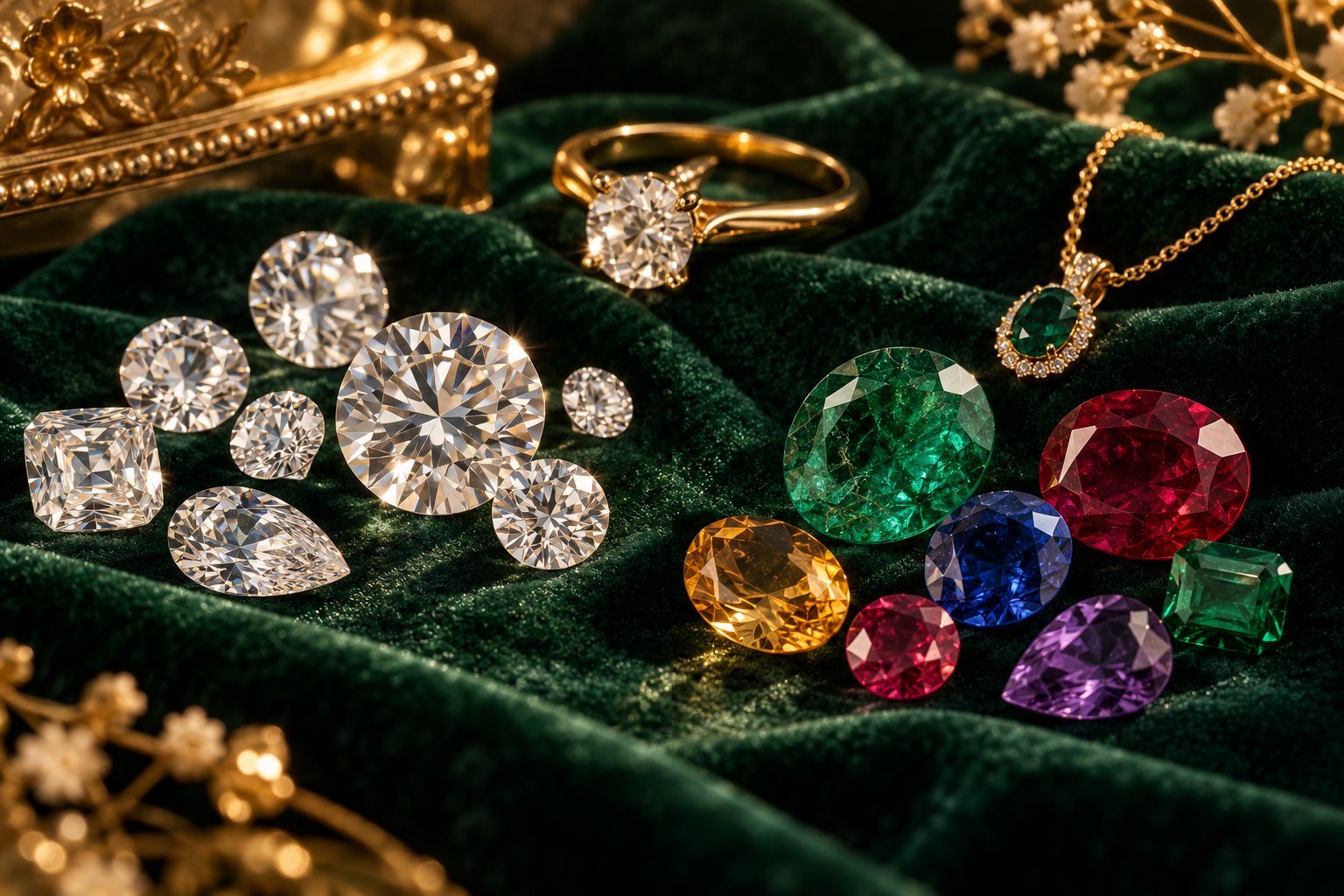
Every jewelry buyer eventually faces the same decision at the quoting stage: should the collection be set with cubic zirconia, or with natural gemstones? The answer shapes almost everything downstream — the unit price you can defend, the durability your customers experience, the consistency you can promise across reorders, and even the way your product photography needs to be shot. And yet the question is often settled in five minutes based on habit, a supplier's suggestion, or a single sample that happened to look good.
This guide is written from the manufacturing side. Aurevo is a Shenzhen-based manufacturer working with wholesale, OEM, ODM and private label programs across watches and jewelry, and the cubic zirconia versus natural gemstone question comes up on nearly every jewelry line we quote. The goal here is not to declare one material the winner. It is to give you the decision framework that experienced buyers use: how the two materials actually differ, where each one earns its place in a collection, and what you should verify before you commit a bulk order to either option.
The Quick Answer for Busy Buyers
If you only have two minutes, here is the short version. Cubic zirconia is the default choice when you need a colorless, diamond-look stone with tight batch consistency, low cost, and freedom from the supply variability that natural stones bring. Natural gemstones are the right choice when color is the product — when a green, red, blue or purple stone is what makes the piece sell, and when slight variation between pieces is acceptable or even part of the appeal.
Most successful collections are not either/or. A common pattern we see in private label jewelry programs is cubic zirconia carrying the core commercial pieces — solitaire-look rings, stud earrings, everyday pendant necklaces — while natural stones differentiate a smaller capsule of statement pieces at a higher price point. The rest of this article explains how to decide which material belongs where in your own line.
What Cubic Zirconia Actually Is
Cubic zirconia is the cubic crystalline form of zirconium dioxide (ZrO₂), produced entirely in a laboratory. It was commercialized in the late 1970s specifically as a diamond simulant, and it has dominated the affordable diamond-look segment ever since. Understanding a few of its material properties explains both why it is so widely used and where its limits are.
On the Mohs hardness scale, cubic zirconia sits at roughly 8 to 8.5. That places it below corundum (ruby and sapphire, at 9) and far below diamond (10), but comfortably above most of the materials a fashion jewelry piece encounters in daily wear. A CZ-set ring worn every day will develop fine surface wear over years, but it resists the everyday scratches from dust, desk surfaces and fabric far better than softer natural stones such as fluorite or turquoise.
Optically, cubic zirconia is genuinely impressive for a synthesized material. Its refractive index is around 2.15 to 2.18 — lower than diamond's 2.42, but high enough to produce strong brightness — and its dispersion of roughly 0.06 actually exceeds diamond's 0.044, which is why a well-cut CZ shows plenty of colorful fire. To a consumer scrolling a product page, a precision-cut CZ can look remarkably close to a diamond in a photograph. This is precisely why it became the workhorse of the affordable jewelry trade.
Two more properties matter for manufacturing. First, density: cubic zirconia is dense, around 5.6 to 6.0 g/cm³, noticeably heavier than most natural colored stones. In earrings and larger statement pieces, stone weight affects wearing comfort and postage cost, which we will come back to. Second, purity: because CZ is grown under controlled conditions, a good-quality stone is clean, with no inclusions, no color zoning, and no internal fractures. That is an advantage for consistency and, at the same time, one of the tells that separates it visually from natural stones under magnification.
One point of confusion worth clearing up immediately, because it appears in real sourcing conversations: cubic zirconia is not the same as natural zircon. Natural zircon is an actual mined gemstone (zirconium silicate) with its own distinct properties, including a lower hardness of about 6.5 to 7.5 on the Mohs scale. The two names are frustratingly similar, and they are not interchangeable in a specification sheet. If a product listing describes stones as "zircon," it is worth confirming with the supplier whether the material is natural zircon or cubic zirconia, because the durability, price and care requirements differ. Our own Aurevo Fashion Zircon Ring product page, for example, describes faceted clear zircon stones — a detail a careful buyer would confirm in writing before sampling.
What "Natural Gemstones" Means in Fashion Jewelry
When buyers say "natural gemstones" in a fashion jewelry context, they usually do not mean diamond, ruby, emerald and sapphire at commercial gem grades. They mean the accessible colored stones that appear in the wholesale trade: amethyst, citrine, garnet, peridot, blue topaz, moonstone, onyx, and occasionally small corundum or emerald accents in higher-positioned lines. Each of these has its own hardness, toughness and optical character, which is why the natural-stone side of the comparison cannot be summarized in a single column the way CZ can.
Amethyst and citrine, both varieties of quartz, sit at Mohs 7 — adequate for pendants, earrings and occasionally worn rings, but they will accumulate fine wear in a daily-wear ring. Garnet ranges from about 6.5 to 7.5 depending on variety. Peridot, at 6.5 to 7, is comparatively soft and also somewhat vulnerable to acids. Blue topaz reaches 8, making it one of the more durable natural choices. Emerald deserves special mention: at 7.5 to 8 it is reasonably hard but characteristically brittle and almost always fissure-filled, so it demands gentler setting and care practices.
The defining characteristic of natural stones, however, is not any single number. It is variation. Two amethysts from different geodes differ in hue, saturation, clarity and inclusions. Even stones cut from the same rough can differ. This variation is not a defect — it is the physical evidence that the stone came out of the ground — but it has direct commercial consequences: batch consistency, photography, price tiers and quality grading all become harder with natural stones than with a synthesized material that can be produced to specification.
For a wholesale buyer, the practical question is therefore not "are natural stones better?" but "can my supply chain grade and match natural stones consistently enough for my channel?" A boutique selling one-of-a-kind pieces can embrace variation. A marketplace seller shipping thousands of identical units cannot.
Durability: How Each Material Survives Real Wear
Durability in jewelry is not just hardness. Gemologists distinguish hardness (resistance to scratching), toughness (resistance to chipping and breaking) and stability (resistance to heat, chemicals and light). Buyers should think in all three dimensions, because customer complaints rarely arrive labeled by cause — they arrive as "the stone looks dull" or "a chip appeared on the edge."
Hardness and surface wear
As noted, cubic zirconia at 8 to 8.5 outscratches most of the natural stones commonly used in fashion jewelry, with blue topaz (8) being the notable exception and quartz varieties (7) close behind. In categories where the stone face is exposed and the piece is worn daily — rings especially — that difference compounds over months. A CZ solitaire-look ring keeps its polished face longer under identical wear conditions than, say, a peridot ring of the same design.
Toughness and chip resistance
Hardness does not protect against chipping. Cubic zirconia, like diamond, has cleavage directions and can chip at a sharp facet junction if knocked hard against a hard surface. Natural stones vary widely: corundum is tough, topaz has perfect cleavage in one direction and can split along it under a sharp blow, and emerald's internal fissures make it the most fragile of the common choices. For prong-set stones in rings, chip resistance matters as much as scratch resistance, because the girdle edge is exposed.
Stability under heat and chemicals
This is the dimension most buyers overlook, and it matters enormously in manufacturing. Jewelry plating and polishing involve heat and chemicals. Stones are typically set after plating to avoid exposing them to plating baths, but repairs, resizing and re-polishing later in the product's life can still expose them. Cubic zirconia is chemically stable and handles routine exposure well. Natural stones are less predictable: amethyst and citrine can lose color if heated, peridot is attacked by acids (including some household chemicals), and emerald's fills can be damaged by solvents and ultrasonic cleaning. If your product copy promises easy care, the stone choice should support that promise.
| Property | Cubic Zirconia | Common Natural Stones (quartz, topaz, garnet, peridot) |
|---|---|---|
| Mohs hardness | ~8–8.5 | ~6.5–8 depending on variety |
| Toughness | Moderate; can chip at facet junctions | Varies; emerald notably fragile, topaz cleaves |
| Chemical stability | High | Varies; peridot acid-sensitive, emerald fill-sensitive |
| Batch consistency | Excellent — grown to spec | Inherent variation between stones |
| Color range | Colorless plus dyed/doped colors | Full natural spectrum, hue varies by origin |
| Density (g/cm³) | ~5.6–6.0 (heavy) | ~2.6–4.7 depending on species |
The table is a starting point, not a verdict. A softer stone set in a pendant that rarely touches anything will outlast a harder stone abused in a daily-wear ring. Match the material to the category's real wear pattern, not to the rawest number.
Brilliance, Fire and How Stones Read in Photos
For an e-commerce or catalog seller, the camera is the primary selling environment, and the two materials behave very differently in front of it.
Cubic zirconia's high refractive index and strong dispersion produce a bright, fiery sparkle that photographs extremely well, especially against dark backgrounds and under controlled studio lighting. The stone is also optically clean, so there are no inclusions to manage in macro photography. The flip side is that CZ's perfection can read as "glassy" or "too clean" under magnification, and sophisticated consumers increasingly know the difference. If your brand story leans on natural authenticity, a flawless CZ is a contradiction your product page will have to manage.
Natural stones photograph differently. Their beauty is in color depth and internal character: the zoning in an amethyst, the silk in a garnet, the glow of moonstone adularescence. These features are harder to capture consistently, which is why natural-stone collections demand more photography effort per SKU — ideally shooting the actual stones used in each production batch rather than reusing a single hero image. The upside is differentiation: two pieces with natural stones are never identical, and that story can be marketed honestly.
Weight is the sleeper factor here. Because CZ is roughly half again as dense as most natural colored stones, a large CZ-set piece feels noticeably heavier. In a ring that can signal quality; in a statement earring it can push the piece past comfortable wear weight, which shows up later as returns or negative reviews. Buyers specifying large stones should ask the manufacturer for the finished piece weight, not just the stone size — this is a standard request and any competent factory will provide it.
Color Range and Batch Consistency
If there is one dimension where the manufacturing reality differs most from catalog expectations, it is consistency across batches.
Cubic zirconia can be produced to a consistent colorless standard essentially without limit. Millions of carats of near-identical stones exist in the supply chain, so a reorder placed twelve months later can match the original production batch without difficulty. Colored CZ exists too, produced by adding metal oxide dopants during growth — common colors include lavender, champagne and black — and these are also reproducible, though color-matching colored CZ across a large order still deserves a signed-off master sample.
Natural stones are a different negotiation entirely. Stones are purchased by parcel, graded by clarity and color, and matched by hand. A production run of five hundred gemstone rings typically involves sorting stones into grades, setting the best stones into the pieces destined for your top price tier, and agreeing explicitly which grade goes into which SKU. When the parcel runs out, the next parcel will not be identical, and the reorder risk sits somewhere between you and the manufacturer depending on how the contract is written. Experienced buyers handle this by specifying color tolerance with physical master samples, agreeing a grading standard in writing, and accepting that natural-stone SKUs may legitimately have slight piece-to-piece variation.
The commercial consequence is straightforward: natural-stone programs reward buyers who build a relationship with a manufacturer capable of grading and matching, and punish buyers who treat gemstone SKUs like commodity SKUs. If your operation cannot absorb variation — for instance, marketplace listings where every photo must match every shipped unit — CZ-led assortments are structurally safer.
Cost Structure: What You Are Actually Paying For
Stone cost is only one line in the landed cost of a piece, but it cascades into several others, so it is worth breaking down.
Cubic zirconia itself is inexpensive, and the cost difference between a modest CZ and a large, high-quality CZ is small relative to the total piece cost. The real cost drivers in a CZ piece are the metal, the plating thickness and quality, and the labor in setting. This is why CZ-led collections offer such attractive margin structures at accessible retail prices: the material budget goes into the visible metalwork, and the stone delivers the sparkle.
Natural stones introduce a different cost curve. Stone price scales steeply with size, clarity and color saturation — a fine deep amethyst can cost several times a pale one of the same carat weight. Sorting and matching add labor. Yield loss adds more: when a stone chips during setting, a CZ replacement costs pennies, while a matched natural replacement may mean regrading the whole parcel. And photography, as discussed, costs more per SKU. None of this makes natural stones uneconomic; it means their pricing must carry those costs, which is exactly why natural-stone pieces command higher retail prices — and why the pieces that justify them are statement pieces, not entry-price items.
A useful budgeting heuristic for a mixed collection: expect the natural-stone capsule to occupy the upper tier of your price architecture, and design it so that the stone is the visible justification for the higher price. A natural stone buried in a busy design looks like a CZ to the customer; a clean design that presents the stone prominently earns the tier.
Channel Positioning and Perceived Value
The right material also depends on who is buying from you and what they believe they are paying for.
For marketplace and volume channels — the kind of operation shipping hundreds of identical units at competitive prices — CZ is nearly always correct. The channel's economics demand consistency, photography efficiency and low unit cost, and CZ delivers all three. The product story is design and value, not geology.
For boutique and brand channels, the calculus shifts. Boutiques buy stories as much as products, and "genuine amethyst" or "garnet" is a story with texture — origin, character, natural variation. Here natural stones earn their premium, provided the brand can deliver the supporting narrative honestly. What they must never do is blur the line: describing CZ as a gemstone, or implying natural origin where none exists, is a compliance risk in several markets and a brand-killer if discovered. Clear, accurate material descriptions protect the brand on both sides of the line.
There is also a pricing-psychology dimension worth naming. Customers do not evaluate stones; they evaluate whether the price feels justified. A CZ piece priced into the premium tier invites scrutiny it cannot survive once a customer learns the material. A natural-stone piece priced at entry level leaves margin on the table and can even read as suspicious — buyers wonder what is wrong with the stone. Position and material need to tell the same story, and your product descriptions are where that alignment becomes visible.
Private label buyers occupy the middle ground and often benefit most from the mixed approach described earlier: CZ core pieces for volume and consistency, natural-stone capsules for margin and differentiation. Because Aurevo works across OEM, ODM and private label programs, we see both models succeed; what separates the successful programs from the struggling ones is rarely the material choice itself, but whether the material choice was made deliberately against the channel's requirements.
Matching Stone Choice to Product Category
The abstract comparison becomes concrete when you map materials onto actual product categories. Here is how the decision plays out across the jewelry types most buyers start with, with examples drawn from our current wholesale line.
Rings
Rings take the hardest wear of any category — they contact surfaces constantly and are worn daily by a large share of customers. For solitaire-look and halo-look designs where the stone must read as colorless brilliance, CZ is the standard choice, and it holds up well. For color-forward statement rings, natural stones work if the setting protects the girdle and the buyer accepts visible wear over time. Our Aurevo Fashion Zircon Ring and Aurevo Gemstone Ring illustrate the two paths side by side: both are gold-tone designs built for boutiques, retailers and private label programs, with the former presenting a faceted clear stone and the latter a faceted clear gemstone presentation — a reminder that the visual difference between stone types can be subtle in product photography, which is exactly why written material specifications matter.
Earrings
Earrings experience gentler wear than rings but add weight sensitivity, especially in studs and drops. CZ dominates the stud category because it is clean, bright and photographically consistent, and because light weight matters for all-day wear; our Aurevo Stud Earrings pair faceted clear stones with gold-tone settings in exactly that mold. Natural stones appear in earring capsules where color is the point — a drop earring with a garnet or amethyst briolette sells the stone, not the setting.
Necklaces and pendants
Pendants are the most forgiving category: the stone is rarely abraded, and the design can present either material beautifully. CZ pendants like the accent on our Aurevo Lumiere Gold Necklace — a 45cm gold-tone piece with a cubic zirconia accent and lobster clasp — deliver diamond-look sparkle at volume-friendly price points, while natural-stone pendants are a classic boutique differentiator where the stone's uniqueness is the sales story.
Bracelets
Bracelets are the impact category — cuffs and bangles knock into tables and doorframes, and tennis-style settings expose many stone edges. CZ is the pragmatic choice for stone-set bracelets precisely because replacements are inexpensive and chipped stones can be swapped without regrading anything. Our Aurevo Gold-Tone Bracelet uses cubic zirconia accents in a gold-tone design with a lobster clasp, and our Aurevo Gemstone Bracelet pairs faceted green gemstones with gold-tone links — again, two valid answers to the same category, at different price positions and with different consistency expectations.
Sterling silver pieces
Stone choice interacts with base metal as well. A 925 sterling silver band like our Aurevo Eterna Silver Ring — mirror-polished, offered in US sizes 6–10 — is often sold stone-free precisely because the metal finish is the product. When silver pieces do take stones, buyers should confirm how the stone is secured and how the setting tolerates the polishing steps silver demands.
Quality Control Checkpoints for Stone-Set Jewelry
Whichever material you choose, the failure modes you should inspect for are similar, though their probability differs by material. Build these checkpoints into your sample approval and pre-shipment inspection routine.
- Stone security. Prong-set stones should show even prong contact with no visible gaps; glued settings should be flagged as a durability risk for rings and bracelets. A gentle probe with a wooden toothpick at the girdle reveals loose stones before customers do.
- Alignment and seating. Stones should sit level in their seats, at consistent heights across the piece. Tilted stones are the most common cosmetic defect in mid-market stone-set jewelry.
- Facet condition. Chipped facet junctions on CZ are usually setting-related (pressure or impact during assembly); on natural stones they may come from the rough itself. Either way, they are rejectable at inspection.
- Color matching across the batch. Especially for multi-stone pieces and for natural stones, inspect pieces side by side under the same light source. A tennis bracelet whose stones visibly step in color across its length will generate returns.
- Setting-area plating integrity. Plating around settings can thin out where the stone blocked access. Check under magnification at the prong bases.
- Finished weight and dimensions. Confirm the actual piece weight and stone dimensions against the approved sample, particularly for large CZ where density affects wearability.
Our product pages state that finish and sizing are checked at multiple QC stations across the jewelry line — for example, the Eterna silver ring page notes consistent finish and sizing checks — and all Aurevo watches and jewelry carry a uniform 12-month warranty, which gives buyers a defined after-sales baseline. But a warranty is a remedy, not a substitute for inspection: the checkpoints above are what protect your reviews and return rate directly.
Caring for Stone-Set Jewelry: What Your Customers Will Ask
Care guidance is an underrated part of the stone decision, because it reaches past your purchasing team into the end customer's experience. Whatever you buy, your retail customers will eventually ask how to clean it, and the answer differs sharply between the two materials.
Cubic zirconia tolerates the widest range of home care. Warm water, a drop of mild dish soap, a soft brush behind the stone where skin oils collect, and a gentle pat dry will restore most of its sparkle. It has no fills to dissolve and no color center to bleach, so the main cautions are mechanical: avoid abrasive pastes that scratch the polish, and store pieces separately so stones do not abrade each other in a jewelry box.
Natural stones need advice matched to their chemistry. Quartz varieties (amethyst, citrine) are forgiving with soapy water but should not be steam-cleaned or left in hot sun for long periods, which can fade some specimens. Peridot dislikes acids, including some household cleaners, so it needs plain water and mild soap only. Blue topaz tolerates cleaning well but its cleavage makes it vulnerable to sharp knocks. Emerald is the special case: most stones carry fissure fillings, so ultrasonic cleaners, steam and solvents are all off the table — warm soapy water and a soft cloth only.
For the wholesale buyer, this translates into two actions. First, put care instructions in your listing and packaging that match the actual material — a one-paragraph care card costs almost nothing and prevents a meaningful share of disappointed reviews. Second, train your after-sales team on the difference between a material defect and a care issue, because the distinction decides whether a claim is covered by the supplier's warranty or falls outside it. Our warranty runs for a uniform 12 months across the watch and jewelry range, and claims are assessed on workmanship and materials; care-related damage to fragile stones such as emerald is the classic gray zone that clear customer guidance prevents.
What to Verify Before You Commit a Bulk Order
The decision between CZ and natural stones should be finalized with evidence, not enthusiasm. Before placing the bulk order, put these items in writing with your supplier.
- Material specification. The exact stone material and variety — "cubic zirconia, colorless, brilliant cut" or "natural amethyst, grade X" — in the order confirmation, not just in a conversation.
- Master samples. A signed physical sample for stone color and quality, plus a color-tolerance statement for natural stones that defines what variation is acceptable.
- Grading standard. For natural stones, the grading criteria used to sort the parcel: clarity, color bands, and how matched stones are selected for multi-stone pieces.
- Setting method. Prong, bezel or adhesive — with adhesive-based settings specifically accepted or rejected by you in writing.
- Replacement policy. What happens if stones are damaged during production, and whether matched natural replacements come from the same parcel.
- Sample-to-bulk equivalence. Confirmation that bulk production stones come from the same sourcing channel as the approved sample, not a "similar" source.
Our separate guide on evaluating a watch or jewelry sample before placing a bulk order walks through the sampling stage in detail, and the same discipline applies to stone selection. For the metal side of the specification — particularly nickel release and skin-safety claims that interact with stone-setting materials — see our guide to hypoallergenic and nickel-free sourcing.
Five Mistakes Buyers Make With Stone Selection
- Choosing natural stones for the wrong economics. A natural stone adds cost that must be recovered in positioning. Putting it in an entry-price SKU squeezes margin without adding perceived value.
- Treating CZ as zero-maintenance. CZ is durable but not indestructible; prong pressure during setting and harsh cleaning can still damage it. Quality control applies to both materials.
- Assuming reorder consistency. For natural stones, the second parcel is never the first parcel. Buyers who do not agree grading and tolerance in writing discover this at the worst moment — mid-reorder.
- Ignoring weight in large stones. CZ's density makes big statement pieces heavy. Always request finished piece weight for anything with stones above a few millimeters.
- Blurring material descriptions. Ambiguous terms like "zircon" without clarification, or gemstone language applied to synthesized stones, create compliance exposure and erode trust. Name materials accurately, every time.
A Simple Decision Framework
Bring the threads together with four questions, asked in order:
- Does the design require color, or brilliance? Colorless diamond-look → CZ. Genuine color as the selling feature → natural stones (or colored CZ, if exact color repeatability matters more than natural character).
- What does the channel demand? High-volume, photo-must-match-every-unit channels → CZ-led. Boutique and brand channels with a story to tell → natural-stone capsule.
- What wear will the piece see? Daily-wear rings and impact-prone bracelets favor CZ's replaceability; pendants and occasional-wear pieces are safe for softer natural stones.
- Can your operation absorb piece-to-piece variation? If no, natural stones need grading agreements and master samples — or a move to CZ for those SKUs.
Two honest closing caveats. First, this article presents general material properties and sourcing practices; the specific performance of any stone lot depends on its actual quality and your supplier's process, which is why the verification list above exists. Second, prices for natural stones move with the market in ways CZ does not, so re-quote natural-stone SKUs at reorder rather than assuming the first quote holds.
Frequently Asked Questions
Is cubic zirconia a real gemstone?
It is a real, synthesized crystalline material — zirconium dioxide — but it is not a natural gemstone and not a diamond. It is best described accurately as a synthetic gem material or diamond simulant. For product listings, "cubic zirconia" stated plainly is both accurate and increasingly accepted by consumers as a legitimate, value-conscious choice.
Does cubic zirconia lose its sparkle?
The material itself does not dull, but surface scratches, soap film and dirty settings reduce perceived brilliance over time. A soft brush, mild soapy water and gentle drying restore most of it. Hardness of 8–8.5 means everyday wear scratches accumulate slowly compared with softer natural stones.
Can customers tell the difference between CZ and natural stones?
Under magnification, yes: CZ's flawless interior and higher dispersion differ from natural stones' inclusions and character. In casual wear and photography, a well-cut colorless CZ convincingly reads as diamond-look, and colored CZ can be difficult to distinguish from similar-hued natural stones without close inspection. This is another reason accurate product descriptions matter more than visual approximation.
Which natural gemstones are best for daily-wear rings?
Among the accessible stones: blue topaz (Mohs 8) and garnet (6.5–7.5) are reasonable choices with protective settings; amethyst and citrine (7) suit occasional-wear rings better; emerald and peridot should generally be reserved for pendants, earrings and careful-wear designs. Match the stone to the setting and the wear pattern, and confirm care instructions with your supplier.
What MOQ should I expect for stone-set jewelry?
It varies by product and stone sourcing. Our current jewelry line lists minimum order quantities of roughly 100 pieces for zircon and gemstone pieces such as the Fashion Zircon Ring, Gemstone Ring, Gemstone Bracelet and Stud Earrings, and around 200 for pieces like the Fashion Ring, Gold-Tone Bracelet, Lumiere Necklace and Eterna Silver Ring — with OEM, ODM and private label options available across the line. Confirm the current figure for your specific configuration when requesting a quote.
How should I word my product listings for CZ versus natural stones?
Name the material plainly ("cubic zirconia" or "natural amethyst"), avoid diamond-equivalent claims, describe any treatments honestly for natural stones, and state care instructions that match the material's chemistry. If your market has specific jewelry labeling regulations, verify the wording against them before launch.
Closing: Choose Deliberately, Verify Everything
Cubic zirconia and natural gemstones are not competitors so much as different tools. CZ gives you consistency, brilliance and cost control at volume. Natural stones give you color, character and story at a premium. The collections that succeed use each where it is strongest, describe both honestly, and verify both with the same discipline — signed samples, written specifications, and inspection checkpoints that catch problems before customers do.
If you are weighing the choice for an upcoming collection, the fastest next step is a conversation about the specific pieces: send us the designs or the product categories you have in mind, and we can quote both material paths with real MOQs and specifications so the decision is made on numbers, not assumptions. You can explore the current wholesale watch and jewelry range here on the site, and reach Aurevo through the inquiry channels listed across our product pages to request a quote or wholesale pricing.
How Should You Price Wholesale Watches and Jewelry for Retail Profit? A B2B Buyer's Guide to Markups, Margins and Channel Pricing
How Do You Protect Your Watch and Jewelry Designs When Outsourcing Custom Manufacturing? A B2B Buyer's Guide to NDAs, IP Ownership and Tooling Agreements