How Do You Buy Bulk Earrings from a Manufacturer Without Sacrificing Quality? A B2B Buyer's Guide to MOQ, Materials and Plating
11/5/2026
Why Buying Bulk Earrings Is a Quality Decision, Not Just a Price Decision
When you order bulk earrings for resale, the unit price on the quotation is the number you see first and the number that matters least. At wholesale volumes, small per-piece savings get erased quickly by three predictable problems: finish that varies across a production run, plating that wears through within a season, and reorders that no longer match the sample your customer approved. Each of those problems shows up as returns, chargebacks, or a listing you quietly delist. Sorting suppliers on price alone optimizes for exactly the wrong variable.
The reason is compounding. A 5% defect rate on 200 pairs costs you ten pairs and a bad week. The same rate on 20,000 pairs across four SKUs costs you a customer service backlog, markdown revenue, and possibly a retail account. And unlike watches, earrings sit against skin all day, so comfort and coating failures surface fast. Buyers who have imported wholesale earrings in bulk once usually learn this on the first order; the ones who learn it on the second order are the ones who ran a full QC process the first time and got lucky on the third.
What "quality" actually means for earrings
"Good quality" is too vague to negotiate against. Break it into six checkable attributes, and require the supplier to commit to each one:
- Finish consistency across the run. Every hoop in a 1,000-pair order should read as the same color, under the same light, next to each other on a display. Tone drift between early and late production is one of the most common failure points in gold-tone alloys.
- Plating durability. The coating has to survive handling, sweat, and retail displays. Thin electroplating on a soft alloy rubs through at contact points first — the post, the inside of the hoop, the backs of studs.
- Closure security. A hinge clasp that opens in a pocket or a butterfly back that loosens on the card is a lost earring and a return, even if the earring itself is flawless.
- Pairing accuracy. Left and right must match in size, shape, and finish. Mixed pairs from parallel production lines are a classic bulk-order defect that a per-piece inspector will miss but a pairing check will catch.
- Post comfort and skin safety. Nickel content in posts is the single most common complaint driver in fashion earrings, so "nickel-free posts" should be a written specification, not a verbal assurance.
- Packaging survival in transit. Scratched pairs and gemstones knocked out of prong settings during freight are factory-side losses, not shipping bad luck, if the packaging spec was wrong from the start.
When you evaluate earrings wholesale suppliers against those six points, the conversation changes from "what's your price at 5,000 pairs" to "show me how you control tone consistency, what your pairing inspection covers, and what happens when a shipment fails my checks." Suppliers with real production systems answer quickly. Price-only vendors stall.
How we frame the rest of this guide
We manufacture watches and jewelry in Shenzhen and export to more than 65 markets, so we see both sides of bulk earring orders daily — 4.5 million pieces a year across 16 production lines, with a six-step inspection process and more than 40 quality stations built around exactly the failure modes listed above. In this guide we walk through the decisions you'll face in the order you'll face them: how MOQs work and why 100–300 pairs is a workable starting point; how to read material and plating claims, including when gold-tone plating is worth the money and what nickel-free actually obligates a supplier to do; how to use sampling to lock your standard before production; what a realistic inspection process covers; and how shipping terms, payment structure, and warranty handling protect you after the goods leave the factory.
One note on sourcing discipline: whether you're browsing wholesale earrings online through a B2B marketplace or evaluating a manufacturer directly, the same verification logic applies. Product pages and quotations are marketing; the evidence you should ask for is a pre-production sample, a written spec sheet, and a clear answer on what the factory checks and when. The rest of this article is structured to help you collect exactly that.
Start With MOQ: How 100-300 Piece Minimums Shape Your First Order
Before you compare plating options or negotiate unit prices, you need to know one number: the minimum order quantity. MOQ determines whether a supplier will take your order at all, and it shapes how much cash you tie up in inventory. For bulk earrings, minimums are usually counted in pairs, and in our factory they run 100-300 pieces or pairs per model depending on the configuration. That range is not arbitrary — it reflects what it actually costs to set up a production run.
Why do earrings wholesale suppliers set minimums in the first place? Three costs drive it. First, setup: switching a production line to a new earring model means preparing tooling, jigs, and printing or labeling — labor that gets amortized across the run. Second, plating batches: electroplating baths are loaded with a fixed volume of solution and racked with a certain number of pieces; plating fifty pairs costs nearly as much as plating two hundred, so tiny runs destroy the economics. Third, component minimums: posts, backs, clasps, and gemstones often come from upstream vendors with their own minimums. When you understand these three drivers, you can negotiate intelligently instead of just asking for a discount on a run the factory cannot profitably produce.
If you want a deeper walkthrough of the mechanics, we cover how minimum order quantities work for wholesale watches and jewelry in a separate guide. Here, let's focus on what to do with the number once you have it.
Ask What the MOQ Actually Covers
A quoted minimum is rarely as simple as it sounds. Ask these questions before you sign anything:
- Does the MOQ apply to a single style in a single colorway, or can it be split across finishes or sizes? Some factories allow it; others require the full minimum per variant because each variant triggers its own setup and plating batch.
- What happens if you need fewer units — say 60 pairs of a test style? Options commonly include a surcharge per pair, running the order alongside another client's batch where the plating bath allows, or starting from an existing open mold to skip tooling costs.
- Is the reorder minimum the same as the first-order minimum? In most programs, reorders are lower because tooling, samples, and engineering are already done. Confirm this in writing — it affects your long-term inventory math far more than the first order does.
Sizing Your First Order Against Sell-Through, Not Guesswork
The right first order is the smallest one that satisfies the MOQ and gives you real sell-through data. If you run retail stores or an e-commerce brand, look at your historical velocity for comparable price points and categories. A style that sells five pairs a week justifies a 200-pair order roughly as a 40-week supply; a new, unproven design should sit near the floor of the range. Buyers new to importing often over-order their first season and then spend the second negotiating closeouts. Order lean, test, and let the reorder — not the first run — carry your volume.
Mixed-SKU orders deserve special attention. Splitting a larger commitment across several styles reduces your risk per design, but each style still needs to clear its own minimum in most factories, because each one occupies line time and plating capacity. A workable structure for many buyers is two or three styles at 100-150 pairs each rather than one style at 300 — you spread your bets while staying above every individual threshold.
Three Order Scenarios Compared
| Scenario | What to Confirm | Risk to Watch |
|---|---|---|
| Single style, 100-300 pairs | Whether the MOQ covers one colorway only; exact count per model and configuration; reorder minimum | Concentrated risk on one untested design; slow sell-through ties up cash |
| Mixed styles or colorways | Whether each variant must independently meet its own MOQ; possible per-variant setup charges | Split orders can quietly multiply tooling and plating-batch costs |
| Reorder of a proven style | Lower reorder minimum in writing; matching tone and finish to the original batch | Finish drift between runs if plating parameters are not documented |
One more practical note: treat the MOQ conversation as a test of the supplier. A factory that explains why its minimum exists — and offers concrete paths for orders below it — is a factory that understands its own cost structure. Vague answers at this stage usually predict vague answers at the quality-control stage.
Materials 101: 925 Sterling Silver, Gold-Tone Alloys and What to Specify
Material decisions drive most of the problems buyers encounter six months after delivery: tarnish complaints, discoloration on posts, Returns from customers with sensitive skin. Before you compare quotes, decide what your earring line is made of — and write it down in a way a supplier can price against.
Sterling Silver: When the 925 Standard Earns Its Premium
The "925" in 925 sterling silver means the alloy contains 92.5% silver by weight, with the remaining 7.5% typically copper or another hardening metal. Pure silver is too soft for posts, hooks and prongs, so the alloy ratio is what makes the metal workable. For a wholesale silver earrings program, that standard matters because it gives you a defined, checkable composition — not just a supplier's claim that a piece "is silver."
Sterling silver tarnishes. That is chemistry, not a defect: silver reacts with sulfur compounds in air, sweat and packaging, forming a dark surface layer. In most programs, tarnish is manageable with anti-tarnish storage strips, sealed polybags and clear care instructions, but you should expect some degree of it on a shelf after months of storage. If a supplier claims their silver "will never tarnish," treat that as a warning sign rather than a selling point.
How do you verify a 925 claim? As buyer practice, layer several checks:
- Request a material composition declaration from the supplier stating the alloy breakdown, and make it a condition of the PO.
- Check for "925" stamps on posts, backings or disc faces — noting that small studs and thin hooks often can't be stamped, so absence alone isn't proof of anything.
- Use quick screening tests on received goods: a strong magnet should not attract sterling silver, and a density check (weight divided by displaced water volume) will reveal obvious base-metal substitutes. These are screening tools, not proof — a passing magnet test doesn't confirm 92.5% content.
- For significant volumes, arrange independent composition testing on production samples before final payment.
We cover the full verification checklist — including how to read stamps and what declarations to ask for — in our guide to How Can You Tell If Jewelry Is Real 925 Sterling Silver?
Gold-Tone Alloys: Cost Control Without the Quality Gamble
Most fashion earrings wholesale programs run on gold-tone plated alloys rather than solid karat gold, and for good commercial reasons. Base alloys cost a fraction of precious metal, they cast and stamp cleanly into detailed shapes, and their consistent weight makes finished earrings comfortable for all-day wear. The trade-off is that the finish — not the core metal — determines how the product wears, which is why plating specification is where buyers should spend their attention.
Three things define a plated finish, and you should specify all three:
- Base alloy. Nickel content is the main question. Nickel-free posts matter for sensitive ears and reduce returns; our hoop earrings, for example, use nickel-free posts on a gold-tone alloy. Ask explicitly what the base contains.
- Plating metal and thickness class. Gold-tone finishes are commonly applied as electroplating, with thickness quoted in microns; thicker plating generally wears longer. Ask which thickness class your quote is based on, because two "gold-plated" quotes can differ enormously in durability. Processes like PVD coating sit at the upper end for wear resistance — see our explainer on Is Gold Plated Jewelry Worth It? for how finish choice affects cost and lifespan.
- Topcoat. A clear protective topcoat slows tarnish and abrasion on the plated surface. Confirm whether one is applied and on which surfaces.
Tone consistency is the other frequent failure point in bulk orders. When hoops from the same batch show visible color differences, you get pairing complaints and retail rejections. Ask your supplier how they control tone across a production run — on our hoops, finish, size and shape pairing is checked at inspection so each pair matches, and the champagne-gold tone is held consistent across the batch.
Writing Material Requirements into Your Purchase Order
A PO that says "gold-tone stud earrings" invites a range of possible quotes. A PO that says "gold-tone plated alloy, nickel-free posts, plating to [X] micron class, clear topcoat, tone matched across batch" lets every supplier price the same product. Vague specifications make cheap quotes look better than they are; precise ones make quotes comparable and give you grounds for a claim if production doesn't match.
At minimum, put these lines in your order document:
- Base metal composition, including nickel-free status where relevant.
- Plating metal, thickness class and topcoat, with tone referenced to an approved sample.
- For silver: 92.5% alloy with a composition declaration supplied per production lot.
- Post and backing materials and function, since these are the contact points against skin.
Then tie the PO to an approved pre-production sample. If you're unsure what to check on that sample before releasing the order, work through our guide to How Do You Evaluate a Sample Before Placing a Bulk Order? — the sample is your material benchmark, and everything in the batch should match it.
Plating Systems and Finish Durability: What Separates Good Gold Tone from Tarnish
When you buy bulk earrings, plating is where quality is won or lost. Two identical-looking pairs can behave completely differently after three weeks on a customer's ears. The difference is rarely the alloy base alone — it is the plating stack, the process behind it, and how consistently the factory controls both across thousands of pairs.
What a plating stack actually is
A finished earring is not one coat of gold color. It is a layered system. In most programs you will see some version of this sequence:
- Base coat / cleaning and activation. The alloy is degreased, descaled and activated so subsequent layers bond properly. Skipped or rushed here, everything above it peels.
- Barrier layers. On hypoallergenic lines, factories use nickel-free barrier deposits that slow base-metal migration and give the gold-tone layer a smooth, even surface. On non-hypoallergenic lines, copper and nickel layers are common — cheaper, but not suitable for buyers targeting sensitive-skin markets. If you are unsure what "nickel-free" should mean contractually, it is worth reading a proper explanation of hypoallergenic jewelry sourcing before you write your RFQ.
- Gold-tone top layer(s). This is the color you actually see. Tone is adjusted with alloyed gold or gold-tone deposits — champagne, yellow, rose — and sometimes sealed with a protective topcoat to slow wear.
Layer count matters as much as total thickness. Each barrier layer changes the wear pattern of the finish, and a well-built three- or four-layer stack on a controlled line will usually outlast a single thick deposit applied over a poorly prepared base.
Electroplating vs PVD coating
Electroplating is the workhorse of the earring trade. Parts are immersed in a chemical bath and an electric current deposits metal ions onto the surface. It is fast, economical at scale, and handles the fine detail on studs and hoops well. Its trade-off: thickness and uniformity depend on bath chemistry, current density, racking and operator discipline. Plating tends to build up on edges and thin out in recesses, which is exactly why inspection of plating finish matters on complicated shapes.
PVD (physical vapor deposition) works differently. In a vacuum chamber, the coating material is vaporized and bonds to the part at the atomic level. As a rule of thumb, PVD finishes show better adhesion and wear resistance, and they hold color longer under daily friction — which is why they are common on watch cases and on earring posts that contact skin. The trade-offs are cost and equipment: PVD lines are more capital-intensive, so per-piece pricing runs higher, and very large bulk earrings volumes are often still done electroplated for cost reasons. We cover the durability behavior, typical applications and realistic lifespan questions in our dedicated article on what PVD coating is and how long the finish lasts.
One practical note: plating thickness is quoted in microns, and it is one of the most frequently vague specifications in the trade. Ask for the written spec — layer names, thickness per layer, process type — not just "gold plated". A supplier who cannot put this on paper is telling you something.
What actually causes tarnish and color drift
Tarnish is a chemical reaction, not a defect that appears randomly. The usual drivers:
- Sweat. Salt and acidity attack the finish, especially at posts and clasps where friction is constant.
- Cosmetics and perfume. Alcohol and sulfur-containing compounds in sprays and lotions discolor thin top layers quickly.
- Sulfur in the air. Humid, sulfur-rich environments accelerate darkening — a real consideration if your market is coastal or tropical.
- Poor packaging. Sealing plated earrings in unventilated plastic with residual polishing compounds traps moisture and speeds tarnish before the customer even opens the box.
Color drift is a separate failure: batch-to-batch tone variation. A champagne tone that reads warm gold in one production run and greenish in the next will generate returns even if neither batch is technically defective.
Questions to put in your RFQ
- What is the full plating system — base, barrier layers, topcoat — and what is the quoted thickness per layer?
- Is the line nickel-free? Which layers are affected?
- Will you hold a master color sample (a physical standard, similar to a Pantone chip) that all production runs are matched against?
- How is batch color consistency checked, and who signs off before shipment?
For context on how this plays out in real product: our Aurevo Gold-Tone Hoop Earrings use a polished champagne-gold tone on a gold-tone alloy with nickel-free posts, and pairing — finish, size and shape — is checked at inspection precisely because tone consistency is what wholesale gold earrings buyers judge first. Our stud earrings are inspected across 40+ quality workstations for plating finish and gemstone setting, since prong settings on faceted stones show plating faults faster than flat surfaces. When you evaluate wholesale stud earrings or any plated line, insist on seeing inspection points, not just a finished sample — a sample proves the factory can do it once; a controlled process proves it can do it 100,000 times.
Hypoallergenic Earrings Wholesale: Posts, Coatings and Sensitive-Skin Standards
When buyers source hypoallergenic earrings wholesale, they often focus on the body of the earring — the hoop, the charm, the stone. That is the wrong starting point. For earrings, the part that matters most is the post. Earlobe skin and the tissue inside a pierced channel are thinner and more reactive than skin on the wrist or neck, and the post sits in constant contact under slight pressure for hours at a time. A finish that performs fine on a bracelet can cause complaints when used on a post. This is why returns and reviews for earring programs tend to cluster around irritation, not breakage.
Nickel is the usual culprit. It is widely used in alloy bases because it hardens metal and holds a plating well, but it is also one of the most common contact allergens. For a broader grounding in this topic, see our guide to What Is Hypoallergenic Jewelry?
"Nickel-free" vs "nickel-safe": ask what the claim actually means
These two terms are not interchangeable, and in buying practice you should treat any of them as a starting question rather than an answer. "Nickel-free" usually means the post material itself contains no deliberately added nickel — the supplier has switched to a different alloy or to sterling silver. "Nickel-safe" or "low nickel release" is a different claim: it typically refers to how much nickel migrates from the surface over time, which depends on the alloy, the plating barrier, and wear conditions. A plated post over a nickel-bearing base can release very little nickel when new and more as the coating wears.
So when you evaluate a supplier's claim, ask three things. Which claim is being made — absence of nickel in the material, or low release from the surface? Which test method or standard does the supplier reference for that claim? And can they document it consistently across batches, not just on a one-off sample? A factory that manufactures its own posts should be able to tell you the alloy composition and the plating stack without hesitation. If the answer is vague or shifts between emails, treat that as a sourcing risk regardless of how the product photographs.
Material options for a sensitive-skin line
Most programs build a sensitive-skin assortment around the post while keeping the decorative body in plated alloy. The post options commonly available include:
- Sterling silver posts. Widely accepted by sensitive-skin customers and easy to communicate at retail. If you go this route, verify the silver content and stamping — our guide on how to tell if jewelry is real 925 sterling silver covers the verification checks worth running on a bulk order.
- Surgical-grade stainless steel. Commonly used for posts because it is durable and low-nickel-release in practice, though it is not literally nickel-free. Generally a mid-price option with good wear performance.
- Plastic or medical-grade polymer posts. These exist in the market and are marketed to highly sensitive wearers; they are softer, so check straightness and breakage rates on samples before committing to volume.
- Nickel-free alloy posts. The simplest upgrade from a standard alloy, and usually the most cost-efficient for mid-market fashion lines.
On our own production, the gold-tone hoop line uses nickel-free posts as standard — for example, the Aurevo Gold-Tone Hoop Earrings pair a polished champagne-gold finish with nickel-free posts and a secure hinge clasp. Every pair is checked for finish, size and shape at inspection, and carries the same 12-month warranty as the rest of the range. That combination — nickel-free contact point, consistent tone, documented inspection — is what a sensitive-skin positioning requires in practice.
What hypoallergenic positioning does to price and assortment
Expect a modest per-pair cost increase when you upgrade posts — silver and stainless posts cost more than standard alloy, and the difference becomes visible at MOQ volumes of a few hundred pairs. In most programs the margin math still works: sensitive-skin positioning supports a higher retail price point and reduces returns from irritation complaints, which are expensive to process and damaging to reviews.
On assortment strategy, a practical approach is to offer both. Keep a standard line for price-driven assortments, and build a smaller hypoallergenic capsule — typically studs and small hoops, which are the categories sensitive-skin buyers purchase most. Our Aurevo Stud Earrings, with faceted gemstones in prong settings and butterfly friction backs, illustrate the stud format buyers use for this capsule. Browse the two product lines to compare finishes and configurations, or when you shop wholesale earrings online more broadly, make the post material a required field on your sourcing checklist — right next to plating thickness and MOQ. If a supplier cannot state it in writing, keep looking.
From Sketch to Golden Sample: How Earring Sampling Should Work
Sampling is where most quality problems in bulk earrings get caught — or don't. A factory that skips structured sampling will discover plating color drift or loose clasps after your goods have shipped. A factory that treats sampling as a distinct stage with named deliverables catches those issues while they still cost almost nothing to fix. The difference shows up in how the process is sequenced, not in how confident the salesperson sounds on a video call.
The Three Stages, and What Each One Is Actually For
Concept or prototype sample. This first physical version answers one question: does the design translate from drawing to metal? Proportions, weight in the ear, how the gemstone reads at actual size, whether the hinge mechanism physically works. At our factory, the prototype stage for the stud earring line runs 7–15 working days depending on stone setting complexity and whether tooling exists already. For a private label buyer adapting an existing style, expect the shorter end of that range; for a true custom shape, the longer one.
First article or golden sample. Once the design is approved, the factory produces a sample using production materials, production plating thickness, and production tooling — or as close to it as possible. This is the reference piece. It should not be an exception made on a better line; it should represent what your bulk earrings will actually look like. If the golden sample is polished by hand more carefully than the production line will ever manage, you have approved a fiction.
Pre-production sample. Made on the actual line, often as one of the first pieces off it, this confirms the transition from sample room to production tooling. In most programs the factory pulls this piece mid-run and checks it against the golden sample. Ask whether pre-production pieces are photographed and sent to you before the full run proceeds — a ten-minute approval at this point protects an entire order of wholesale earrings in bulk.
Lead Times and Revision Rounds: What Is Typically Negotiated
For our stud earrings, the standard production lead time is 20–40 working days after sample sign-off, and we hold to that range across our 16 production lines. For hoop styles with simpler construction, production is commonly faster. As a rule of thumb across the industry, allow one revision round to add 7–15 working days — which is exactly why evaluating the first sample carefully matters more than negotiating how many "free revisions" you get.
Who pays for revisions varies. Commonly, the supplier absorbs the cost of a first revision when the deviation stems from factory error (wrong plating tone, a clasp that fails testing), while buyer-initiated design changes after prototype approval are charged at cost. Get this allocation in writing before the prototype stage starts, including whether shipping for sample couriers is on you. A detailed walk-through of the stages and documentation is in our guide to How Does the Sampling Process Work?
How to Evaluate an Earring Sample Like a Buyer, Not a Browser
Run the same checks our 40+ quality inspection stations apply, on your own desk:
- Finish under light. Rotate the piece under a daylight lamp and a warm bulb. Champagne-gold tone should read consistent from every angle; swirl marks or dull patches indicate the polishing step was rushed.
- Clasp cycle test. Open and close a hoop hinge 50 times. It should stay springy and lock with a click, not develop play. On studs, screw or push butterfly backs on and off 20 times and check they still grip.
- Post alignment. Lay the pair flat. Both posts should point identically and sit centered. Misaligned posts are the most common return reason in stud earrings and the cheapest thing to reject at sampling.
- Stone setting. Under magnification, prongs should sit evenly over the stone girdle with no gaps. Flick the stone gently with a fingernail — any movement means the setting will fail in transit.
- Weight and tone versus master. Weigh both pieces of the pair; a spread of more than a few percent suggests inconsistent casting or plating pickup. Compare tone side by side with the approved reference, not from memory or a photo.
A fuller checklist, including what to document at each stage, is covered in How Do You Evaluate a Sample Before Placing a Bulk Order?
Why the Signed Golden Sample Is Your Strongest Quality Control
If you take one action from this article, take this: sign or date the golden sample, keep one sealed reference piece yourself, and require the factory to keep a second one at the line. Our pairing checks — matching finish, size and shape within a batch, standard on styles like the Aurevo Gold-Tone Hoop Earrings — are only meaningful because they measure against an agreed reference, not against an opinion. When a shipment dispute arises, two retained golden samples turn "the color looks different" into a checkable comparison. For a small buyer who cannot visit the line every week, this one signed object does more for consistency than any clause in a purchase order, and it is backed in our programs by a 12-month warranty on every piece that ships.
Quality Control and Pre-Shipment Inspection for Bulk Earring Orders
Earrings are unforgiving products. A plating blemish on the back of a pendant may never be seen, but a mismatched pair of hoops sits on a customer's face. Scratches, uneven tone, stiff clasps and loose stones all get noticed immediately, and they come back as returns. That is why the inspection system behind a bulk earrings order matters as much as the design itself.
In-line inspection versus final inspection
Serious manufacturers inspect at two points, not one. In-line inspection happens during production: after plating, after stone setting, after assembly. Catching a bad plating batch at that stage means hundreds of defective pieces never reach assembly. Final inspection happens on packed, finished goods, and it is your last line of defense before shipment. A factory that only inspects at the end has no way to trace a defect back to its cause, so the same problem repeats order after order.
At our factory, quality checks sit along the whole production flow: more than 40 inspection stations and a six-step inspection process covering plating finish, stone setting, post and back function, assembly, pairing and packing. On earrings specifically, pairing checks confirm that finish, size and shape match within a pair before the pieces are boxed together. This is a small step that large factories sometimes skip, and it is the single most common cause of earring returns in retail.
AQL-style sampling, explained plainly
At volumes of thousands of pairs, 100% inspection of every unit is neither realistic nor reliable — fatigue sets in, and inspectors start passing defects. Instead, most manufacturers and most third-party inspectors work from an acceptance sampling plan. The logic is simple: you draw a random sample from the batch, inspect it against defined criteria, and if the number of defects stays within an agreed limit, the whole batch is accepted. If it exceeds that limit, the batch is rejected or reworked. The commonly used frameworks are known generically as AQL (Acceptable Quality Limit) sampling; buyers and suppliers agree the acceptance level for each defect class before production, rather than inventing numbers on inspection day.
What should you expect your supplier to check per batch? On our stud earring line, for example, the 40+ QC workstations cover plating finish, gemstone setting, post and back function, and assembly on every production run. For a fuller picture of what a structured QC program looks like from the buyer's side, see our guide to what quality checks you should expect from a wholesale manufacturer.
When a third-party inspection is worth paying for
A third-party inspection adds independence. The inspector works for you, samples the finished goods against your criteria, and reports before goods ship. It is most worthwhile in three situations: your first order with a new supplier, a high-value order where a rejection would be expensive, and any order with a new material or plating process the factory has not run for you before. On repeat orders with a stable product, an established manufacturer's internal six-step process usually gives you adequate coverage, and you can shift to periodic third-party checks instead of every shipment.
Write your inspection criteria into the PO
Verbal quality agreements cause disputes. Put defect classes for earrings directly into the purchase order, in plain language both sides can apply. A practical structure looks like this:
- Plating defects: scratches, peeling, uneven color tone, bubbles or exposed base metal on visible surfaces.
- Stone setting: missing, loose, chipped or misaligned stones; prongs that do not hold the stone flush.
- Clasp and post function: hinge clasps must open and close securely; posts must be straight and, where sold as nickel-free, confirmed nickel-free; friction backs must grip.
- Pairing mismatch: differences in size, shape or finish between the two pieces of a pair.
- Tarnish spots: any visible discoloration on arrival, checked against a retained reference sample.
Two supporting documents make these criteria enforceable. First, a sealed golden sample agreed before mass production — this is the reference the inspector judges against. Second, an agreed sampling plan with acceptance limits per defect class, so "acceptable" is a number, not an opinion. If you are still choosing among earrings wholesale suppliers, the most direct way to judge QC depth is to see it yourself: walk the inspection stations, ask how defects are logged, and check whether in-line checks trace back to production batches. Our guide to auditing a watch and jewelry factory in China walks through that visit step by step.
One last point on shared responsibility: even the best sampling plan tolerates a small defect rate, so agree in advance how rework, discounts or replacement of rejected batches will be handled. A supplier confident in its process — and willing to stand behind it with a written warranty on every piece — will put that in writing without hesitation.
Logistics, Payment Terms and Warranty: Closing the Deal Safely
You have agreed on a model, confirmed the plating spec and signed off a pre-production sample. The remaining risks sit in three places: who owns the goods while they move, when money changes hands, and what happens if something fails after delivery. Settle all three in writing before the deposit leaves your account.
Incoterms in Plain Terms
Incoterms decide where the seller's responsibility ends and yours begins. We offer four options — EXW, FOB Shenzhen, CIF and DAP — and the right one depends mostly on your shipment size and how much freight handling you want to control yourself.
- EXW (Ex Works). You collect the goods from our factory. You arrange everything: pickup, export clearance, freight, insurance. It makes sense when you have a consolidator or freight forwarder already collecting from several Shenzhen suppliers and want to pool cargo. For a first-time importer of bulk earrings, it puts the most paperwork in your hands.
- FOB Shenzhen. We deliver the goods cleared for export onto the vessel at Shenzhen port; you own the freight from there. For palletized cartons or full consolidated containers, this is the most common choice because it keeps our export process local and lets you shop for ocean rates yourself.
- CIF. We pay freight and insurance to your named destination port, but risk transfers to you earlier, once the goods are loaded. Buy this when you want a single landed freight cost and do not have time to compare forwarder quotes.
- DAP. We carry the goods to a destination you name, and you handle import clearance and duties. This suits buyers in markets where they prefer to run their own customs broker rather than negotiate local delivery from a port.
A practical rule of thumb: small earring orders shipped as parcels usually move cheapest by express air under EXW or DAP; larger orders that fill several cartons justify FOB or CIF. If you are still weighing freight modes, our guide to how to ship wholesale watches and jewelry from China compares air, sea and express in detail.
Packaging Survival for Earrings
Earrings are small, hard and heavy relative to their packaging, which makes them surprisingly good at destroying it in transit. As a rule of thumb, ask your supplier for these three things before the carton is sealed:
- Pairing cards or sealed poly bags per pair. Studs and hoops separated from their backs end up as mixed stock you cannot sell. Card-mounted pairs also let your team spot-check the matched finish quickly on arrival — we check pairing (finish, size, shape) at inspection, and you should re-verify at receiving.
- Anti-tarnish considerations. For gold-tone plating, prolonged humidity in a sealed carton during a long sea crossing is a real, if occasional, problem. Commonly, suppliers include anti-tarnish strips or silica gel for ocean shipments; ask whether it is standard or an option.
- Carton drop protection. Inner boxes with dividers or molded inserts stop pairs from grinding against each other. Request that cartons are stacked no higher than an agreed number of layers, and photograph the packed cartons before loading.
Payment Terms: What Each Structure Protects
Our standard terms are T/T 30/70 — a 30% deposit when the order is confirmed, and the remaining 70% before shipment. The deposit reserves production capacity and covers materials; the balance structure means you can arrange a pre-shipment inspection, or at least review shipment photos, before releasing the final payment. If you want stronger protection, we accept L/C at sight for orders of USD 50,000 or more. A letter of credit costs bank fees and more documentation work, but it ties payment to documents rather than trust — a reasonable trade on larger orders. The trade-offs between deposit structures, milestones and documentary credit are covered further in our guide to which payment terms to accept when buying wholesale.
Customs Paperwork Basics
Jewelry HS codes differ by material and construction — plated alloy earrings classify differently from precious-metal items — and the code you declare affects both duty rate and clearance speed. Give your broker the accurate material description and let them confirm the code for your market. Duty rates and required documents vary by country, so we will not quote figures here; our guide to import duties and customs clearance for wholesale jewelry walks through the codes and paperwork in detail.
The 12-Month Warranty and What to Confirm in Writing
Every product from our factory carries a 12-month warranty. In a B2B context, this typically covers manufacturing defects — plating that lifts abnormally, clasps that fail in normal use, gemstones that come loose from their settings. It does not cover damage from mishandling after delivery or normal wear. For earring buyers, the highest-frequency claims are plating wear and back function, which is why our QC stations check plating finish, gemstone setting, and post and back function before goods ship.
A warranty is only as good as its claim process. Before you confirm the order, get three things in writing: what counts as a defect, how claims are submitted (typically with photos and batch or PO references), and the remedy — replacement pieces in the next shipment, credit note, or rework. Our overview of what warranty to expect from a wholesale supplier explains how B2B warranty terms are usually structured.
With incoterms assigned, payment milestones agreed and warranty handling documented, your bulk earring order is closed on defensible terms. The same framework applies whether you source wholesale earrings online through catalogs or negotiate a custom OEM run — the buyers who avoid disputes are the ones who put the commercial details on paper before the first deposit moves.
Building a Starter Bulk Earring Assortment: Studs and Hoops That Sell Year-Round
If you are placing your first fashion earrings wholesale order, resist the temptation to chase seasonal trends. The earrings that move consistently across markets, channels and seasons are the two silhouettes almost every successful jewelry program starts with: the stud and the hoop. They are neutral enough to sit in any assortment, recognizable enough that a customer needs no education, and low-risk enough that unsold inventory rarely becomes a write-off. For a distributor or e-commerce brand building a catalog from scratch, these two shapes cover the everyday baseline and the gift occasion in a single purchase order.
Studs and hoops also complement each other commercially. Studs carry the lowest price point in most earring programs, which makes them the entry product for new customers and an easy add-on at checkout. Hoops read as a step up: more metal, more presence, higher perceived value. When you merchandise them side by side, the stud anchors the price ladder and the hoop lifts the average order value. Gift-market buyers — Valentine's, Mother's Day, Christmas — tend to buy both, at different price points, from the same supplier.
Online selling adds another practical argument. Studs and hoops photograph cleanly against neutral backgrounds, and because their forms are geometric, batch-to-batch consistency is easy to verify in your product images. That matters more than most first-time importers expect: if one batch of hoops arrives a warmer gold than the pair shown on your listing, returns and review damage follow. We discuss that further below.
The stud: your everyday entry point
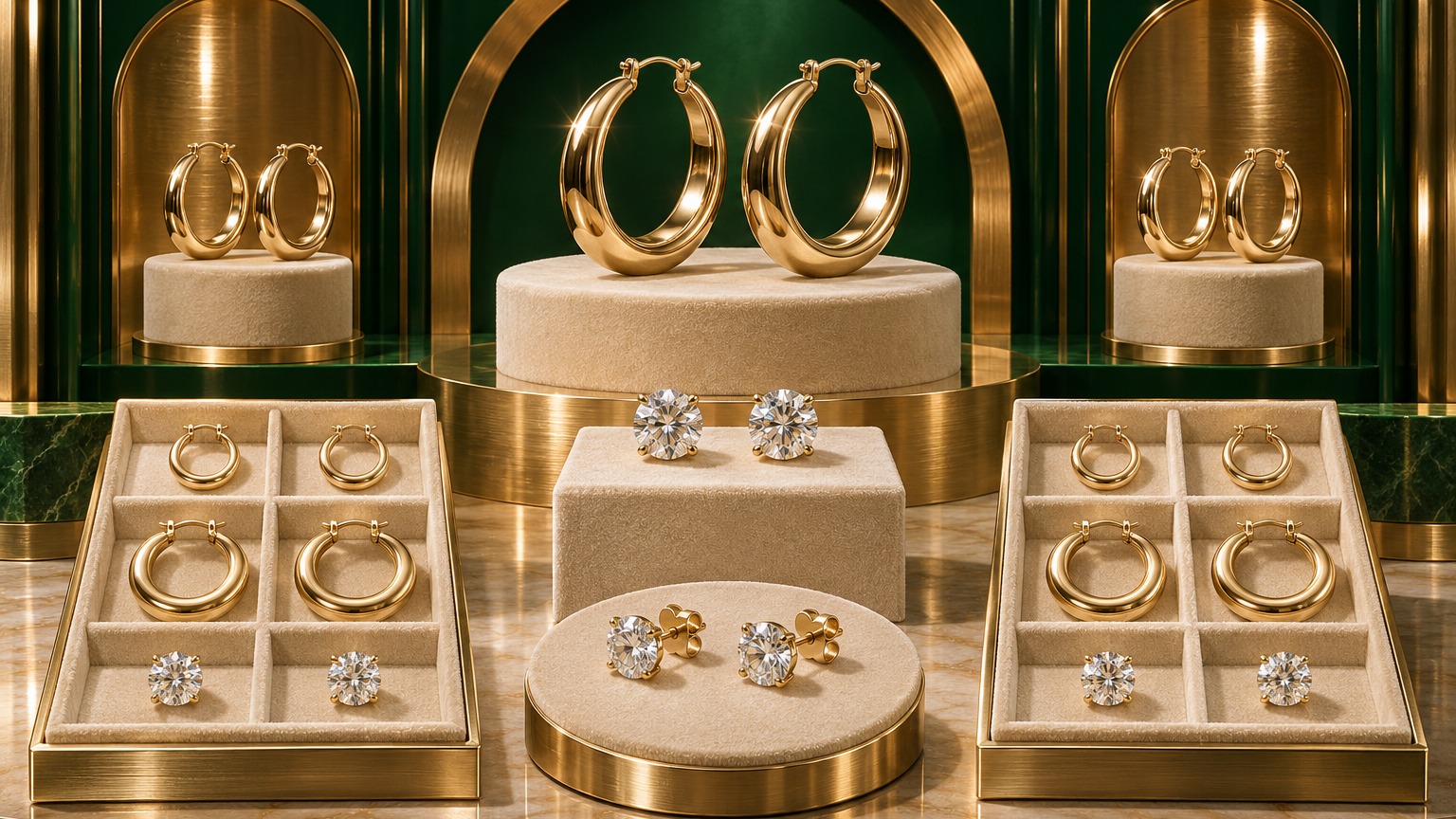
Our wholesale stud earrings, the Aurevo Stud Earrings, are a gold-tone plated alloy design with faceted clear gemstones set in prong settings and butterfly friction backs. The prong setting is worth noting if you are comparing suppliers: it holds the stone visibly and is the setting retail customers associate with fine jewelry, but it demands tighter assembly control than a glued stone. Our inspection stations check plating finish, gemstone setting, post and back function, and final assembly before anything ships. The minimum order is 100 pairs, which keeps your first commitment modest. Sample lead time runs 7–15 working days and standard production 20–40 working days, so plan your launch calendar backwards from those figures. Every pair carries a 12-month warranty.
The hoop: higher perceived value, same production discipline
Our wholesale hoop earrings, the Aurevo Gold-Tone Hoop Earrings, use a polished champagne-gold tone finish on a gold-tone alloy, with nickel-free posts and a secure hinge clasp. Two details deserve a buyer's attention. First, nickel-free posts address the single most common customer complaint in fashion earrings — ear irritation — and give your listing copy a concrete, checkable claim. Second, the champagne-gold tone is checked for consistency across the batch, and pairs are matched for finish, size and shape at inspection. Hoop earrings punish inconsistency: a mismatched pair is an immediate return. As with the studs, OEM, ODM and private label options are available, and the 12-month warranty applies.
How a first order can combine both
A balanced starter order does not require a large budget. Since the stud line starts at 100 pairs, a practical first program might look like this:
- 100–150 pairs of studs as your volume and entry-price driver, in one or two stone configurations rather than five.
- 100–200 pairs of hoops (MOQ varies by model and configuration) as your mid-tier and gift option.
- Sample both models first, evaluate plating tone and clasp function against your photography plan, then commit to production quantities.
That structure lets you test two price points with a combined commitment of a few hundred pairs — small enough to correct, large enough to generate real sell-through data. If you are unsure how minimums interact across models and finishes, our guide on how MOQ works when you buy wholesale watches and jewelry breaks down the mechanics.
E-commerce readiness: tone consistency is a photography problem
When you sell wholesale earrings online, your product photo is the contract. Buyers return items that look different from the listing, and plating tone is the variable most often blamed. This is why we check tone consistency across a batch on the hoop line and pair-match finish, size and shape at inspection — the goal is that the pair in your hero image matches the pair your customer unboxes. Before you approve any supplier, ask specifically: how is tone matched across a production batch, and at what inspection stage? A factory that can answer that question in concrete process terms is one you can build a catalog around.
Which Wholesale Men's Watches Should B2B Buyers Stock for Retail and Corporate Programs?
How Should You Price Wholesale Watches and Jewelry for Retail Profit? A B2B Buyer's Guide to Markups, Margins and Channel Pricing