Which Watch Strap Material Should You Choose for Your Wholesale Watch Program?
10/18/2026
Strap material decides how your wholesale watch program is judged
Ask a room of watch buyers what they check first when a sample carton arrives, and most will talk about the case, the dial, or the movement. Very few start with the strap. That is a mistake, because the strap is the part of a wholesale watch that customers touch, adjust, sweat on, and complain about most. In our experience shipping watches and jewelry to retailers, distributors, and private label brands in more than 65 markets, strap-related issues are among the most common reasons a listing quietly underperforms: not because the watch failed, but because the band did not match what the buyer expected when they approved the sample.
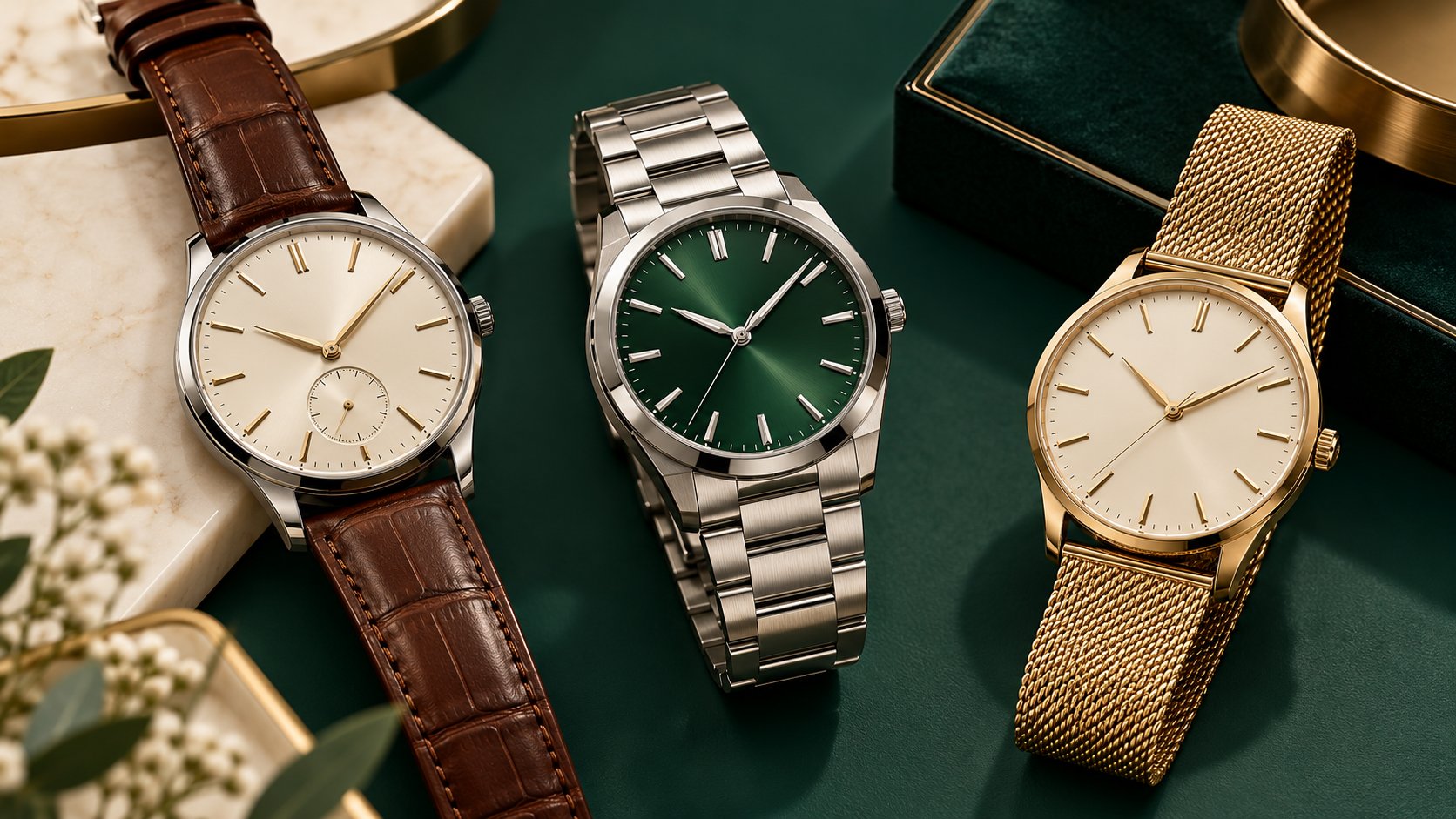
So the question in the title — which watch strap material should you choose for your wholesale watch program — is not a styling question. It is a sourcing decision that affects your return rate, your price positioning, your reorder cycle, and even how much after-sales stock you need to hold. This guide walks through the three strap materials we produce and ship most often in bulk — genuine leather straps, stainless steel link bracelets, and metal mesh (Milanese) bracelets — explains how each one behaves in a wholesale program, and gives you a practical checklist for judging strap quality before you commit to a full order.
Everything here is written from the buying side. Where we cite specific products, we use real models from the Aurevo line so you can see how the same decision looks on an actual order: the Aurevo Classic Leather Watch, the Aurevo Steel Quartz Watch, the Aurevo Ladies Bracelet Watch, and the Aurevo Heritage Automatic Watch. If you have read our guides on quartz versus automatic movements or stainless steel grades, treat this as the companion piece that covers the part of the watch your customer actually grips.
Why strap material is a sourcing decision, not a styling detail
On a product page, the strap is one line in a specification table. In a wholesale program, it drives four separate costs, and each of them lands on your margin.
1. Returns and complaints
The strap is the component most exposed to skin, moisture, and daily flexing. A leather strap that stiffens or discolors, a bracelet with a loose clasp, or a mesh band that catches hair will generate returns even when the movement inside is flawless. When you evaluate a supplier, you are implicitly evaluating how their strap supply chain holds up across a batch of thousands, not just on the golden sample.
2. Perceived value and price positioning
Customers judge price with their eyes and their wrists. A well-finished steel bracelet or a supple leather band makes a mid-price watch feel considered; a rattly, lightweight band makes the same watch feel cheap regardless of what is inside the case. If you are building a private label line, the strap is one of the cheapest places to upgrade perceived quality — and one of the most expensive places to cut corners, because it is the first thing a disappointed customer mentions in a review.
3. Reorder rhythm and inventory
Straps wear out faster than cases and movements. That is not a defect; it is normal product behavior. But it changes your inventory math. A program built on leather straps needs replacement-strap availability sooner than one built on steel bracelets. A supplier that can supply spare straps, buckles, and clasps along with your orders — as we do for watches shipped with after-sales spare parts — turns that wear cycle into a repeat revenue opportunity instead of a support burden.
4. Customization surface area
Strap material determines what "custom" realistically means for your program. Leather gives you color, grain, stitching, and lining options. Steel link bracelets give you finishing options — polished, brushed, or mixed — and easy length adjustment with removable links. Mesh gives you a distinctive look with an adjustable clasp. Knowing which lever matters for your brand should come before you pick a model, not after.
With that frame in place, let us look at each material on its own terms.
Genuine leather straps: the classic choice for dress and everyday lines
Leather remains the default answer for buyers who want a watch to read as classic, warm, and wearable with everything from a shirt to a weekend jacket. The Aurevo Classic Leather Watch is exactly this formula: a polished 316L stainless steel case, a clean white dial with silver baton indices, a quartz movement, and a brown genuine leather strap closed with a pin buckle. The design intent is a stock item that sells steadily across seasons instead of chasing a trend — and the strap is central to that intent.
What wholesale buyers should check on a leather strap
Leather quality varies more than any other strap material, because "genuine leather" covers a wide range of raw hides and finishing processes. When you receive a sample, go beyond the color and check the details that predict how the strap will age in your market:
Edge finishing. Look at the cut edges of the strap. Cleanly sealed, evenly coated edges resist moisture and fraying; rough or glue-heavy edges are where straps start to peel first.
Stitching. Even stitch spacing and consistent thread tension along both sides of the strap. Loose or skipped stitches are a batch-level warning sign, because stitching is done per unit and varies with process control.
Flex and break-in. Flex the strap a few dozen times. A properly finished leather strap softens slightly without creasing sharply or cracking at the folds.
Buckle and spring bar fit. The pin buckle should close with a positive click and the tongue should align with the holes without tearing them. Check that spring bars seat fully in the case lugs — a half-seated bar is the classic cause of a watch falling off a customer's wrist.
Color consistency across units. Ask to see several samples from the same batch, not just one. Dye lots vary; a supplier with controlled finishing can show you batch-to-batch consistency, which is exactly what protects your listings.
Where leather fits best
Leather suits dress watches, gifting programs, and any line where the story is "timeless" rather than "technical." It is also the natural partner for automatic movements in higher price tiers: the Aurevo Heritage Automatic Watch pairs its 40mm 316L steel case, sapphire crystal, and exhibition caseback with a genuine leather strap, because a steel link bracelet would pull the design toward sportiness and undercut the dress-watch positioning that buyers of an automatic expect.
The trade-offs are equally concrete. Leather absorbs water and sweat, so it is the wrong primary material if your market is humid, your customer profile is sporty, or your listings emphasize swimming and showering. None of the leather-strapped models in the Aurevo line are positioned for submersion — the Classic Leather Watch carries a 3 ATM splash-resistant rating, and the Heritage Automatic carries 5 ATM, which covers splash and rain but not swimming. If your buyers expect water exposure, steer them toward steel or mesh, and read our detailed guide on what 3 ATM actually means before you write your listing copy.
Stainless steel link bracelets: the durability workhorse
If leather is the classic choice, a stainless steel link bracelet is the operational one. The Aurevo Steel Quartz Watch shows the standard wholesale configuration: a 40mm 316L stainless steel case (excluding crown), a silver dial with a date window at 3 o'clock, mineral glass, and a stainless steel link bracelet closed with a folding clasp. For distributors supplying department stores, marketplaces, and multi-door retail chains, this is the configuration that survives shipping, trying-on, and daily wear with the fewest surprises.
Why 316L matters on the bracelet, not just the case
We cover steel grades in depth in our guide to stainless steel grades for wholesale watches and jewelry, but the short version for straps: 316L is a low-carbon, corrosion-resistant grade that holds its finish through daily contact with skin and moisture. Bracelets are handled even more than cases — every customer at a retail counter picks the watch up by the band — so a bracelet in a lesser grade shows scratches, dull spots, and discoloration faster. When you compare quotes between suppliers, confirm the bracelet material specifically, not just "stainless steel."
What wholesale buyers should check on a link bracelet
Link action. Each link should articulate smoothly with no rattling. Lay the bracelet flat and flex it along its length; stiff spots indicate uneven pin fitting that will worsen with wear.
Clasp security. Open and close the folding clasp at least twenty times. It should snap shut decisively and show no side-to-side play when locked. A clasp that feels loose on the sample will be a warranty claim pattern in the field.
Finishing consistency. Check that polished and brushed surfaces transition cleanly at each link's boundary. Blurry transitions are a polishing-process signal that shows up across the whole batch.
End-link fit. The connection between the bracelet and the case should be tight with no visible gap. A loose end-link is the most visible defect a customer can find, and one of the easiest for your QC to catch before shipment.
Length adjustment. Confirm the bracelet uses removable links and that your order ships with spare pins or a link-removal allowance. Sizing complaints are the top "not a defect" return reason for steel-bracelet watches, and they are almost entirely preventable with clear sizing guidance and an adjustable band.
Where steel fits best
Steel link bracelets fit sporty and everyday lines, gifting programs that need to suit any wrist, and any channel where products get tried on repeatedly. They also handle humid climates far better than leather. The trade-offs: steel reads cooler and more industrial than leather, which can soften a dress-watch story; and a folding clasp mechanism has more moving parts than a pin buckle, which makes clasp QC the single most important checkpoint on this configuration.
Milanese mesh bracelets: the distinctive middle ground
Metal mesh — often called Milanese mesh — is the third configuration, and it occupies a useful middle position between leather and link bracelets. The Aurevo Ladies Bracelet Watch is a good reference: a 26mm gold-tone plated 316L steel case, a champagne-gold dial with slim gold-tone markers, hardened mineral glass, and a delicate gold-tone metal mesh bracelet. The look is dressier than a link bracelet and more durable than leather, which is exactly why mesh is a mainstay in women's watch programs.
What wholesale buyers should check on a mesh bracelet
Weave density and evenness. Run a fingernail across the mesh. The weave should be tight and uniform with no loose coils or gaps. Sparse or uneven weaving is a tell for low-grade mesh that will snag and lose shape.
Edge wrap. The mesh should wrap smoothly around the band's edges. Exposed or sharp coil ends catch skin and hair — the single most common complaint about cheap mesh bands.
Magnetic clasp or slider fit. Whatever closure the design uses, it should hold position under a firm tug and slide (or release) without excessive force. Test it repeatedly; a closure that drifts on the sample will drift on every unit.
Plating quality. On gold-tone mesh, plating covers a large, textured surface area. Check the recesses of the weave for even color — that is where thin plating shows first as a dull or patchy tone.
Where mesh fits best
Mesh is strongest in women's lines, fashion-forward programs, and price tiers where you want jewelry-like presence without jewelry-like weight. It also photographs beautifully — the fine texture reads as premium in listing images, which matters if your channel is e-commerce. The trade-offs: mesh is harder to clean than a link bracelet, and a damaged mesh section generally means replacing the whole band rather than swapping a link. That makes mesh the configuration where supplier consistency matters most, because you are least able to repair it in the field.
Side-by-side: how the three materials compare on the numbers that matter
The table below summarizes how the three configurations behave across the decisions a wholesale buyer actually makes. Where a figure is program-specific, confirm it with your supplier for your order — the point of the table is the shape of the trade-offs, not a universal price list.
Criterion | Genuine leather | Steel link bracelet | Milanese mesh |
|---|---|---|---|
Style positioning | Classic, dress, gifting | Sport, everyday, unisex | Fashion, feminine, jewelry-like |
Comfort in heat/humidity | Absorbs sweat; needs break-in | Excellent; easy to clean | Good; breathable weave |
Durability in daily wear | Good; wear shows over time | Excellent; scratches can be brushed out | Good; damage usually means band replacement |
Adjustment for fit | Buckle holes; limited range | Removable links; wide range | Slider/magnetic clasp; continuous |
Perceived value per dollar | High in dress tiers | High in everyday tiers | High in fashion tiers |
Common field complaints | Stiffening, edge wear | Clasp play, sizing | Snagging, clasp drift |
QC focus points | Edges, stitching, dye consistency | Clasp, end-link fit, link action | Weave density, edge wrap, plating |
Best Aurevo reference model |
One more dimension belongs outside the table: weight. A steel bracelet adds noticeable heft to a small case, which some customers love and others find tiring. If your catalog spans 26mm women's models and 40mm men's models — as the Aurevo line does — remember that the same bracelet style carries differently across case sizes, and sample both size tiers before you lock a spec.
How to judge strap quality before you commit to a bulk order
Whatever material you choose, the practical question is the same: how do you verify that a batch of thousands will match the sample you approved? Straps are assembled from multiple components — band material, buckles or clasps, spring bars, keepers — and each junction is a potential batch-level failure point. Here is the verification sequence we recommend to every buyer, and the one we apply across our own production.
Step 1: approve a golden sample, and photograph it
Approve one physical sample as the reference standard and photograph it from all angles, including macro shots of edges, stitching, clasp internals, and lug connections. This record is what you will compare incoming batches against. Without it, "matches the sample" becomes a matter of opinion; with it, it becomes a checklist your QC team can execute.
Step 2: ask what the production-line checks are
A capable manufacturer checks strap-related items at defined stations rather than only at final packing. Aurevo operates more than 40 quality-control stations across the production process, from incoming material inspection to final inspection, and watch assembly follows a defined multi-stage sequence where strap or bracelet installation is inspected as its own step. When you evaluate any supplier, ask specifically: at which stage is strap attachment checked, what does the inspector verify (torque, seating, alignment, clasp function), and what happens to a unit that fails. Vague answers are themselves a signal.
Step 3: inspect early-production units, not just the golden sample
The golden sample was made carefully by hand. The first fifty units off the line are a better predictor of your batch. Ask for early-production photos or, for larger orders, arrange an inspection at that stage. This is also the right moment to check the two batch-level risks that individual samples cannot reveal: dye-lot consistency on leather and plating-batch consistency on metal bands.
Step 4: define the defect standard in writing
Agree in advance on what counts as a defect and what tolerance applies — stitch deviation, clasp actuation force, plating tone range, end-link gap. On our orders, defect rate targets are agreed in the PI and the AQL level is confirmed per order, and we welcome third-party inspection (SGS/BV/TUV) at the buyer's cost. Whatever your supplier's terms, get the standard into the contract before production starts, not into a dispute after the goods land.
Step 5: plan the wear cycle into your program
Ask what spare parts ship with the order. Straps, buckles, batteries, and clasps are the components your end customers will need first. A supplier who includes after-sales spare parts — as standard practice on our watch orders — is signaling that they expect the program to run for years, not one cycle. Budget your inventory to hold those spares from day one; it is far cheaper than handling a warranty claim with no replacement stock.
Matching strap material to your sales channel
The right material also depends on where and how you sell. The same watch can be a strong performer in one channel and a returns generator in another, and the strap is usually the reason.
Boutique and specialty retail
Physical retail lets customers handle the product, which favors materials that feel good immediately. Leather and mesh both win here; the tactile difference between a good and mediocre leather strap is obvious in-hand. The Aurevo Classic Ladies Quartz Watch — a white-dial, gold-tone model built for boutique programs — illustrates the pairing of a refined case with a band that needs to sell on touch.
E-commerce and marketplaces
Online, the customer cannot feel the strap, so expectations are set by photos and reviews. Two implications: first, choose materials that photograph well and match the images (mesh is exceptionally photogenic; textured leather reads richly in macro shots). Second, over-communicate fit and adjustment in your listing — sizing complaints on steel bracelets are almost entirely a copy problem, not a product problem.
Distributors and multi-door chains
Volume channels need consistency and serviceability above all. Steel link bracelets handle repeated trying-on best, and their adjustability covers the widest range of end customers without SKU proliferation. If your program spans both men's and women's lines, standardizing on 316L cases with matching bracelets or mesh — as the Aurevo men's and women's ranges do — simplifies your QC checklist across the whole catalog.
Corporate gifting and private label
Gifting programs prize a premium unboxing moment and broad wrist-size coverage. Leather straps with quality buckles deliver the classic gift presentation; mesh delivers a jewelry-like moment for women's programs. Both adjust easily. For gifting, also confirm packaging customization early — gift boxes, logo printing, and instruction cards are configurable per order and materially affect the perceived value of the same watch.
Customization: what "private label strap" realistically includes
For buyers building their own brand, the strap is one of the most customizable components of a watch — but the realistic scope depends on the material and the order structure. Based on how our OEM and ODM projects run, here is what each material typically offers in a private label program.
Leather customization levers
Color, grain texture, stitching thread color, and lining options are the standard levers. Branding can extend to a debossed logo on the strap or a branded buckle. Because leather is cut and finished per order, small program differences are feasible without new tooling in most cases. What leather customization does not usually change: the fundamental behavior of the material in humidity, which is physics rather than finish.
Steel bracelet customization levers
Finishing (polished, brushed, or mixed), link width, and clasp style are the main variables, plus plating tone for gold-tone executions such as the champagne-gold treatment on our women's models. Custom end-link geometry to match a specific case is possible but enters ODM territory, where sample development comes before production — our standard sampling timeline is 7–15 working days, and production runs 20–40 working days after approval depending on quantity and customization level.
Mesh customization levers
Tone and clasp mechanism are the primary choices, along with weave fineness. Mesh is less modular than leather or links, so the specification you approve is the specification you ship — one more reason the weave and clasp checks in the earlier section matter so much for mesh programs.
What customization never includes
A note on boundaries, because it protects both sides: customization changes how a product looks and fits your brand; it does not rewrite the material's inherent properties. A leather strap customized in your brand color is still a leather strap with leather's relationship to water. A gold-tone mesh bracelet in your brand tone is still a plated surface whose longevity depends on plating quality. Writing listings that promise what the material cannot deliver is the fastest way to convert a good program into a returns problem, so align your marketing claims with the material reality before launch.
Ordering basics: MOQ, sampling, and lead times for strap programs
The commercial mechanics of a strap-focused order are the same as any wholesale watch program, but a few points deserve emphasis when the strap is a decision variable.
MOQ structure. Standard watches start from an MOQ of 100 pieces; custom watch orders start from 300 pieces; custom jewelry starts from 200 pieces. If your program needs a specific strap that is not a catalog standard, expect the custom tier to apply.
Sampling timeline. Samples take 7–15 working days. Use them to run the full verification sequence above — including multi-unit comparison if the order is large — before approving mass production.
Production timeline. Standard production runs 20–40 working days depending on quantity and customization level. Build your launch calendar backward from that figure plus shipping; air, sea, and express options cover different urgency levels.
Payment structure. Standard terms are a 30% T/T deposit with the 70% balance before shipment; L/C at sight is accepted for orders above USD 50,000. Samples and tooling fees are payable in advance, and tooling fees are refundable for qualifying volume orders — relevant if your program needs custom buckle or clasp tooling.
Inspection rights. In-line inspection during production plus final random inspection before shipment are the baseline; third-party inspection at the buyer's cost is welcome. If straps are your key risk, tell the inspector to sample strap-specific checkpoints, not just general appearance.
Coordinating straps with the rest of your catalog
If you sell more than watches, strap color and finish are also catalog decisions. A women's program that pairs the champagne-gold dial and gold-tone mesh of the Aurevo Ladies Bracelet Watch with gold-tone jewelry — for example the Aurevo Gold-Tone Bracelet with its cubic zirconia accents and lobster clasp, or the Aurevo Lumiere Gold Necklace, a 45cm gold-tone pendant piece — gives customers a coordinated set they can buy as a gift without styling advice. The same logic applies to silver: the sterling silver side of a catalog pairs naturally with steel bracelets finished in a matching tone rather than gold.
Treating strap tone as a catalog-level decision has a practical payoff at ordering time, too. When your watch straps and your jewelry share a finish family, your photography, your merchandising displays, and your gift-copy all reuse the same visual language, and your buyers can cross-sell between categories without a styling explanation. When they clash, every product page quietly works against the others. None of this requires custom manufacturing — it requires deciding the finish family before you confirm strap tones on the watch order, when changes cost nothing.
A worked example: a three-SKU launch lineup
To make the material decision concrete, consider how the logic assembles into a realistic launch. Suppose you are a boutique chain planning a first private label watch program with three SKUs: a men's everyday model, a men's dress model, and a women's fashion model.
For the everyday SKU, the steel link bracelet is the low-risk answer: it survives trying-on, suits the widest wrist range through removable links, and supports the "suitable for daily wear" positioning. The Aurevo Steel Quartz Watch configuration — 40mm case, 316L case and bracelet, folding clasp, date window — is a reference spec for this slot. For the dress SKU, a genuine leather strap carries the positioning: the Aurevo Classic Leather Watch formula of a polished 316L case, white dial, and brown leather strap with a pin buckle reads as considered rather than sporty, which is what a dress SKU needs. For the women's fashion slot, mesh delivers jewelry-like presence at a light weight; the Aurevo Ladies Bracelet Watch — 26mm, champagne-gold dial, gold-tone mesh — shows how that spec comes together.
Three observations from this structure matter more than the individual choices. First, all three SKUs share 316L case material, so one steel-grade claim covers the line and your QC checklist stays uniform. Second, each strap material serves a different customer motive — durability, dressing up, gifting — so the three SKUs compete with each other far less than three dial variations would. Third, because sampling runs 7-15 working days per configuration, submitting all three sample requests together keeps the whole lineup on one production calendar instead of three.
Five strap mistakes that cost wholesale buyers money
Most strap problems in wholesale programs trace back to a handful of avoidable decisions made before the order was placed. These are the five we see most often.
Choosing the strap last. Buyers who select a case and dial first, then accept whatever strap ships with the reference design, discover at photography time that the band undermines the positioning they paid for. Decide the strap material as part of the model selection, and the rest of the specification follows.
Writing water claims the strap cannot honor. A 3 ATM splash rating describes the case; it does not make a leather strap shower-proof. Listings that ignore this generate returns that look like quality complaints but are copy problems. Our article on what water resistant means on a watch walks through honest wording.
Ordering only the golden sample's strap length. Standard strap lengths fit standard wrists; markets differ. Confirm the size range the strap serves, order spare buckles and spring bars, and check whether extension pieces or longer stock sizes are available for your market before mass production.
Skipping multi-unit sample comparison. One sample proves the design; three samples from the same batch prove the process. Dye-lot and plating-batch variation only appear across units, and discovering it after mass production means negotiating a discount instead of preventing a defect.
Treating spare straps as optional. Straps, buckles, batteries, and clasps are supplied with orders for after-sales service on our watch shipments. Buyers who decline them to trim unit cost usually pay more later, handling complaints one by one with no replacement inventory to offer.
None of these mistakes involves exotic knowledge — they are ordering discipline. The buyers who avoid them are not more experienced; they put the strap on the agenda before the PI is signed, when every option is still free.
After-sales: spare parts and warranty as program infrastructure
Two after-sales facts should shape how you structure a strap-led program. First, spare parts: straps, buckles, batteries, and clasps are supplied with orders for after-sales service. Hold them in your own stock and you convert most strap complaints into a five-minute swap instead of a return shipment. Second, warranty: watches in the Aurevo line carry a 12-month warranty, which covers the movement and workmanship issues that fall outside normal strap wear. Communicate the distinction clearly in your own customer service — "the watch is warranted for 12 months; the strap is a wearable component that we support with spare parts" — and you will find that most end-customer conversations end well before they become disputes.
This division of labor is normal across the watch industry, and buyers who plan for it report smoother programs than those who treat every strap complaint as a defect claim. The warranty terms for each order are confirmed in the PI, so there is no ambiguity at the moment it matters.
Frequently asked questions
Can I mix strap materials within one order?
Yes, provided each configuration meets its own MOQ. Mixing materials is often the smart structure: a core steel-bracelet SKU for volume plus a leather or mesh variant for differentiation. Confirm the MOQ for each configuration with your sales contact, because custom straps may carry the custom-watch minimum.
Which strap material has the lowest return rate?
There is no universal answer, because return causes differ by channel. In physical retail, leather and mesh convert best because customers feel the product first. Online, steel bracelets generate the most "not a defect" sizing contacts — which are preventable with adjustable links and clear listing copy — while mesh generates the most snagging complaints when weave quality is poor. The lowest-return programs we see are the ones that match material to channel, not the ones that chase a single "best" material.
How do I verify plating quality on gold-tone straps?
Check the recessed areas of the weave or link surfaces, not just the flats — thin plating shows in recesses first. Compare several units from the same batch for tone consistency, and ask whether plating thickness is controlled as a process parameter. For a deeper comparison of gold-tone executions, see our guide on evaluating gold-plated jewelry at wholesale, which applies to straps as much as to jewelry.
Do straps affect water resistance ratings?
They affect what the rating means in practice. A watch rated 3 ATM resists splashes, but a leather strap that gets soaked will stiffen and age regardless of the case rating — so the practical water guidance for your customers should consider the strap, not just the case. Our article on what water resistant means on a watch covers how to translate ratings into honest listing copy.
What should I include in my strap QC checklist for incoming goods?
At minimum: edge finishing and stitching (leather), clasp actuation and end-link fit (links), weave density and clasp hold (mesh), spring bar seating on all types, and tone consistency against your golden-sample photos across a random sample of units. Align the tolerance levels with your supplier before the first production run so the checklist is enforceable rather than aspirational.
How does strap choice interact with a private label launch timeline?
Custom straps that reuse existing hardware fit the standard 7–15 working day sampling window. Custom buckles, clasps, or end-link geometry add tooling time before sampling can start. If your launch date is fixed, choose catalog-standard straps with branding-level customization and reserve hardware-level customization for phase two of the program.
Is a more expensive strap always more profitable?
Not necessarily. Profit comes from the match between material, price tier, and channel. A well-chosen mesh bracelet at a mid-tier price can outperform a poorly matched leather strap at a premium price, because perceived value — not component cost — drives conversion and repeat purchase. Sample the candidate materials against your actual price point and let the customer's response decide, rather than assuming cost equals value.
How should retailers communicate strap care to end customers?
Briefly and honestly. For leather, keep it dry, avoid prolonged sun exposure, and expect normal aging. For steel and mesh, occasional cleaning with mild soap and water, dried promptly, keeps the finish bright — our care guide for stainless steel watches translates directly to bracelets and mesh. A short care line on your product page or packaging card reduces "the strap looks worn" contacts, because customers who know a material's behavior interpret it as normal instead of as a defect.
Can the strap material be changed after the first order?
Usually yes, and planning it that way is common. Because straps attach with standard spring bars on most models, a program can launch on one material, read real sell-through for a season, and add a second configuration as a variant SKU rather than a redesign. The efficient path is to tell your supplier at the first order that a second strap configuration is planned: sampling for the variant can reuse the approved case tooling, and the 7-15 working day sampling window then covers only the strap, not the whole watch.
Choosing your strap material: the short version
If you need the decision compressed: choose genuine leather when your story is classic and your channel lets customers feel the product; choose a 316L steel link bracelet when durability, adjustability, and humidity resistance matter more than warmth; choose Milanese mesh when you want jewelry-like presence in a women's or fashion program. Then verify the choice with the golden-sample discipline above — because in wholesale, the strap you approved is only as good as the batch that ships.
Every model referenced in this guide is a current Aurevo product, and all of them are available for wholesale, OEM/ODM, and private label programs from our Shenzhen facility — 220+ employees, 16 production lines, more than 8,000 existing styles, and watch capacity above 200,000 units per month, serving buyers across more than 65 markets. Tell us which strap direction fits your program, and we will confirm the MOQ, sampling plan, and customization options for your order — with warranty terms, spare parts, and inspection standards written into the PI before production begins.
How Should You Price Wholesale Watches and Jewelry for Retail Profit? A B2B Buyer's Guide to Markups, Margins and Channel Pricing
How Do You Protect Your Watch and Jewelry Designs When Outsourcing Custom Manufacturing? A B2B Buyer's Guide to NDAs, IP Ownership and Tooling Agreements