Which Wholesale Men's Watches Should B2B Buyers Stock for Retail and Corporate Programs?
11/4/2026
Why the Men's Watch Question Decides More of Your Margin Than Any Single Order
Before any buyer compares factories, negotiates payment terms, or requests samples, a more fundamental decision shapes the whole program: which men's watches to stock, in which tiers, and in what proportions. A buyer with a limited opening budget cannot stock everything. Choosing one automatic reference means giving up two quartz SKUs at the same spend; choosing a steel bracelet model commits cash to a mid-tier price point that may or may not match the store's traffic. That assortment decision — not the unit price on any single order — is what actually drives sell-through, return rates, and whether customers come back to buy a second piece.
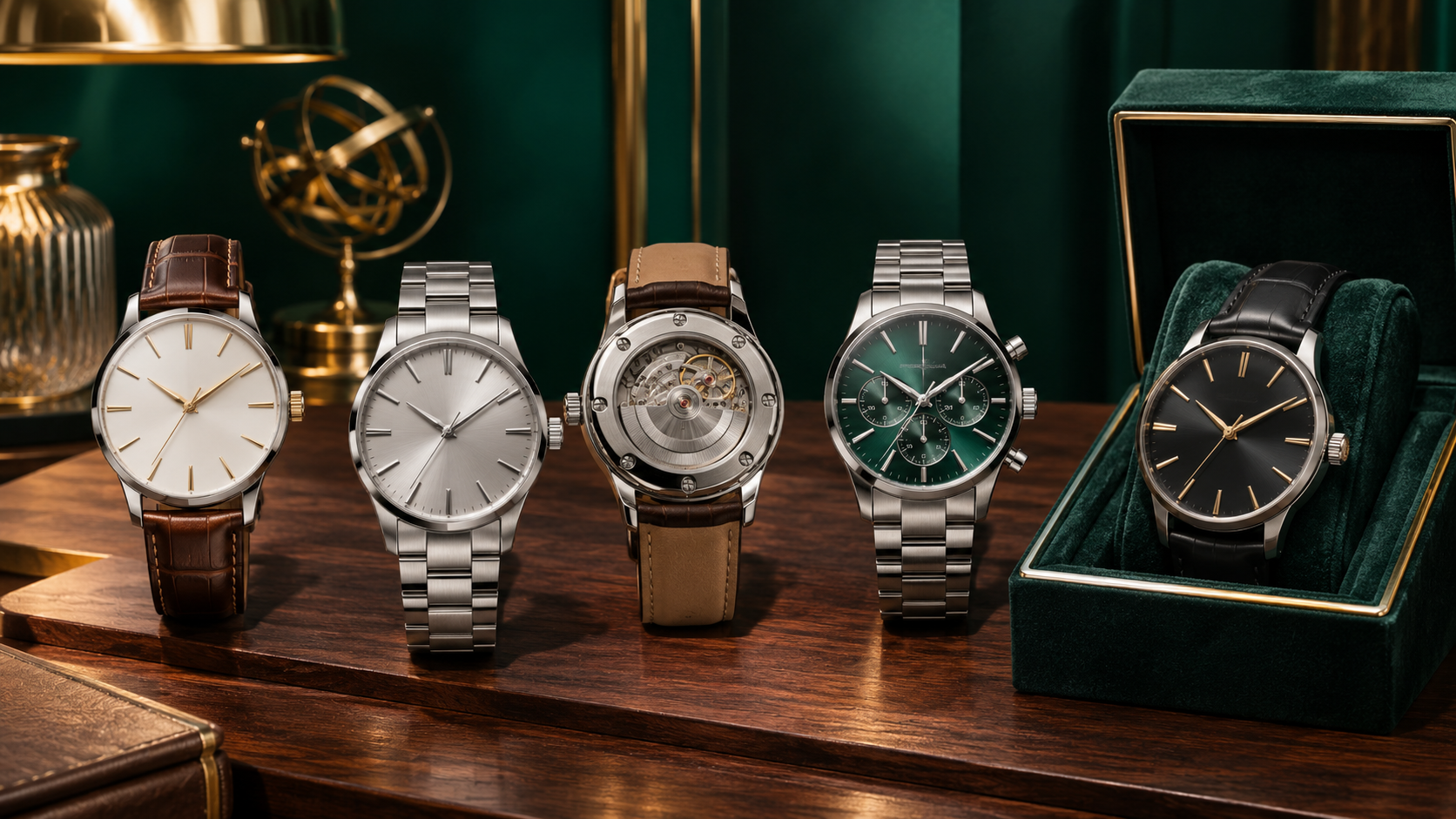
The reason is structural. Men's watches for wholesale fall into distinct tiers that behave differently at retail:
- Entry quartz dress watches — low ticket, high rotation, sensitive to design and price point.
- Steel bracelet mid-tier models — heavier perceived value, slower rotation, stronger gifting demand.
- Automatic premium pieces — fewer units, higher margin per unit, buyers who compare specifications closely.
- Custom and private label designs — your own dial artwork, tooling and packaging; the tier where brand equity is built.
When these tiers are matched to the wrong channel — for example, stocking automatics in a fast-turn e-commerce shop built around price-driven traffic, or filling a corporate gift catalogue with anonymous unbranded quartz — the result is predictable: slow inventory turns, discounting to clear stock, and margin erosion that no factory quote can fix. This is why a serious watch sourcing guide starts with assortment structure before it starts with supplier lists.
Supplier selection still matters, of course, but it is the second-order decision. A reliable manufacturing partner protects the assortment you chose; it cannot rescue a range aimed at the wrong customer. Buyers weighing where to source can start with how to choose a reliable watch wholesale supplier for a retail business, and separately consider whether buying on B2B marketplaces or directly from manufacturers fits their risk tolerance and order size.
For context on who is writing this: Aurevo is a watch and jewelry manufacturer based in Shenzhen, operating since 2012 and serving wholesale, OEM, ODM and private label buyers across more than 65 markets. The company runs 16 production lines producing more than 4.5 million watch and jewelry pieces per year, with a style library exceeding 8,000 designs. That scale is relevant here for one reason: the tiers described above are not theoretical categories — they are the configurations buyers actually order, from 100-piece runs of standard catalogue quartz references to 300-piece fully custom programs with branded packaging.
This article walks through that decision in order: which wholesale mens watches fit which retail and corporate segments; how movement, case material, glass and water-resistance choices should differ by tier; a worked example using real catalogue references; the margin math behind each tier; MOQ and cash-flow planning; gift-set bundling for corporate gifting programs; quality control and warranty fit; and shipping logistics — closing with a practical checklist before you commit your opening order.
Match the Assortment to the Channel: Retail Doors, Online Sellers and Corporate Programs
The same wholesale mens watches catalog can serve very different businesses, but the right mix depends on how the watch reaches the end wearer. A reference that performs well on a store counter may be the wrong choice for a marketplace listing, and vice versa. Before selecting styles and order quantities, it is worth deciding which channel dynamics actually apply to you, because that decision drives which references carry depth and which carry breadth.
Physical retail doors: service at the counter
Brick-and-mortar retailers sell with hands-on presentation. Shoppers try the watch on, feel the weight of the case and judge the dial under store lighting. Quartz dress watches with leather straps are a natural fit for this environment: the Classic Leather Watch with its clean white dial and brown genuine leather strap needs no adjustment before it leaves the counter. Steel bracelet styles such as the Steel Quartz Watch with its link bracelet and folding clasp present a different operational reality — bracelet sizing typically requires a bench, a sizing tool and trained staff at the point of sale. Stores without that capability should weigh whether the added service labor is justified by the style's appeal, or whether to weight the assortment toward strap-based references. The 40mm case size used across these references also works well for a broad male customer base in a physical fitting context.
E-commerce and marketplace sellers: photography and low-friction fulfillment
Online sellers cannot rely on touch, so visual detail carries the sale. Dials with distinct character — the deep green dial with gold-tone markers on the Custom Logo Men's Watch, or the exhibition caseback on the Heritage Automatic Watch — photograph well and give product pages concrete features to describe. Two operational factors matter most in this channel. First, water-resistance wording must be accurate on the listing: 3 ATM references are splash resistant, and the automatic is rated 5 ATM, which covers splash and rain but not swimming; overstating this in copy is a common driver of returns. The 3 ATM water-resistance guide explains how to phrase this correctly. Second, lower after-sales burden favors quartz references for high-volume listings, while the automatic suits a higher-positioned product where the movement itself is part of the pitch — the quartz versus automatic comparison sets out that trade-off in detail.
Distributors: consistency across repeat orders
Distributors building a regional range live or die by repeatability. A catalog reference ordered today must match the shipment ordered six months later — same dial, same case finish, same packaging. Standard catalogue items with a published reference number (the four men's references above all start at 100 pieces) give a distributor a stable base, while fully custom builds from 300 pieces make sense once volume justifies differentiation. When evaluating any B2B watch supplier for a distribution program, consistency of specification across repeat orders is one of the points worth verifying directly.
Corporate gift and incentive programs: branding and bundling
Corporate buyers typically need watches that carry a logo cleanly and arrive in packaging that reflects the occasion. The Custom Logo Men's Watch supports dial logo printing, custom dial colors and case finishing, which covers the recognition-program use case directly. For milestone awards or executive gift sets, watches can also be bundled with jewelry pieces — pairing a watch with the gold-tone bracelet or the stud earrings turns a single item into a coordinated watch gift set. Packaging choice shapes how the set is perceived on presentation day; the custom packaging guide covers boxes, inserts and branding options.
Whichever channel applies, the practical consequence is the same: one channel justifies depth in two or three proven references, while another rewards a broader, shallower spread to test demand. Deciding which tier carries depth before ordering is what keeps an assortment profitable rather than merely full.
Movement, Case and Crystal: the Specifications That Separate the Tiers
When you plan a men's watch range, a handful of specifications do most of the work of placing each model in a price tier and setting buyer expectations. Movement, crystal, steel grade, water resistance and strap type are the five you should decide deliberately, because they determine unit cost, after-sales burden and how customers read the product's value.
Movement: quartz for entry and mid tiers, automatic for premium
Quartz movements are the practical choice for entry and mid-tier wholesale programs. They keep unit cost down, run accurately, and need only periodic battery replacement — a service most counters or local repair shops can handle without a dedicated watchmaker. Automatic movements belong in your premium tier: they carry higher perceived value, need no battery cycle, and justify higher retail prices. The trade-off is a different quality exposure — automatics depend on assembly precision and regulation, so your supplier's assembly and functional testing matter more. Our quartz vs automatic guide covers the decision in detail, and the choice of movement origin (Japanese, Swiss or Chinese) is a separate sourcing question with its own cost and branding implications.
Crystal: sapphire versus mineral glass as a tier marker
Crystal choice is one of the clearest signals customers use to judge tier. Sapphire crystal resists scratches far better than mineral glass, which is why it appears on premium references — our Heritage Automatic (ATW-1001) uses sapphire with an exhibition caseback. Mineral glass is the cost-efficient choice for entry models like our Steel Quartz (ATW-1003) and Classic Leather (ATW-1005); it performs acceptably in daily wear but will show fine scratches over time. Hardened mineral glass, used on the Custom Logo Men's Watch (ATW-1007), sits between the two. Before committing, review what each material means for warranty claims and customer satisfaction — our sapphire crystal buyer's guide breaks down the selection criteria.
Case material: name 316L in your orders
316L stainless steel is the grade to specify explicitly in purchase orders for both cases and bracelets. It is the standard for watch cases because it resists corrosion and skin irritation better than lower-grade alloys. A supplier quote that says only "stainless steel" without a grade leaves room for substitution; writing 316L into the specification removes that ambiguity. See our guide to stainless steel grades in wholesale watches for what to check on a spec sheet.
Water resistance: a listing-copy risk, not just a spec
Water resistance is where overstated marketing most often turns into returns. A 3 ATM rating means splash resistance — hand washing, light rain — not swimming. Our Steel Quartz, Classic Leather and Custom Logo models are rated 3 ATM; the Heritage Automatic is 5 ATM, which covers splash and rain but is still not rated for swimming. Writing "waterproof" in listing copy against a splash-rated watch is a common cause of dissatisfied customers and chargebacks. Match your product descriptions to the actual rating; our 3 ATM water resistance guide explains the ratings in listing-ready language.
Straps and bracelets: brand feel versus counter labor
Strap choice affects both brand positioning and after-sales workload. Genuine leather straps with pin or butterfly buckles read as classic and premium, but leather wears faster than metal and is more sensitive to water — relevant given the ratings above. Stainless steel link bracelets with folding clasps, like the one on ATW-1003, last longer and suit sportier positioning. Our watch strap material guide compares the options for wholesale programs.
Aurevo's own men's catalogue follows exactly this tier logic: quartz with mineral glass at the entry level, quartz with hardened glass and plating in the mid tier, and an automatic with sapphire crystal at the premium end. You can review the tiered range on the Heritage Automatic, Steel Quartz, Classic Leather and Custom Logo Men's Watch product pages, and use the same specification ladder when building your own mix of bulk watches for retail or corporate programs.
A Worked Example: How One Manufacturer's Men's Range Maps to the Four Tiers
Abstract tiering advice is easier to act on when it is mapped onto real product references. Aurevo's published men's catalogue contains four references that, read together, form a complete tiered assortment covering the channel needs described earlier: entry dress watches for general retail, mid-range steel quartz for e-commerce volume, a premium automatic for halos and gift programs, and a logo-ready base for private label and corporate work. The table below sets out each reference with the specification that determines where it fits.
| Tier | Reference (SKU) | Movement | Case & Crystal | Strap / Bracelet | Water resistance | Entry MOQ |
|---|---|---|---|---|---|---|
| Entry dress quartz | Classic Leather Watch (ATW-1005) | Quartz | Polished 316L stainless steel; white dial with silver baton indices; mineral glass | Brown genuine leather strap, pin buckle | 3 ATM (splash resistant) | From 100 pieces (standard) |
| Mid steel quartz | Steel Quartz Watch (ATW-1003) | Quartz | Polished 316L case, 40mm excluding crown; silver dial with date window at 3 o'clock; mineral glass | Stainless steel link bracelet with folding clasp | 3 ATM (splash resistant) | 100 standard / 300 custom |
| Premium automatic | Heritage Automatic Watch (ATW-1001) | Automatic self-winding | 316L stainless steel, 40mm; sapphire crystal; exhibition caseback | Genuine leather strap | 5 ATM (splash and rain resistant; not for swimming) | From 100 pieces (this reference) / 300 fully custom |
| Logo / private label base | Custom Logo Men's Watch (ATW-1007) | Quartz | 316L gold-tone plated, 40mm; deep green dial with slim gold-tone markers; hardened mineral glass | Brown leather strap | 3 ATM | From 100 pieces; logo printing on dial, custom dial colors and case finishing available |
Two rows reference the remaining catalogue pages directly: the Classic Leather Watch and the Steel Quartz Watch, both published with full specifications and MOQ terms.
How each row answers a different channel need
The Classic Leather Watch is the entry dress row. Its clean white dial, leather strap and 316L case give it the look of a formal watch at an entry price position, and the 100-piece standard MOQ lets a retailer test demand without committing deeply. It suits boutiques and general retail assortments where the watch is one category among many.
The Steel Quartz Watch occupies the mid tier. The stainless steel link bracelet with folding clasp and the date window at 3 o'clock make it read as a step up from leather-strap entry pieces, which supports a higher retail price while keeping quartz running costs low. Its 300-piece custom tier means an e-commerce seller can later move from buying the standard reference to branding it without changing supplier.
The Heritage Automatic Watch is the premium anchor. Automatic self-winding movement, sapphire crystal and an exhibition caseback are the specification points buyers associate with a higher price band, and the 5 ATM rating covers daily splash and rain exposure (though it is not intended for swimming — see the separate guide to what 3 ATM actually means for water resistance). It works as a gift-program flagship or the top of a retail range, giving the cheaper references something to sit beneath. The movement choice behind this tier is examined in more depth in the guide to quartz versus automatic movements.
The Custom Logo Men's Watch is the private label row. Dial logo printing, custom dial colors and case finishing are available at the 100-piece entry MOQ, which is the practical threshold that makes small corporate-gift orders and first private label runs viable. A buyer building a full branded program would combine this reference with decisions on custom packaging and, for fully tooled designs, the OEM, ODM and private label distinction.
On pricing: Aurevo does not publish unit prices. Wholesale prices are quoted per order configuration, with movement grade, finishing and packaging all affecting unit cost. That is worth stating plainly because a tiered range built from one catalogue does not carry four fixed prices — the same reference can be configured up or down before a quote is issued.
What the four references share
The reason a tiered range is operable from a single B2B watch supplier is not the individual specifications — it is what stays constant across them. All four references share the same MOQ entry logic (100 pieces standard, 300 fully custom), the same QC flow with inspections running from incoming material through functional testing to packaging, and the same standard 12-month warranty from delivery covering manufacturing defects under normal use. For a buyer, that means one sampling process, one warranty policy to explain to end customers, and one set of order terms across the whole range rather than a different commercial structure for each price tier. The mechanics behind those constants — how sampling runs, how warranty terms work in practice, and how MOQs are calculated — are covered in the dedicated guides linked from the sections above.
Margin Math: How Each Tier Earns Its Place on the Shelf
Choosing which wholesale men's watches to stock is ultimately an arithmetic decision, not a taste decision. A range can look balanced on a spreadsheet of product photos and still fail commercially if the numbers behind each tier do not work in your channel. Before comparing styles, it helps to run the buyer-side calculation that decides whether a reference deserves shelf space: gross margin dollars and gross margin percentage.
Gross margin dollars are what you actually earn per unit sold: retail price minus landed wholesale cost. Margin percentage is that figure divided by the retail price. Both matter, and they can point in different directions, which is why working a full example is worth the time.
A hypothetical two-tier stock program
Take a purely hypothetical example. Suppose you build a two-tier program: an entry quartz dress watch bought at a wholesale unit cost of USD 18 and retailed at USD 45, and a premium automatic bought at USD 62 and retailed at USD 149. The arithmetic runs as follows.
| Reference (hypothetical) | Wholesale cost | Retail price | Gross margin per unit | Margin % |
|---|---|---|---|---|
| Entry quartz dress watch | USD 18 | USD 45 | USD 27 | 60.0% |
| Premium automatic | USD 62 | USD 149 | USD 87 | 58.4% |
The entry watch shows a 60.0% margin ((45 − 18) ÷ 45), while the automatic shows 58.4% ((149 − 87) ÷ 149). On paper the two tiers are nearly identical in percentage terms, but each dollar invested behaves very differently: USD 100 of buying budget covers roughly five units of the entry watch or one and a half units of the automatic. That difference in capital velocity is often more decisive than the two-figure margin gap.
The second layer: what erodes paper margin
Paper margin is not realized margin. Three costs sit between the two, and they do not hit every tier equally:
- Returns and warranty handling. Defect rates, exchange logistics and refurbishing labor reduce realized margin. A standard 12-month warranty covering manufacturing defects is a normal B2B expectation, but the operational cost of processing claims is yours to budget.
- Counter time and service labor. A steel bracelet needs sizing before it leaves the counter; a leather strap largely does not. Minutes of staff time per sale are a real cost in physical retail, and they fall more heavily on bracelet-heavy references.
- Dead stock. A slow mover ties up cash, occupies space and often ends in markdowns that collapse the margin you calculated. This is reasoning, not a measured industry statistic, but the logic is hard to escape: a tier with a slightly lower paper margin and faster sell-through can beat a higher-margin slow mover once markdown risk is priced in.
This is why the right evaluation unit is margin earned per unit of cash and time invested, not margin percentage alone. An entry quartz reference that turns four times a year can outperform a premium automatic that turns once, even at a near-identical margin percentage — provided the entry tier's quality holds up well enough that returns do not eat the difference.
From margin model to actual quotes
To run this math on real numbers, you need actual quotations rather than assumptions. Aurevo quotes wholesale prices per order configuration, because movement grade, case finishing and packaging all change the unit cost of the same reference. Deeper guidance on structuring markups, margins and channel pricing is covered in the dedicated pricing and margin guide, and the cost drivers behind a fully custom watch — tooling, dial artwork, packaging — are covered separately in the custom watch cost guide.
Once the margin model is set, the remaining constraint is cash: MOQ determines how much capital each tier locks up before the first unit is sold, which is the subject of the next section.
MOQ, Sampling and Lead Time: Sizing Each Tier Without Tying Up Cash
For most B2B buyers, the biggest cash-flow risk in a watch program is not picking the wrong model — it is committing too much depth to a tier before the market has spoken. This is where minimum order quantities, sampling timelines and production lead times work together as a planning system rather than three separate numbers.
Test at Entry MOQ Before You Commit to Depth
Aurevo's published MOQ structure is built for staged commitment: standard catalogue items start from 100 pieces, while fully custom watches — your own dial artwork, tooling and packaging — start from 300 pieces. In practice, that means you can build a first range across all three tiers at entry quantities: for example, 100 pieces each of the Heritage Automatic Watch, the Steel Quartz Watch and the Classic Leather Watch, and test the automatic tier's pull without committing hundreds of units to it upfront.
The MOQ difference between standard and custom also shapes sequencing. Many buyers validate demand on a standard catalogue reference first, then move that winning model into a 300-piece custom run with logo printing — the Custom Logo Men's Watch configuration shows what that stage can look like, with logo printing on the dial, custom dial colors and case finishing available. For a fuller explanation of how minimums are calculated across configurations, see the guide on how MOQ works.
Sample the Shortlist, Then Time the First Runs
The recommended rhythm for a first range: sample your shortlist, evaluate the physical references, place first runs at entry MOQ, then reorder only the tiers that actually sell. Sampling runs 7–15 working days, so a three-reference shortlist is a realistic pre-season project rather than a last-minute decision. What to check on those samples — movement feel, finishing, strap quality against the spec sheet — is covered in the guide to evaluating a sample before a bulk order, and the stages from prototype to pre-production sample are laid out in the sampling process guide.
Once samples are approved, standard production runs 20–40 working days. That window is the number to build your replenishment math around. If a tier sells steadily, the second run needs to be confirmed before the first one sells out — because a sell-out followed by a 20–40 day gap is a month or more of shelf or listing downtime on your best performer. As a working rule, track how many weeks a first run lasts, and trigger the reorder roughly six to eight weeks before projected stock-out, adjusting for your own freight transit time on top of the production window.
Building the Reorder Logic into Peak Season
The same logic scales for holiday and gifting periods. If corporate gift programs or Q4 retail are on your calendar, work backwards from your ship-to date through freight time, the 20–40 day production window and the 7–15 day sampling stage. First-time custom programs — new dial artwork, tooling, packaging — add revision cycles to that chain, so a seasonal order for a fully custom reference belongs in your planning months earlier than a reorder of a proven standard item. The seasonal sourcing calendar guide walks through that backward planning in detail, and the production lead time guide breaks down what happens at each stage of the 20–40 day window.
Sized this way — entry-MOQ first runs, data-led reorders, and lead time built into the calendar — the 100/300-piece structure lets you cover all three tiers of a men's range while keeping working capital concentrated on the references that have already proven themselves.
From Stock References to Your Own Range: the Private Label Ladder and Watch Gift Sets
Wholesale men's watches do not have to begin with a fully custom project. The practical way to build a branded range is a ladder: start from stock references at a low minimum, adapt them once sales justify it, and commit to full development only when the program has proven demand. Each step up changes what you supply, what the factory builds, and how long the order takes.
Step 1: Stock references with your branding, from 100 pieces
The entry point is a catalogue reference customized at the surface: logo printing on the dial, your brand name on the dial or packaging, from a minimum of 100 pieces. The Custom Logo Men's Watch (ATW-1007) is built for exactly this use — a quartz movement, 316L gold-tone case, deep green dial and leather strap — with logo printing on the dial and custom dial colors available. Because the base design and tooling already exist, sampling is fast (7–15 working days for a sample) and production runs 20–40 working days after approval. This step suits retailers testing a private label line or corporate buyers needing branded units without long lead times.
Step 2: Adapted designs, from 300 pieces
The second step changes the product configuration itself: different dial colors, case finishing, strap choices and custom packaging, on designs still derived from existing references. The MOQ rises to 300 pieces for fully custom work because new artwork, finishes and packaging inserts each require approval rounds and, where finishing changes, additional production setup. You should plan for sample revisions before bulk release — the dial color, plating tone and box are all visible brand decisions, and evaluating a physical sample carefully before placing the bulk order is what protects the rest of the run. Lead time stays within the same 20–40 working day production window after approval, but the approval stage itself is longer than at step 1 because more elements are new.
Step 3: Full OEM/ODM development
At the top of the ladder, development starts from your drawings — or from adaptation of designs in Aurevo's style library of more than 8,000 watch and jewelry designs, reworked for your market. This involves case design, movement selection, tooling and multiple approval rounds across the six production stages, with quality control checkpoints from incoming material inspection through final and packaging inspection. The distinction between manufacturing models matters here, and the OEM, ODM and private label comparison explains which model fits which stage of a brand's growth. If custom tooling or molds are involved, agree in writing who owns the tooling and the designs before development starts; the guide to protecting designs when outsourcing custom manufacturing covers the questions to raise at this stage.
Corporate programs and watch gift sets
The same ladder serves corporate recognition and client-gift programs, where a watch works well because it carries an engraving surface, a branded dial and a presentation box — all places to apply the recipient company's or giver's identity. Where a program needs a broader gift, a watch gift set extends the logic: the watch paired with complementary jewelry from the same manufacturer, such as a gold-tone bracelet, a gemstone bracelet or a gold pendant necklace. This suits unisex and couples programs and keeps production, quality control and warranty handling (all Aurevo watches and jewelry carry a standard 12-month warranty from delivery) under one supplier.
In gifting, packaging is not an accessory — it is part of the gift. Box structure, inserts, materials and branding decide whether the set reads as a premium recognition item or as a bulk purchase, so packaging deserves its own development and approval cycle alongside the product. Aurevo develops packaging per program, and the guide to choosing custom packaging for wholesale watches and jewelry walks through boxes, inserts and branding options. For programs built around two brands or a licensed identity, the co-branded collection guide covers how collaborations, licensing and manufacturing partnerships fit together.
Whichever step you enter at, the sequence is the same: define the configuration, approve samples, then release bulk production — and move up the ladder only as fast as your sales data supports.
Quality Control and Warranty: What Keeps a Tiered Range Sellable
When you stock a tiered range of men's watches, consistency matters more than any single perfect sample. A pre-production sample that is flawless does not help you if units three hundred through three thousand in the batch arrive with misaligned dials, inconsistent plating or a different strap tone than the units photographed for your listing. A batch mismatch is not a minor cosmetic issue for a reseller: it converts product listings into returns, and returns consume margin, staff time and customer trust. The commercial question to ask any supplier is not "how good is your best unit" but "how repeatable is your process across an order of thousands of pieces."
Aurevo's answer to that question is structural. Watch production on its Shenzhen lines follows six main stages, with quality-control checkpoints built inside the flow rather than applied only at the end: incoming material inspection, component inspection, in-process inspection, assembly inspection, functional testing (movement operation and water resistance), appearance inspection, final inspection and packaging inspection. This is supported by more than 40 quality-control workstations and a dedicated in-house quality lab added in 2016. The practical meaning for a buyer is that defects are caught at the point where they occur — a faulty batch of movements at component inspection, a water-resistance failure at functional testing — instead of being discovered after the goods are packed and shipped. If you want to understand what a full QC program should look like before you commit to a supplier, our guide to quality checks from a wholesale watch and jewelry manufacturer walks through the stages in detail.
What to verify on receipt, regardless of the supplier's process
A structured in-factory QC flow reduces risk; it does not remove the buyer's own duty of inspection on arrival. Before you release the balance payment and list the goods for sale, check a cross-section of the cartons rather than only the top one: confirm the model and configuration match the approved sample, spot-check movement operation and timekeeping, verify water-resistance markings and strap or bracelet attachment, and compare units from different cartons against each other for finishing consistency. Packaging condition matters too, since dented boxes create unsellable retail units even when the watch inside is fine. If discrepancies appear, document them with photographs and carton numbers before contacting the supplier — this is exactly the situation a defined warranty exists to resolve.
The 12-month warranty and why a claims route protects you
Every Aurevo watch and jewelry piece carries a standard 12-month warranty from the date of delivery, covering manufacturing defects under normal use. For a reseller, the value of this warranty is less about the occasional defective unit and more about what a defined claims route does for your own return policy. When you can point to a written warranty period, a documented defect definition and an agreed claim process, you can offer your retail customers a returns policy with confidence, knowing that genuine manufacturing faults flow back up the chain rather than being absorbed as your own loss. Our guide to warranty terms for wholesale watches and jewelry explains what to confirm before signing an order, and the follow-up on after-sales service, RMA and warranty claims covers how to structure the handling of returns and spare parts once goods are in market.
Taken together — inspection inside the production flow, verification on receipt and a warranty with a clear claims route — these are the mechanisms that keep a tiered range sellable over repeated orders, not just on the first shipment.
Shipping, Payment and Trade Terms for a Multi-Tier Order
A multi-tier men's watch program does not need to be split into separate orders. Standard catalogue pieces such as the Classic Leather Watch, the Steel Quartz Watch and the Heritage Automatic Watch can be combined into one production run and one shipment, packed as mixed cartons by reference and quantity. Consolidating the tiers in this way reduces freight events, simplifies documentation and lets a single delivery cover entry-level quartz models, mid-range steel bracelet watches and higher-ticket automatics at once. For fully custom references — own dial artwork, tooling or packaging — remember the higher minimum of 300 pieces per style applies, so confirm each tier's configuration before the production schedule is locked.
Choosing an Incoterm
Aurevo quotes on EXW, FOB Shenzhen, CIF and DAP, and the choice changes what your company handles:
- EXW (Ex Works): goods are made available at the Shenzhen facility; you arrange collection, export clearance, freight and insurance.
- FOB Shenzhen: Aurevo delivers the goods cleared for export onto the vessel at Shenzhen; you take over from that point, booking the main carriage and insurance.
- CIF: Aurevo covers cost, insurance and freight to your named destination port, but import clearance and onward delivery remain yours.
- DAP: goods are delivered to your named destination place, with you still responsible for import clearance and any duties or taxes.
Buyers without a freight forwarder in China often start with FOB or CIF; those with established logistics partners frequently prefer EXW or FOB for more control over the main carriage. Whichever term you select, plan the mode around your in-store date: sea freight suits large, non-urgent multi-tier orders, air freight works for tighter timelines, and express handles samples and small replenishment runs. The trade-offs between cost, speed and volume are covered in the guide to sea, air and express shipping from China.
Payment Structure
Standard terms are T/T with a 30% deposit and the balance before shipment, which aligns payment milestones with production and pre-shipment stages. For orders of USD 50,000 or more, L/C at sight is available, giving bank-issued payment security that some finance departments require for larger consolidated orders. Major online payment methods are also accepted, typically useful for samples or smaller initial orders. A fuller comparison of these structures and how to evaluate them is in the guide to T/T, L/C and milestone payments.
Prepare the Import Side Early
Import duties, HS code classification and customs documentation sit on the buyer's side under these terms, and a multi-tier order means each reference — quartz, automatic, plated and leather — needs correct classification on the commercial invoice and packing list. Start this preparation before production finishes, not after the goods are ready: confirm your country's tariff rates for watches, decide whether you or your broker files the entry, and verify which compliance documentation is required for your market, which Aurevo confirms per market per order. The guide to import duties and customs clearance walks through the documents and classifications to have ready. Getting the paperwork right before shipment protects the lead time you negotiated and keeps a consolidated multi-tier delivery from stalling at the border.
A Checklist for Building Your Wholesale Men's Watch Range
Before you send a request for quotation, it helps to have your range defined on paper. A structured RFQ gets comparable answers from suppliers and reduces back-and-forth during sampling and production. Work through the following checklist before you contact a manufacturer:
- Define your channels and price tiers. Decide whether the range serves retail shelves, e-commerce, corporate gifting or a mix, and set two or three tiers (entry, mid, premium) so each watch has a clear role.
- Pick one movement and spec combination per tier. A quartz watch with mineral glass and leather strap suits an entry tier; an automatic with sapphire crystal and 316L steel suits a premium tier. Locking one spec per tier keeps quoting and QC simple.
- Name the steel grade, crystal and water-resistance wording. Confirm 316L stainless steel, the glass type and the exact ATM rating you will print in listings — for example, 3 ATM means splash resistant, not swim-ready. Accurate wording prevents returns and disputes.
- Set your target margin and verify it with markup math. Calculate the retail price implied by your quoted wholesale price before you commit, using your channel's typical markup.
- Decide depth versus breadth per tier. Fewer references in deeper quantities simplify production and reorder planning; broader ranges suit multi-channel sellers. Match the choice to your capital and storage capacity.
- Plan sampling time. Sample lead time is 7–15 working days, so build that into your launch calendar and evaluate samples against your written spec before approving bulk production.
- Set first-run quantities at the entry MOQ. Standard catalogue items start from 100 pieces and fully custom builds (own dial artwork, tooling, packaging) from 300 pieces, so a first order at minimum depth limits risk while proving demand.
- Agree acceptance figures and the warranty route in writing. Confirm inspection expectations before production and note that all Aurevo watches and jewelry carry a 12-month warranty from delivery covering manufacturing defects under normal use.
- Plan the reorder date inside the production window. Standard production takes 20–40 working days after approval, so set a reorder trigger based on your sell-through rate rather than waiting for stock-outs.
- Prepare packaging and gifting requirements. If the range doubles as a watch gift set for corporate programs, specify boxes, inserts and branding early, since packaging affects both unit cost and lead time.
Frequently Asked Questions
Can I mix different men's watch references in one order to meet the MOQ?
The MOQ published for each catalogue reference applies per reference — from 100 pieces for standard items and 300 pieces for fully custom builds. Shipping different references together in one shipment is a normal part of consolidated production, but whether minimum order quantities can be combined across references is a commercial question that gets confirmed per order by the supplier's sales team. When you enquire, list each reference and quantity separately so the answer you receive applies to your actual basket.
What watch sizes sell best for men?
As general market guidance, 38–42mm covers most men's dress and everyday wear, which is why so many wholesale ranges cluster around that span. All four Aurevo men's references — the Heritage Automatic, the Steel Quartz, the Classic Leather and the Custom Logo Men's Watch — sit at 40mm, a middle position that reads as classic on most wrists without dating quickly. If you are building a unisex or corporate range, a single 40mm case diameter keeps tooling and photography consistent across the collection.
Are quartz or automatic watches better for a first order?
For a first order, quartz usually makes the simpler starting point: lower unit cost, thinner cases, and no winding behavior for customers to learn, which suits entry retail tiers and gift programs. Automatic movements suit a premium tier where the exhibition caseback and self-winding mechanism justify a higher retail price and support a brand story. Many buyers launch with quartz at the entry MOQ, then add an automatic reference once sell-through data justifies the deeper investment in a second tier.
What warranty comes with wholesale men's watches from Aurevo?
Every Aurevo watch and jewelry piece carries a standard 12-month warranty from the date of delivery, covering manufacturing defects under normal use. The warranty applies across the whole men's range, from quartz references to the Heritage Automatic. For clarity with your own customers, state the warranty terms in your listings and agree the claims route — how units are returned, assessed and replaced — in writing before your first bulk shipment.
How do I get a wholesale price list?
Wholesale unit prices are quoted per order configuration, because movement grade, finishing and packaging all affect unit cost. To receive an accurate quote, send your target quantities per reference, the catalogue references you want (or your customization needs — dial artwork, logo printing, case finishing), and your packaging requirements. The more complete your specification, the closer the first quote lands to your final production price, and the fewer revision rounds you need before ordering.
Ready to build your range? Request a wholesale men's watch quote through the Aurevo homepage and start with a specification built from the checklist above.
How Should You Price Wholesale Watches and Jewelry for Retail Profit? A B2B Buyer's Guide to Markups, Margins and Channel Pricing
How Do You Protect Your Watch and Jewelry Designs When Outsourcing Custom Manufacturing? A B2B Buyer's Guide to NDAs, IP Ownership and Tooling Agreements